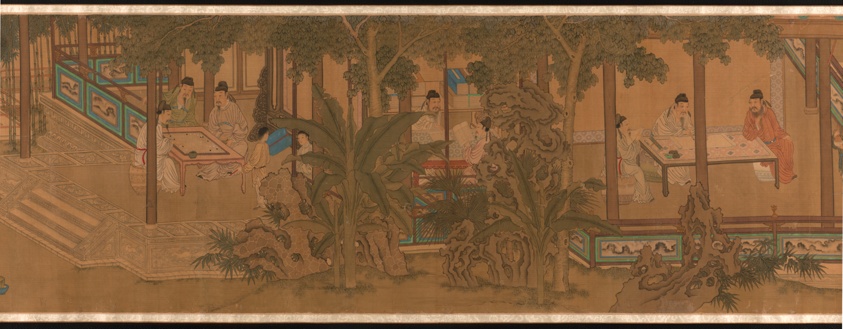
An Examination of Refinement: The Four Accomplishments as a Benchmark of Discretion
To engage with a handscroll of The Four Accomplishments, rendered in ink and colour upon silk, is to participate in a dialogue of the most profound discretion. It is not a mere viewing; it is an audience. The medium itself, silk, establishes the initial and non-negotiable terms of this engagement. This is not the democratic, absorbent fibre of paper, prone to the eager bleed of ink and the accidents of a hastier hand. Silk, particularly that prepared for the scholar’s brush, represents a covenant between material and maker. Its surface, a tight, luminous weave, is a plane of immense resistance and exquisite receptivity. Each application of ink or wash of colour is a deliberate negotiation, the silk yielding only to the most assured touch, holding the pigment in a state of suspended animation upon its threads. The resulting artifact possesses a depth and a subtle luminosity—a quiet sheen—that paper can never emulate. It is, in essence, the foundation of a legacy, a testament to the understanding that true expression is predicated on mastery of one’s materials.
The Grammar of Elegance: Composition and Line
The subject matter—qin (the zither), qi (the board game), shu (calligraphy), and hua (painting)—constitutes the classical curriculum of the cultivated mind. To portray these pursuits upon silk is to doubly encode their significance. The handscroll format further dictates a specific, ritualised mode of consumption. One does not "see" the scroll; one "unfurls" it, approximately an arm’s length at a time, from right to left. This controlled, sequential revelation is the very antithesis of the panoramic gaze. It demands patience, a measured pace, and a commitment to the narrative as it unfolds. The composition, therefore, is not a static tableau but a carefully choreographed procession of scenes, a visual syntax where spacing and rhythm are paramount.
The line work, executed with the tapered tip of a wolf-hair brush, is where the artist’s character is laid bare. There is no room for indecision or correction upon silk. The line must speak with clarity and conviction—the tensile strength of a robe’s fold, the contemplative curve of a scholar’s spine as he leans over the qi board, the delicate tracery of bamboo leaves against rock. This is a language of economy and suggestion, where a single, modulated stroke can define a mountain’s spirit or the drape of a sleeve. The elegance here is not ornate; it is structural. It is the elegance of a perfectly fitted garment, where the integrity of the line follows the form without excess.
A Palette of Restraint: The Application of Colour
The use of colour in such a work is never gratuitous. Applied in translucent washes over the underdrawing in ink, it functions as tonal modulation rather than chromatic spectacle. One may observe the faintest suggestion of malachite in a grove, a whisper of cinnabar in a seal, or the diluted warmth of ochre in a courtyard wall. These hues do not shout; they murmur. They serve to articulate depth, to highlight a focal point, or to establish the time of day—the cool blues of twilight settling over a figure lost in the strains of the qin. The silk, with its inherent warmth, breathes beneath these washes, lending them a vitality and softness unattainable on a dead ground. This restrained palette is a marker of supreme confidence. It understands that the power of suggestion, of what is left for the cultivated eye to complete, far outweighs the brute force of explicit statement.
Heritage as a Living Practice: Beyond the Artifact
To commission or to steward such an artifact is to align oneself with a philosophy of cultivated attainment that transcends mere aesthetics. The Four Accomplishments were never intended as passive hobbies; they were disciplines for the refinement of the self. The qin cultivated auditory sensitivity and emotional resonance; qi strategic foresight and patience; shu the discipline of mind and body in unison; hua the observation of nature’s essential principles. The handscroll depicting them is, therefore, both a representation of this philosophy and an embodiment of it in its own making.
The contemporary relevance is palpable, if one knows how to look. The fluid elegance captured in the silk is not antiquated; it is the visual equivalent of bespoke tailoring’s insistence on clean lines, perfect drape, and intuitive movement. The restraint in colour mirrors the Savile Row maxim of a considered, coherent palette over transient fashion. The mastery of material—the respect for the silk—parallels the relationship between a master cutter and the finest woolens, where the cloth is listened to, not merely commanded. This artifact, then, stands as a permanent reminder that heritage is not a relic to be preserved under glass. It is a set of principles: the pursuit of mastery through discipline, the expression of individuality within a canon of excellence, and the understanding that true luxury lies in the seamless integration of substance and form.
In the final analysis, this handscroll of The Four Accomplishments is a benchmark. It measures not wealth, but discernment. It speaks not of ostentation, but of inner cultivation made manifest through material intelligence. It is, in the most profound sense, a silent arbiter of taste, declaring that the highest accomplishments are those that harmonise the hand, the eye, and the mind. To possess its understanding is to appreciate that the most enduring legacies are woven, stitch by deliberate stitch, on the loom of disciplined practice.