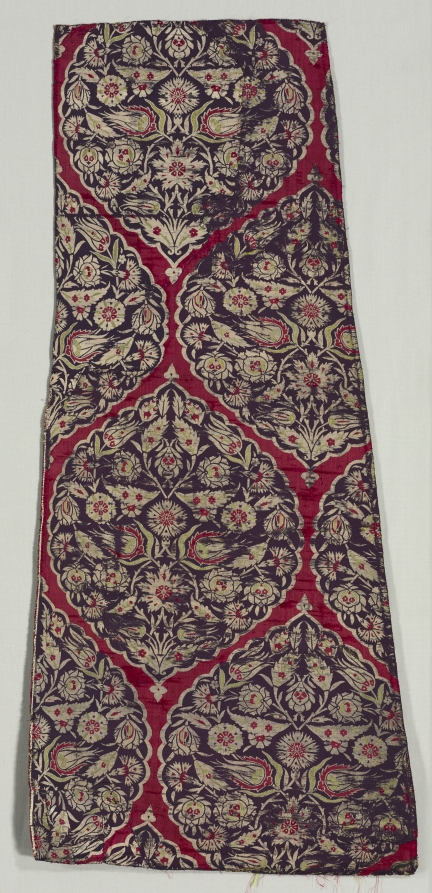
The Brocaded Silk with Foliate Medallions: A Testament to Imperial Craftsmanship
In the hushed corridors of heritage preservation, where the weight of history meets the precision of modern scholarship, the brocaded silk with foliate medallions from a kaftan stands as a singular artifact. This piece, woven from the finest silk and adorned with intricate foliate medallions, is not merely a fragment of textile; it is a narrative of imperial ambition, artisanal mastery, and the enduring legacy of silk weaving that shaped global trade and cultural exchange. As a Senior Heritage Specialist at the Lauren Fashion Heritage Lab, I approach this artifact with the reverence of a Savile Row tailor examining a bespoke suit—every thread, every weave, every motif tells a story of provenance, power, and precision.
Materiality and the Silk Legacy
The materiality of this brocaded silk is paramount. Silk, derived from the cocoons of Bombyx mori silkworms, has been revered for millennia as a symbol of luxury and status. In the context of imperial silk weaving, particularly within the Ottoman, Safavid, and Mughal empires, silk was not merely a fabric but a medium of statecraft. The brocading technique employed here—where supplementary weft threads are woven into the ground fabric to create raised, patterned designs—demonstrates an extraordinary level of technical sophistication. The foliate medallions, likely inspired by Persian or Chinese floral motifs, are rendered with a precision that suggests the work of master weavers in imperial workshops, such as those in Bursa or Isfahan. The silk’s lustrous sheen, even after centuries, speaks to the quality of raw materials and the meticulous care in its creation. This is not a fabric for the commoner; it is a textile designed for the elite, perhaps a kaftan worn by a sultan or a vizier during ceremonial occasions.
The Kaftan as a Cultural Artifact
The kaftan, a long, robe-like garment, has a storied history across the Islamic world and beyond. In the Ottoman Empire, kaftans were markers of rank and wealth, often bestowed as gifts to dignitaries or worn during court ceremonies. The brocaded silk with foliate medallions suggests a garment of significant importance. The medallions, arranged in a repeating pattern, evoke the celestial gardens of paradise—a common theme in Islamic art, where geometric and floral motifs symbolize the infinite and the divine. The use of gold or silver threads in the brocading, though now tarnished, would have caught the light, creating a dazzling effect that underscored the wearer’s power. This kaftan was not merely clothing; it was a statement of imperial authority, woven into the very fabric of the empire’s identity.
Imperial Silk Weaving: A Legacy of Innovation
The legacy of imperial silk weaving is a tapestry of cross-cultural exchange and technological innovation. From the Silk Road’s earliest days, Chinese silk techniques spread westward, influencing Persian and Byzantine weavers. By the 16th century, Ottoman and Safavid workshops had perfected brocading, creating textiles that rivaled their Chinese counterparts. The foliate medallions on this silk reflect a synthesis of influences: the lotus and peony motifs from China, the arabesque scrolls from Persia, and the geometric precision of Islamic art. This hybridization is a hallmark of imperial silk weaving, where workshops employed artisans from diverse backgrounds, fostering a creative environment that produced some of the world’s most exquisite textiles. The kaftan’s silk, therefore, is not just a product of its time but a testament to centuries of artistic dialogue.
Preservation and Interpretation
In the Lauren Fashion Heritage Lab, our approach to this artifact is guided by the principles of conservation and contextualization. The silk’s fragility demands careful handling—controlled humidity, minimal light exposure, and archival storage. Yet, preservation is only half the story. We must interpret this artifact within its historical and cultural framework. The foliate medallions, for instance, are not merely decorative; they encode meanings of fertility, eternity, and divine order. By analyzing the weave structure, dye composition, and motif placement, we can reconstruct the kaftan’s original form and function. Was it a ceremonial garment, a diplomatic gift, or a funerary shroud? Each possibility offers insights into the social and political dynamics of the era. Moreover, this artifact challenges modern notions of fashion as ephemeral. In imperial contexts, textiles were heirlooms, passed down through generations, their value appreciating with age. The brocaded silk is a reminder that fashion, at its highest echelons, is an investment in legacy.
The Savile Row Perspective: Craftsmanship and Continuity
From a Savile Row perspective, this brocaded silk embodies the principles that define bespoke tailoring: precision, material integrity, and timeless design. Savile Row’s ethos—where a single suit can take weeks to construct, with hand-stitched details and perfectly balanced proportions—mirrors the dedication of imperial weavers. The foliate medallions, with their symmetrical arrangement and rhythmic repetition, echo the disciplined geometry of a well-cut jacket. Just as a Savile Row tailor selects cloth for its drape and durability, the imperial weaver chose silk for its luminosity and strength. This artifact, then, is a precursor to the modern luxury garment, a bridge between the artisan’s hands and the wearer’s presence. It reminds us that true craftsmanship transcends time, whether in a 16th-century kaftan or a 21st-century bespoke suit.
Conclusion: A Living Heritage
The brocaded silk with foliate medallions from a kaftan is more than a heritage research artifact; it is a living document of imperial silk weaving’s legacy. Its materiality, context, and craftsmanship offer a window into a world where textiles were currency, art, and power. As we preserve and study this piece, we honor the weavers who poured their skill into every thread, the patrons who commissioned such opulence, and the cultures that continue to inspire. In the Lauren Fashion Heritage Lab, we do not merely catalogue the past; we curate a dialogue between history and the present, ensuring that the legacy of imperial silk weaving remains woven into the fabric of our shared heritage.