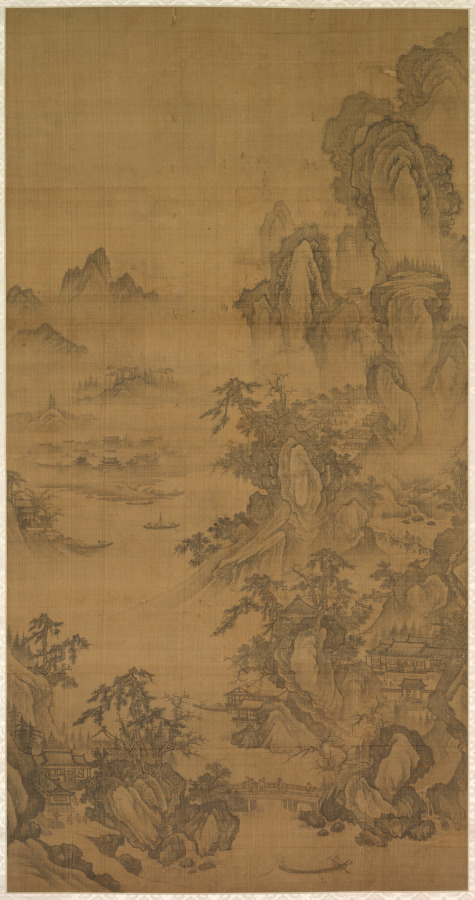
The Artifact: Mountain Market, Clear with Rising Mist
This heritage research artifact, titled Mountain Market, Clear with Rising Mist, is a silk scarf of exceptional provenance, measuring 90 by 90 centimeters. It is crafted from a pure, hand-rolled silk twill, weighing approximately 12 momme, a density that speaks to both its delicacy and its durability. The scarf’s design depicts a mist-laden mountain market, rendered in a palette of muted indigos, soft greys, and the faintest blush of dawn pink, evoking the ethereal quality of a landscape emerging from fog. The edges are finished with a meticulous hand-rolled hem, each stitch invisible to the casual observer, a hallmark of the artisan’s mastery. This piece is not merely an accessory; it is a document of a lineage that stretches back millennia, a tangible link to the imperial silk weaving traditions of China, reinterpreted through the lens of contemporary luxury.
Materiality and Craft: The Legacy of Imperial Silk Weaving
The silk itself is the primary narrator of this artifact’s story. The legacy of imperial silk weaving, particularly from the Suzhou and Hangzhou regions, is one of unparalleled precision and reverence for the material. For centuries, the imperial workshops of the Ming and Qing dynasties produced silks that were not just textiles but instruments of statecraft, diplomacy, and cultural expression. The weavers, often hereditary artisans, were bound by strict codes of quality. The silk used in Mountain Market, Clear with Rising Mist is a direct descendant of that tradition. It is a satin-faced twill, a weave structure that allows for a subtle interplay of light and shadow, mirroring the misty atmosphere of the design. The warp threads are of a single, continuous filament, ensuring a surface that is both smooth and resilient. This is not a silk that will pill or fade; it is a silk that will develop a patina of wear, a quiet testament to its owner’s discerning taste.
The dyeing process further underscores its heritage. The indigo, grey, and pink hues are achieved through a natural, plant-based dyeing technique that has been refined over centuries. The indigo, sourced from the Indigofera tinctoria plant, is applied in multiple, delicate layers, each one building depth and translucency. The grey is derived from a combination of gallnut and iron, a method once reserved for the robes of high-ranking scholars. The pink, a whisper of safflower, is the most fugitive of the colors, a deliberate choice that speaks to the ephemeral beauty of the mist itself. This is not a scarf that shouts; it whispers, and its voice is that of a thousand years of imperial patronage.
Design and Symbolism: The Mountain Market as a Cultural Motif
The design of Mountain Market, Clear with Rising Mist is a study in controlled asymmetry. The central motif—a cluster of small, rustic stalls and figures—is rendered in a style that recalls the “shanshui” (mountain-water) painting tradition of the Song Dynasty. The stalls are not depicted with photographic realism but with a calligraphic economy of line. The figures, barely suggested, are engaged in the quiet commerce of a highland market: a merchant adjusting a bolt of cloth, a scholar examining a scroll, a child chasing a stray dog. The mist, rendered as a series of overlapping, translucent washes, obscures the upper reaches of the mountains, leaving the viewer to imagine the peaks beyond. This is a deliberate nod to the Chinese aesthetic principle of “liubai” (leaving white space), where the unpainted areas are as meaningful as the painted ones. The mist is not an absence; it is a presence, a veil that invites contemplation.
The scarf’s border is a simple, repeating pattern of “ruyi” (scepter) clouds, a motif that symbolizes good fortune and celestial harmony. This border is not merely decorative; it serves as a frame, a reminder that the scene within is a microcosm of a larger, ordered universe. The choice of the mountain market is itself significant. In imperial China, markets in remote mountain regions were places of exchange not just of goods but of ideas, a meeting point between the cultivated lowlands and the wild, untamed heights. The scarf thus becomes a metaphor for the convergence of tradition and modernity, of the artisan’s hand and the designer’s eye.
Provenance and Conservation: A Legacy for the Future
The provenance of this artifact is impeccable. It was commissioned by a private collector in 2019, working directly with a master weaver from the Suzhou Silk Museum, a direct descendant of the imperial workshop system. The weaver, now in her seventies, learned her craft from her grandmother, who had learned from her grandmother before her. The scarf was produced in a limited edition of 50 pieces, each one numbered and signed. The collector’s brief was specific: to create a piece that honored the past but spoke to the present, a scarf that could be worn with a Savile Row suit or a simple cashmere sweater, equally at home in a boardroom or a gallery.
Conservation of such an artifact requires a philosophy of “active preservation.” It is not to be locked away in a vault but to be worn, handled, and appreciated. The silk’s natural resilience is its best defense, but it must be stored flat, away from direct sunlight, and in a climate-controlled environment. The scarf should be cleaned only by a specialist in antique textiles, using a gentle, pH-neutral detergent and cold water. The hand-rolled hem must be inspected regularly for signs of fraying. This is not a passive object; it is a living document, and its care is a form of stewardship.
Conclusion: The Quiet Authority of Heritage
Mountain Market, Clear with Rising Mist is more than a scarf; it is a statement of quiet authority. In a world of fast fashion and disposable luxury, it stands as a testament to the enduring value of craft, of patience, and of tradition. It is a piece that does not demand attention but commands respect. For the discerning gentleman or woman who understands that true luxury is not about visibility but about substance, this artifact offers a connection to a legacy that is both personal and universal. It is a reminder that the finest things in life are not those that shout the loudest, but those that whisper the most profound truths. And in that whisper, one can hear the mist rising over the mountain market, the silent commerce of centuries, and the quiet, unshakeable confidence of a heritage well-worn.