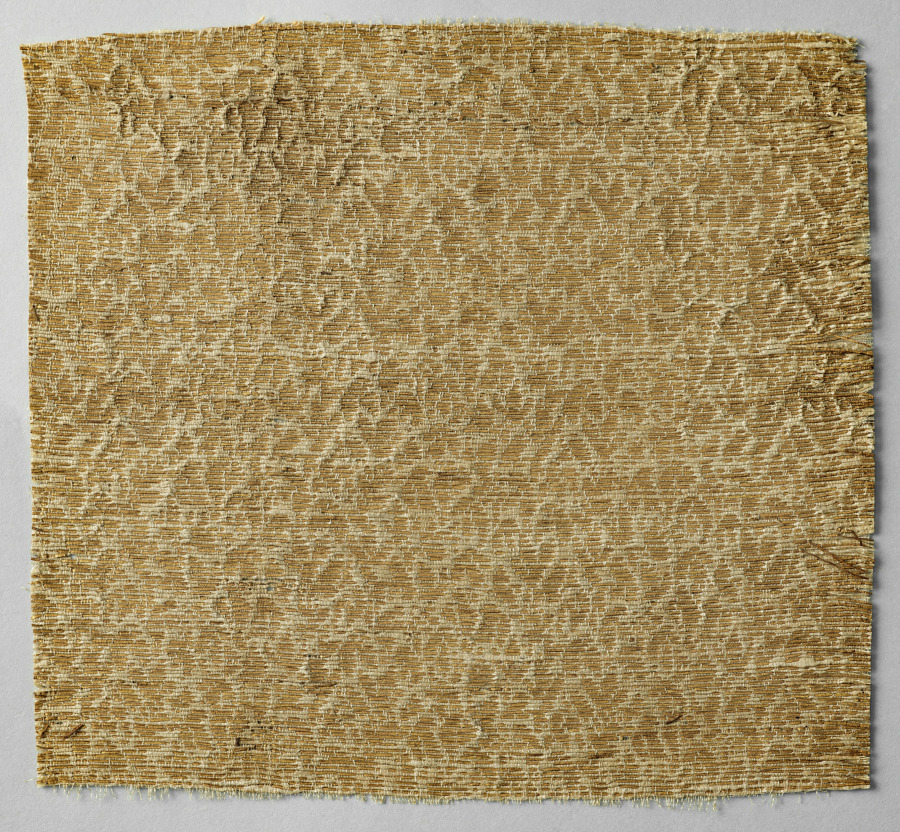
A Treatise on the Imperial Silken Leaf: An Examination of Botanical Miniaturisation in Woven Form
To the discerning eye, the true measure of a textile’s consequence lies not in its expanse, but in the precision of its minutiae. Consider, if you will, the subject at hand: a length of silk, ostensibly unremarkable in its field of deepest charcoal. Upon closer inspection, however, one is met with a phenomenon of exquisite discipline—a systematic scattering of tiny, perfectly rendered leaves. This is not mere decoration; it is a statement of capability, a quiet manifesto of technical sovereignty that speaks directly to the legacy of imperial silk weaving. The material, of course, is paramount. Silk is not simply a fibre; it is the accepted substrate of power, its very molecular structure capable of capturing light with a deference no other medium can muster.
The Loom as Imperial Edict
The context of imperial production transforms the loom from a tool into an instrument of state. In the ateliers serving dynastic courts, from Byzantium to Kyoto, and most notably within the vast, administrated workshops of China’s Forbidden City, weaving was a bureaucratised art. Patterns were not left to artisanal whim. They were codified, archived, and assigned according to a strict hierarchy of visual language. The appearance of a five-clawed dragon or a specific phoenix was governed by sumptuary laws as rigid as any legal code. Within this ecosystem, the motif of the leaf—particularly the modest, tiny leaf—occupies a fascinating niche. It represents the point at which overwhelming technical resource is applied to an object of profound subtlety. The ability to miniaturise and perfect a natural form within the unforgiving grid of the warp and weft was a demonstration of control over both nature and craft.
This was not the bold, sprawling floral scroll of the Baroque, demanding attention. This was a whisper of cultivated nature, a suggestion of a perfectly ordered garden, perhaps the very grounds of the palace itself, rendered in infinitesimal detail. The silk thread, inherently fine and strong, was the only possible medium. A leaf measuring perhaps three millimetres in length, yet possessing a defined central vein and serrated edge, required yarns of extraordinary tensile refinement. The weaver’s hand and eye, guided by a complex drawloom system, executed these details with a repetitive accuracy that borders on the mechanical—yet retains the vital, slight irregularity that confirms its human, and thus imperial, provenance.
Materiality & Luminary Effect
The choice of silk is absolute. Its triangular prism-like structure refracts light, giving the fabric its characteristic lustre—a quality known as ‘scroop’ in the parlance of our own clothiers. This inherent luminosity is crucial to the narrative of the tiny leaf. In our specimen, the leaves are not rendered in a contrasting colour, but in a slight variation of weave structure—a satin float against a twill ground, perhaps. This means the motif reveals itself not through chromatic shout, but through a play of light. The leaf becomes apparent only as the wearer moves, a fleeting, shimmering impression of cultivated flora emerging from the shadows of the base cloth.
This luminary effect is a deliberate, sophisticated language. It speaks of wealth that does not require garish declaration, of status so assured it can afford subtlety. In an imperial context, such a textile might line a robe or form an underlayer, its detail reserved for intimate audiences or revealed in the specific, graceful movements of court ritual. The silk itself, cultivated from the finest mulberry-fed worms under state-controlled sericulture, was a protected commodity, its export often forbidden. Thus, the very presence of this cloth, in any form, was a direct token of imperial reach and economic priority.
A Legacy in Contemporary Bespoke
What, then, is the modern legacy of this imperial silken leaf? It is found not in replication, but in principle. The Savile Row ethos, though separated by continents and centuries from the Qing dynasty workshops, understands profoundly the language of understatement achieved through superlative means. The focus on minute, perfect detail—the pick stitching on a lapel, the tension of a buttonhole, the internal structure of a canvassed front—is our own form of botanical miniaturisation. We, too, build our authority on a foundation of technical excess, applied to achieve a result of quiet, undeniable assurance.
The client who appreciates a cloth woven with a barely perceptible shadow stripe, or a lining of exceptional fineness printed with a discrete, personal motif, is engaging in the same dialogue as the courtier whose robes whispered of ordered gardens with every measured step. They are conversant in the grammar of quality that speaks softly. The ‘tiny leaf’ in our modern idiom is the hidden detail, the flawless execution where no one will see it, the selection of a material for its intrinsic excellence rather than its obvious display.
In conclusion, this textile artifact—a field of charcoal silk animated by scattered, luminous leaves—is far more than a decorative fragment. It is a crystallised moment of imperial ideology. It demonstrates how supreme technical mastery, when directed by a refined aesthetic intelligence, chooses to express itself not in grandeur, but in exquisite, deliberate slightness. It is a lesson in the power of restraint, a testament to the fact that true luxury resides in the mastery of the minute, and that the most enduring legacies are often those woven in whispers, not shouts. The silk remains, the leaves still catch the light, and the statement of sovereign capability is as clear today as it was the moment it left the loom.