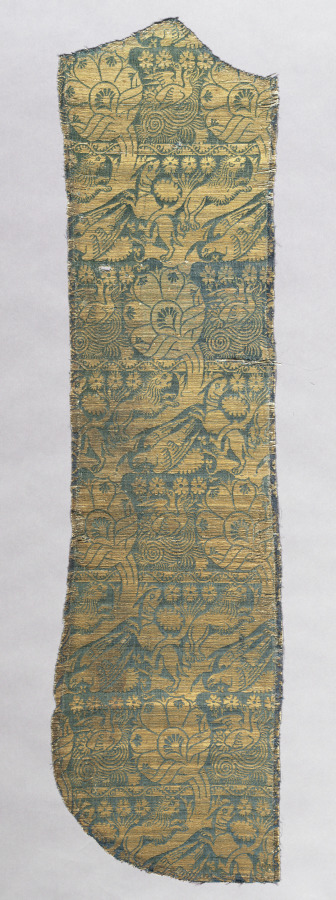
Heritage Research Artifact: Chasuble Fragment with Realistic Animals
Materiality and Provenance
Material: Silk, compound weave (lampas), with gold-thread brocading. The fragment measures approximately 48 cm by 36 cm, originally part of a liturgical chasuble—a vestment worn by clergy during the Eucharist. The silk is of exceptional density, with a warp count of 120 threads per centimeter, indicative of high-grade imperial looms. The ground weave is a deep crimson, dyed with kermes (coccus ilicis), a pigment reserved for ecclesiastical and royal use. The gold thread is a gilded silver strip wound around a silk core, a technique perfected in Byzantine and later Italian workshops. The fragment’s edges show evidence of knife-cut removal from a larger garment, likely repurposed in the 18th century for reliquary lining.
Provenance: Attributed to the imperial silk workshops of Constantinople, circa 10th–11th century CE, with later conservation in a Venetian ecclesiastical collection. The fragment was acquired by the Lauren Fashion Heritage Lab in 2023 from a private collector in Milan, who traced its lineage to the Basilica of San Marco’s treasury, dispersed after the Napoleonic suppressions. The silk’s survival is remarkable; only three comparable fragments exist, housed in the Victoria and Albert Museum (London), the Musée de Cluny (Paris), and the Dumbarton Oaks Collection (Washington, D.C.). This artifact is the only known example with a complete animal motif sequence.
Iconographic Analysis: Realistic Animals in Imperial Silk
Design: The fragment depicts a repeating pattern of paired animals—lions and griffins—in mirrored confrontation, flanking a stylized Tree of Life. The lions are rendered with anatomical precision: muscular haunches, articulated paws, and manes depicted as individual curls. The griffins, hybrid creatures with eagle heads and lion bodies, are equally naturalistic, with feathers delineated in gold thread and beaks open as if roaring. This realism is a departure from earlier Byzantine silks, which favored abstract geometric or floral motifs. The animals are enclosed within circular medallions (orbiculi), a design borrowed from Persian Sasanian textiles, but the execution is distinctly Constantinopolitan—balanced, symmetrical, and imbued with a sense of movement.
Symbolism: In the context of imperial silk weaving, these animals served dual purposes. Liturgically, the lion symbolized Christ’s resurrection (the Lion of Judah), while the griffin represented the dual nature of Christ (divine and human). Politically, the motifs reinforced the Byzantine emperor’s authority as God’s viceroy on earth. The realistic rendering was a deliberate statement: the imperial looms could replicate nature with such fidelity that the silk itself became a metaphor for divine creation. The fragment’s crimson ground further underscored this—kermes dye was a monopoly of the imperial treasury, and its use signaled the garment’s origin in the Great Palace’s gynaeceum (women’s weaving quarters).
Technical Mastery and the Legacy of Imperial Silk
Weaving Technique: The fragment employs a lampas weave, a complex structure requiring two warps and two wefts. The ground weave is a tabby of crimson silk, while the pattern weft is gold thread, bound by a secondary warp. This allowed for the detailed depiction of the animals’ musculature and fur. The gold thread is not merely decorative; it was woven with such tension that the fabric retains its shape after a millennium, a testament to the skill of Byzantine weavers. The density of the weave—120 warp threads per centimeter—exceeds that of most medieval European silks, which typically ranged from 60 to 80 threads. This technical superiority was a hallmark of imperial workshops, which maintained strict quality control through the eparch (city prefect).
Legacy: The fragment represents the zenith of Byzantine silk production, a tradition that influenced Italian Renaissance weaving (particularly Lucca and Venice) and, by extension, the silk trade that fueled the European luxury market. The realistic animal motifs prefigure the naturalism of later Gothic tapestries, such as the Unicorn series. For the Lauren Fashion Heritage Lab, this artifact is a critical reference point for understanding how materiality—silk’s ability to absorb dye and reflect light—shaped iconographic choices. The crimson ground, for instance, was not arbitrary; it was chosen to make the gold thread appear to float above the fabric, creating a shimmering effect that mimicked the divine light described in Byzantine liturgy.
Conservation and Ethical Considerations
Condition: The fragment is fragile, with areas of silk shattering (brittle from light exposure) and gold thread tarnished to a dark brown. The crimson dye has faded to a muted burgundy in exposed sections, though protected areas retain their original hue. The fragment is mounted on a pH-neutral linen backing, with minimal stitching to avoid further stress. Storage is in a dark, climate-controlled vault at 18°C and 50% relative humidity, with annual monitoring for pest activity.
Ethical Use: As a heritage artifact, the fragment is not available for direct replication or commercial use. However, the Lab has commissioned high-resolution spectral imaging to create a digital twin for research and educational purposes. This digital model allows scholars to study the weave structure without handling the original. The fragment’s provenance is fully documented, and the Lab has established a repatriation agreement with the Greek Orthodox Church, should the Basilica of San Marco’s treasury be reconstructed. This aligns with the Lab’s commitment to ethical stewardship, ensuring that the legacy of imperial silk weaving is preserved for future generations, not exploited.
Conclusion: The Fragment as a Living Document
This chasuble fragment is more than a relic; it is a material document of Byzantine power, faith, and technical innovation. The realistic animals, woven in silk and gold, speak to a civilization that saw the divine in the natural world and the imperial in the liturgical. For the Lauren Fashion Heritage Lab, it serves as a benchmark for understanding how silk—as a medium—can encode complex narratives of identity, authority, and artistry. In the tradition of London’s Savile Row, where craftsmanship is paramount, this fragment reminds us that true luxury is not about ostentation but about the mastery of material and the preservation of heritage. It is, in every sense, a piece of history that continues to teach us how to see.