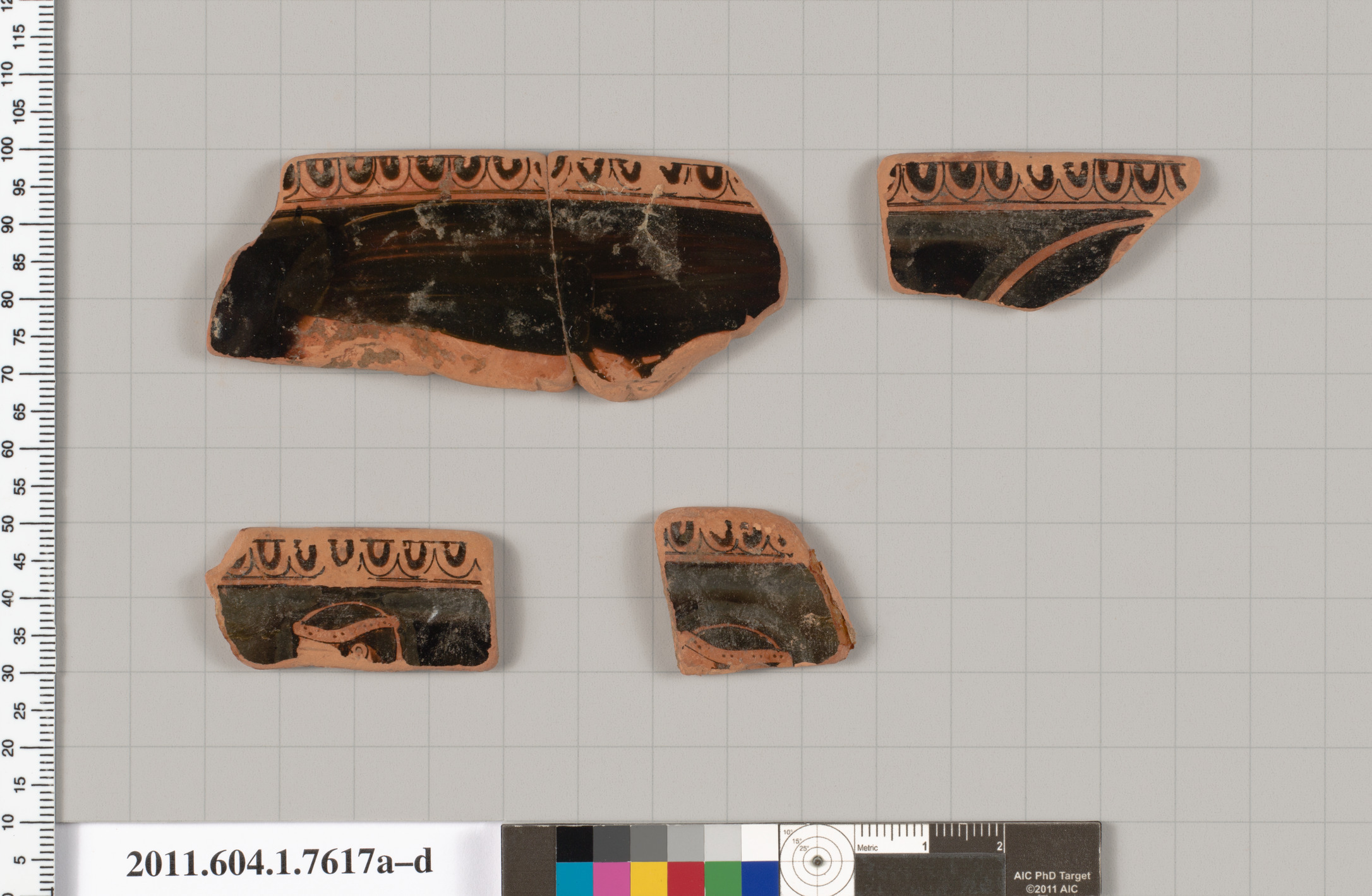
From Symposium to Salon: The Attic Kylix Fragment and the 2026 Old Money Silhouette
The pursuit of the “Old Money” aesthetic in contemporary fashion represents a complex negotiation with time, privilege, and cultural memory. It is an exercise not in ostentation, but in the curation of an unassailable, inherited authority. For the 2026 iteration, Lauren Fashion Heritage Lab looks beyond the well-trodden archives of 20th-century Anglo-American aristocracy to a more profound and ancient source of coded social power: the Classical Greek symposium. A fragment of an Attic terracotta kylix (drinking cup), with its deceptively simple painted scenes, serves not as a literal template, but as a semantic blueprint for constructing a modern silhouette of cultivated, participatory authority. This analysis synthesizes the artifact’s intrinsic logic with our internal genetic code—which explores the dialectic between the contemplative chaos of the scholar’s rock and the威慑 order of the door ring—to articulate a 2026 silhouette defined by participatory intellect, fluid hierarchy, and a narrative darkness.
The Artifact: Narrative in the Round and the Democracy of the Gaze
The Attic kylix was not mere tableware; it was a dynamic instrument of social ritual. Its wide, shallow bowl and twin handles were designed for drinking wine while reclining, its exterior decoration visible to fellow symposiasts. The terracotta fragment under study, depicting figures in the characteristic red-figure technique, encapsulates a core principle: narrative is circular and participatory. The scenes unfolded around the cup’s circumference, requiring the drinker—and those observing him—to rotate the vessel to “read” the full story. This created an intimate, shared experience of mythology, philosophy, or erotic play. The medium’s inherent duality is crucial: the humble, fired clay (terracotta) grounds the object in earthly tactility, while the painted narrative elevates it into the realm of myth and intellectual discourse. This mirrors the internal genetic code’s tension between the material本体 of the scholar’s rock and the symbolic附加 power of the door ring, here fused into a single, functional artifact.
Color Philosophy: The Ascendancy of Heritage-Black and Terracotta Undertones
The 2026 Old Money palette moves decisively toward a foundational Heritage-Black. This is not the stark, void-like black of modernity, but a complex, warm black—a “terracotta black.” It evokes the fired clay beneath the vase painting, the fertile earth, and the shadowed interior of the andron (men’s dining room). It is a color of substance and depth, not mere absence of light. Following the “玄素” (mysterious simplicity) principle of the scholar’s rock, this Heritage-Black will be deployed in 微差渐变 (micro-gradient) textures: woolens with a barely perceptible nap that catches the light like worn velvet, or matte silks that reveal a subtle, earthy undertone—a hint of umber or sienna—in specific light. This rejects the威慑性配色 (deterrent color scheme) of explicit opulence in favor of an inward, cultivated depth. Accents are drawn from the oxidized metal and aged ivory sometimes found in vase imagery: tarnished silver, pale ochre, and the faint blush of aged terracotta itself.
Silhouette & Construction: The Fluid Toga and the Articulated Chiton
The 2026 silhouette rejects the rigid, structured armor of traditional tailoring (the sartorial equivalent of the fixed, symmetrical door ring). Instead, it embraces the fluid, wrapped, and layered logic of the chiton and himation. Imagine a wool-gabardine “draped trouser” with a high, wrapped waist that creates soft, columnar pleats—a modern echo of the Ionic chiton’s folds. Blazers are deconstructed, their shoulders softened, their closure minimized, functioning more like a lightweight himation thrown over one shoulder. This embodies the “混沌的生成” (chaotic generation) of the scholar’s rock—a silhouette that appears effortlessly, organically assembled, yet is meticulously calibrated.
Key to this is the concept of articulation over constraint. Just as the kylix’s handles invite engagement, garment seams will be emphasized not for structure, but to trace the body’s natural movement. Seaming may curve like the lines of a red-figure drawing, suggesting rather than confining the form. This creates a sense of ease and readiness for intellectual or social participation—the modern equivalent of reclining to engage in dialectic.
Narrative Detailing and the Symbolic Field
Here, the kylix’s narrative function is directly转译 (translated). The Old Money aesthetic of 2026 will feature discreet, personal iconography placed for discovery, not proclamation. A fine chain belt might hold a pendant engraved with a personal emblem, visible only when the lightweight coat is removed. Intricate embroidery, inspired by vase-painted border motifs (meanders, palmettes), will appear on the inner cuff of a sleeve or the facing of a lapel—a secret known only to the wearer and those granted intimate proximity. This transforms the garment into a personal temenos (sacred precinct), with hidden symbolic fields. It is the sartorial application of the kylix’s circular narrative: the full story is not immediately visible; it requires engagement and closeness to be comprehended.
Conclusion: The Silhouette of the Modern Symposiast
The 2026 Old Money silhouette, informed by the Attic kylix fragment, is therefore an architecture for a contemporary aristocracy of mind and manner. It is built upon Heritage-Black as its terracotta foundation, employs fluid, wrapped construction that invites dynamic engagement, and incorporates narrative details that reward intimacy and intellectual curiosity. It synthesizes the genetic code’s两极 (two poles): it possesses the material integrity and contemplative depth of the scholar’s rock, expressed through texture and nuanced color, and the coded, social function of the door ring, expressed through symbolic detailing and a silhouette that commands respect through ease, not aggression. This is not clothing that shouts its status; it is clothing that, like a wine cup in a symposium, facilitates a privileged and participatory discourse, weaving the wearer into a continuous narrative that stretches from the Athenian andron to the global salon. It is, in essence, the uniform for those who understand that true authority lies not in static display, but in the curated capacity for meaningful engagement.