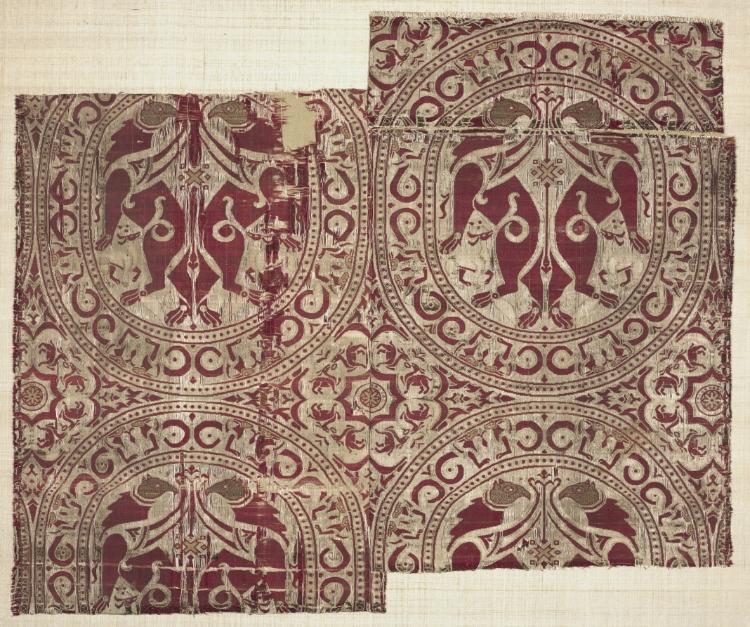
The Lampas with Griffins in Roundels: A Study in Imperial Silk Weaving and Ecclesiastical Legacy
Introduction: The Artifact as a Testament to Craft
Within the hallowed confines of Siguenza Cathedral, the Reliquary of Saint Librada houses a textile of extraordinary historical and material significance: a lampas weave silk, adorned with griffins enclosed in roundels. This artifact, dating from the late medieval period, is not merely a decorative fabric but a sophisticated document of cross-cultural exchange, imperial ambition, and the enduring legacy of silk weaving. As a Senior Heritage Specialist for the Lauren Fashion Heritage Lab, I approach this piece with the precision of a Savile Row tailor—examining its structure, provenance, and the narrative it weaves across centuries. The lampas technique, a complex compound weave, elevates this silk beyond mere utility, positioning it as a luxury commodity that traversed the Silk Roads and found sanctuary in a Spanish cathedral.
Materiality: The Silk and the Weave
The materiality of this lampas is paramount. Silk, derived from the cocoons of Bombyx mori, was a material of immense value, often reserved for royalty, clergy, and the elite. The lampas weave itself is a testament to technical mastery: it employs a ground warp and a pattern warp, with wefts that float across the surface to create the design. In this artifact, the griffins—mythological creatures with the body of a lion and the head and wings of an eagle—are rendered in a repeating roundel pattern. The roundel, a circular frame, was a hallmark of Byzantine and Islamic textile design, symbolizing eternity and divine order. The silk’s chromatic palette, likely featuring deep crimson, gold, and indigo, would have been achieved through natural dyes, such as madder for red and woad for blue, underscoring the artisanal sophistication of the era.
The structural integrity of the lampas is notable. Unlike simpler weaves, lampas requires a secondary warp to articulate the pattern, resulting in a fabric that is both durable and sumptuous. This technical complexity aligns with the standards of Savile Row tailoring, where the cut and construction of a garment are as important as the cloth itself. The griffin motif, with its symmetrical wings and poised stance, demonstrates a precision that would satisfy the most exacting master tailor. The silk’s preservation within the reliquary—likely used as a lining or wrapping for sacred relics—speaks to its perceived sanctity and value.
Context: The Legacy of Imperial Silk Weaving
The context of this lampas is rooted in the legacy of imperial silk weaving, a tradition that flourished under the Byzantine Empire, the Islamic Caliphates, and later, the courts of medieval Europe. The griffin motif, in particular, has deep antecedents: it appears in Sasanian Persian textiles, where it symbolized power and protection, and was later adopted by Byzantine weavers in Constantinople. By the 12th and 13th centuries, silk workshops in Sicily, Spain, and Italy—such as those in Palermo and Almería—were producing lampas silks that combined Eastern motifs with Western ecclesiastical demands. The Reliquary of Saint Librada, a 14th-century piece, likely incorporated this silk as a precious textile, imported or gifted to the cathedral as a mark of piety and prestige.
The imperial legacy is evident in the roundel design. In Byzantine court culture, roundels were used to frame imperial portraits and heraldic beasts, reinforcing the authority of the emperor. The griffin, a guardian of treasure and a symbol of Christ’s dual nature (human and divine), was a fitting motif for a reliquary. This silk, therefore, served a dual purpose: it was a material marker of wealth and a spiritual artifact. The Siguenza Cathedral, located in Castile, was a center of religious power during the Reconquista, and the presence of such a textile underscores the interconnectedness of medieval trade routes. Silk from the East, woven in Iberian workshops, and consecrated in a Christian context—this lampas embodies the syncretism of medieval material culture.
Heritage and Conservation: A Tailor’s Perspective
From a heritage perspective, the lampas with griffins presents both challenges and opportunities. The conservation of such a textile requires an understanding of its material fragility. Silk, while strong, is susceptible to light, humidity, and handling. The reliquary’s enclosed environment has likely protected the fabric, but any restoration must respect the original weave and dyes. As a heritage specialist, I advocate for a minimal intervention approach, akin to the Savile Row philosophy of preserving a garment’s integrity through careful repair rather than replacement. The griffin roundels, with their intricate patterning, should be documented using high-resolution imaging and digital reconstruction to ensure their legacy endures beyond physical decay.
The educational value of this artifact is immense. It offers a tangible link to the Silk Roads, a network that connected China, Persia, Byzantium, and Europe. For students of fashion heritage, the lampas technique is a precursor to modern jacquard weaving, demonstrating how pattern and structure can coalesce into art. The griffin motif, meanwhile, invites interdisciplinary study—from art history to religious iconography. In the Lauren Fashion Heritage Lab, we treat such artifacts as primary sources, analyzing them with the rigor of a master tailor examining a bespoke suit. The silk’s warp and weft tell a story of trade, technology, and transcendence.
Conclusion: The Enduring Thread
The lampas with griffins in roundels from the Reliquary of Saint Librada is more than a relic; it is a masterpiece of material culture. Its silk embodies the legacy of imperial weaving, its design reflects a global aesthetic, and its preservation within a sacred space underscores the intersection of commerce and faith. As we continue to study and conserve such artifacts, we honor the artisans who wove them and the cultures that valued them. In the tradition of Savile Row, where every stitch matters, this lampas reminds us that heritage is not static—it is a living thread that connects past, present, and future. The griffin, forever poised in its roundel, stands as a guardian of this legacy, inviting us to unravel its secrets with the same care and precision that brought it into being.