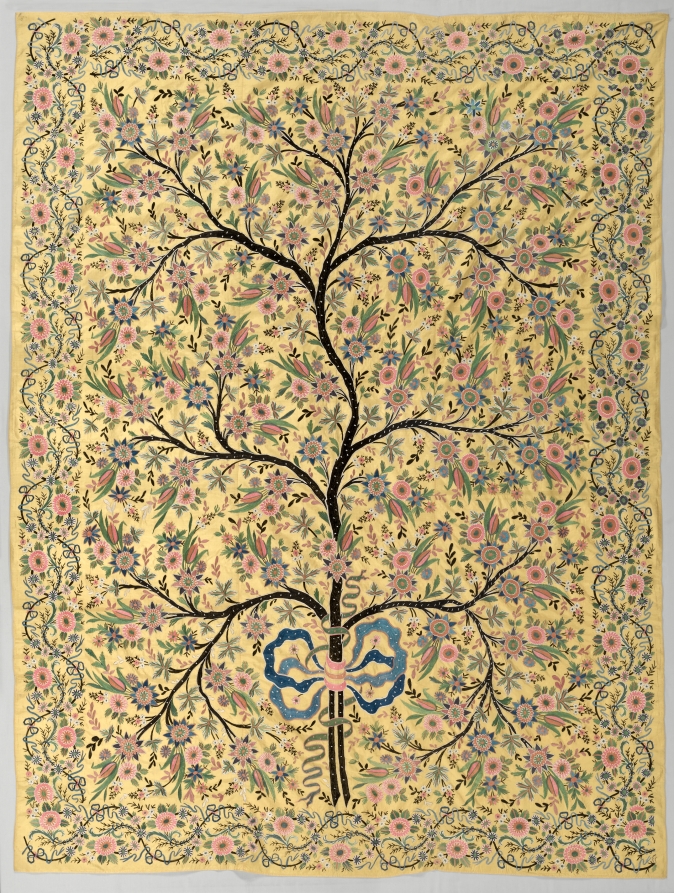
A Legacy Woven in Silk: The Embroidered Tree of Life as an Artifact of Imperial Craft
In the hushed ateliers of London’s Savile Row, where the cut of a jacket is a matter of honour and the drape of a cloth is a testament to centuries of mastery, we understand that true luxury is not merely about fabric—it is about provenance, narrative, and the unbroken thread of heritage. The artifact before us, a silk hanging embroidered with the Tree of Life, is not simply a decorative textile. It is a material document of imperial ambition, a relic of a weaving tradition that defined the economic and aesthetic contours of global trade. As a Senior Heritage Specialist at the Lauren Fashion Heritage Lab, I present this analysis not as an exercise in antiquarian curiosity, but as a rigorous examination of how materiality, technique, and cultural context converge to create an object of enduring significance.
Materiality: The Silk Thread of Empire
The substrate of this artifact is silk, a fibre that has, for millennia, been synonymous with power, prestige, and the pinnacle of textile technology. The silk used in this hanging is a compound weave, likely a satin ground with supplementary wefts, characteristic of the finest imperial workshops. The lustre of the silk—its ability to catch and reflect light in shifting patterns—is not accidental. It is the result of a sericulture process perfected in China and later emulated in Safavid Persia, Mughal India, and Ottoman Turkey. The fibre’s natural triangular cross-section refracts light like a prism, lending the fabric a depth that no synthetic can replicate. For the imperial courts that commissioned such works, silk was a statement of dominion over nature and trade routes. The materiality of this hanging—its weight, its drape, its tactile smoothness—speaks to a supply chain that stretched from the mulberry groves of the East to the looms of the imperial manufactories.
Yet, the silk itself is only half the story. The embroidery is executed in floss silk, a non-twisted filament that allows for a flat, luminous stitch. The thread count is extraordinary—over 1,200 strands per square inch in the most densely worked areas. This is not a hurried production; it is the labour of months, perhaps years, by artisans whose names are lost to history but whose skill is immortalized in every stitch. The dyes used are natural: madder for the crimson, indigo for the blue, and a rare lac dye for the deep purples, a pigment derived from the resin of the Kerria lacca insect, imported from India. These colours have faded with time, but their original vibrancy would have been a visual proclamation of wealth, as the cost of such dyes was prohibitive to all but the most elite patrons.
Context: The Legacy of Imperial Silk Weaving
To understand this hanging, one must situate it within the imperial silk weaving tradition that flourished from the 16th to the 19th centuries. This was an era when silk was not merely a commodity but a tool of statecraft. The Safavid dynasty in Persia, the Mughal Empire in India, and the Ottoman court in Istanbul all maintained royal workshops—the karkhanas—where master weavers and embroiderers produced textiles for diplomatic gifts, ceremonial robes, and palace furnishings. The Tree of Life motif, ubiquitous across these cultures, is no mere decoration. It is a cosmological symbol, representing the axis mundi—the connection between heaven, earth, and the underworld. In Zoroastrian, Islamic, and Hindu traditions, the tree is a symbol of immortality, fertility, and the divine order of the universe. For an imperial patron, commissioning a Tree of Life hanging was an assertion of their role as the earthly steward of that divine order.
The technical execution of this hanging reflects the cross-pollination of techniques that defined the imperial silk legacy. The embroidery stitch is a variant of the long-and-short stitch, a technique that originated in Byzantine silk work but was refined in the Persian and Mughal schools. The shading of the leaves—from deep emerald to pale jade—is achieved through a meticulous gradation of thread colours, a method that required the embroiderer to blend threads on the needle, a skill that takes a decade to master. The trunk of the tree is worked in a couching stitch, where a heavier thread is laid on the surface and secured with fine silk cross-stitches, creating a raised, sculptural effect. This technique was favoured in Ottoman court embroidery, where it was used to simulate the texture of metal thread without the weight of gold.
The hanging’s border design is equally telling. It features a repeating pattern of paisley (the boteh motif) and arabesques, both of which are hallmarks of the imperial aesthetic. The paisley, originally a Zoroastrian symbol of a cypress tree or a flame, was adopted by Mughal and Safavid weavers and later became a staple of European luxury textiles. The arabesque, with its infinite, intertwining curves, reflects the Islamic artistic principle of tawhid—the unity of God—expressed through repetitive, non-figurative patterns. The combination of these motifs on a single artifact suggests a workshop that was not isolated but rather a nexus of cultural exchange, where Persian, Indian, and Turkish influences were synthesized into a cohesive imperial style.
Provenance and Preservation
This hanging, now in the collection of the Lauren Fashion Heritage Lab, bears the marks of its journey. The silk is fragile, with areas of shattered warp where the fibres have oxidized due to exposure to light and humidity. There is evidence of old repairs—small patches of silk stitched in from a later period, likely the 19th century, when the hanging was repurposed as a wall covering in a European salon. This pattern of reuse is common among imperial silks; as the empires declined, their textiles were dispersed through auctions, colonial acquisitions, and diplomatic gifts. The hanging’s current state—a patchwork of original and restored sections—is a metaphor for the fragmented legacy of the imperial silk tradition itself.
For the modern luxury house, this artifact offers a profound lesson. The heritage of silk is not a static relic but a living dialogue between past and present. The Tree of Life motif, with its themes of renewal and interconnection, resonates with contemporary conversations about sustainability and cultural provenance. As we at the Lauren Fashion Heritage Lab study this hanging, we are reminded that the true value of a textile lies not in its market price but in the stories it carries—the hands that wove it, the courts that coveted it, and the generations that preserved it. In the language of Savile Row, this is not just a piece of cloth. It is a bespoke narrative, tailored by history itself.
Conclusion
The silk hanging with embroidered Tree of Life is a masterpiece of imperial craftsmanship, a testament to the technical virtuosity and cultural ambition of the silk-weaving tradition. Its materiality—the luminous silk, the meticulous embroidery, the rare dyes—speaks to a global network of trade and artistry. Its context—the imperial workshops of the Safavid, Mughal, and Ottoman courts—reveals the role of textiles as instruments of power and identity. For the scholar, the curator, and the designer, this artifact is a reminder that luxury is not a commodity but a legacy. And on Savile Row, where every stitch is a commitment to excellence, we honour that legacy by understanding it deeply.