An Examination of Materiality and Narrative in a Specimen of Figurative Silk Art
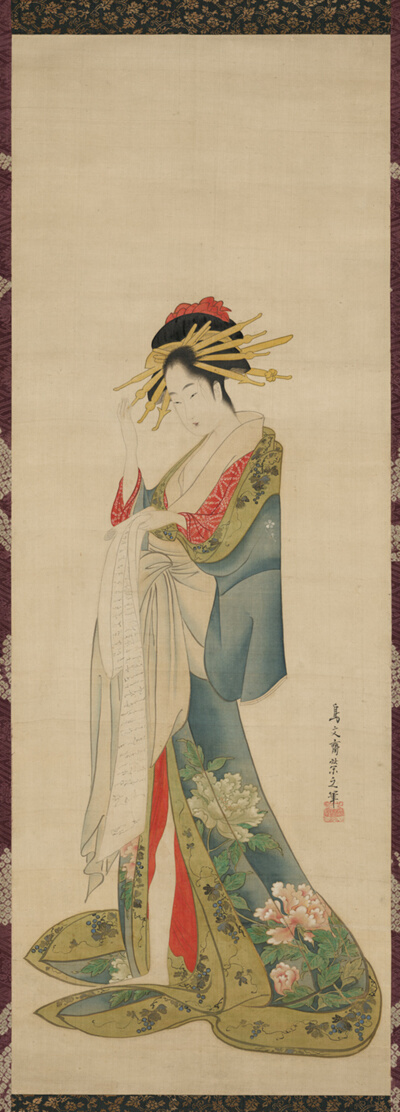
Upon first consideration, the artifact presents itself as a definitive statement in the language of classical figurative painting. The subject—a courtesan engaged in the intimate act of reading a letter—is, of course, a well-established motif within a certain canon. However, to dismiss this piece as merely derivative would be to commit a profound error of aesthetic judgement. The true subject, the primary narrative, is not the figure herself, but the ground upon which she is rendered: the silk. It is the silk that dictates the terms of engagement, demanding a specific discipline from the artisan and conferring a particular character upon the finished work. The medium is not merely a support; it is the senior partner in this creative enterprise.
The Foundation: A Bespoke Ground
One must understand that silk, in this context, is not a passive canvas. Its selection is the first and most critical decision, equivalent to the commissioning of a unique cloth from a specialist mill on the Isle of Bury or the selection of a rare vicuña for an overcoat. The inherent properties of a finely woven silk hanging scroll—its slight sheen, its tensile strength, its particular absorbency—establish a set of immutable parameters. The artisan does not conquer this surface; he negotiates with it. The application of ink and mineral pigment is a dialogue, where the silk’s resistance and acceptance actively shape the final mark. A brushstroke on silk possesses a liquidity and a softness of edge that paper denies, resulting in a fluid elegance that is the hallmark of the form. This is not illustration; it is a form of sartorial drafting, where the line must be both expressive and impeccably controlled, respecting the grain and fall of the material.
The Draughtsmanship: A Tailored Line
The depiction of the courtesan herself must be analysed through this lens of material-led discipline. The lines describing the drape of her robes are not merely descriptive; they are structural. Each fold and cascade is rendered with the precision of a master cutter who understands how cloth behaves under gravity and movement. The flow of the sleeve, the cinch at the waist, the pool of fabric at her knees—these are studies in tailored articulation. The colour, derived from meticulous grinding of minerals and careful application of vegetable dyes, sits upon the silk with a depth that is both luminous and subdued. It does not obscure the ground but enhances it, much as a well-chosen silk lining provides a flash of brilliance without compromising the jacket’s external form. The overall composition, a vertical scroll, dictates a specific viewing ritual—a slow, contemplative unfurling—which in turn influences the narrative pacing. The scene is revealed, not seized in a single glance.
The Narrative Stitch: Context as Craft
The context of classic silk craftsmanship elevates the narrative beyond the anecdotal. The courtesan, a figure of complex social standing, is defined by her cultivation and her artifice. Her world is one of performed intimacy and coded communication. The letter she reads is the central prop, but its contents are forever withheld from us. The true message is conveyed through her posture, the slight incline of her head, the delicate tension in her fingers—all rendered possible by the sensitivity of the silk ground. The setting, likely indicated by a mere suggestion of a screen or a single branch of blossom, relies on the silk’s ability to hold a whisper of ink, a suggestion of form. This is narrative through implication, a technique that demands a confident clientele, one who appreciates the unspoken and the finely wrought. It is the visual equivalent of a perfectly placed buttonhole, executed not out of necessity, but as a testament to consummate skill.
Conclusion: A Legacy in the Making
In final analysis, this hanging scroll stands as a peer to the most considered creations of the atelier. It demonstrates that heritage in material arts is not a matter of slavish reproduction, but of deeply understanding the intrinsic qualities of one’s medium and allowing those qualities to inform and elevate the creative vision. The silk is the constant, the timeless foundation. The courtesan and her letter are the seasonal variation, the narrative motif. Together, they form a complete garment, if you will, of aesthetic experience. To preserve and study such an artifact is to acknowledge a universal principle: whether in the weaving of silk, the cutting of cloth, or the application of pigment, true luxury lies in the unwavering respect for the material, and the disciplined, elegant expression of its inherent character. This piece, therefore, is not simply a painting. It is a masterclass in materiality, a silent dialogue between artisan and medium, resulting in an object of enduring and quiet authority.