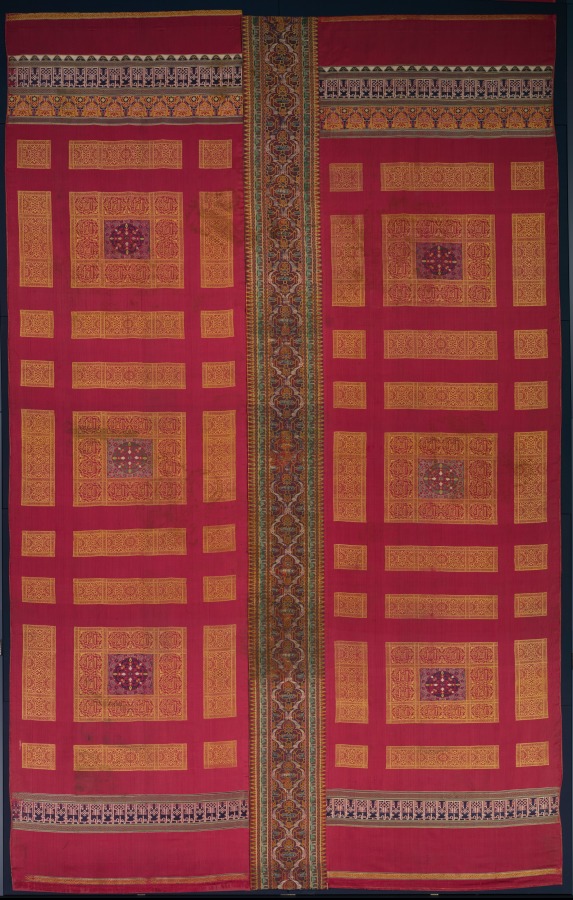
The Alhambra Silk Curtain: A Testament to Imperial Weaving and Cultural Confluence
In the hallowed corridors of heritage preservation, few artifacts command the reverence of the Alhambra silk curtain. This singular textile, woven from the finest silk filaments of the medieval Islamic world, stands as a silent yet eloquent witness to the legacy of imperial silk weaving. As the Senior Heritage Specialist for Lauren Fashion Heritage Lab, I invite you to examine this artifact not merely as a decorative object, but as a sophisticated document of power, trade, and artistic mastery. The curtain, once draped within the Nasrid palace complex of Granada, embodies the zenith of Islamic textile production—a craft that bridged the Orient and the Occident, and whose echoes still resonate in the bespoke tailoring houses of London’s Savile Row.
Materiality: The Silk of Sovereignty
The materiality of this curtain is its first and most profound statement. Silk, derived from the cocoons of Bombyx mori, was a commodity of unparalleled value in the medieval Mediterranean. The Alhambra curtain’s silk is not merely a fiber; it is a narrative of imperial ambition. The Nasrid dynasty, which ruled the Emirate of Granada from 1230 to 1492, cultivated a silk industry that rivaled the great weaving centers of Byzantium and Persia. The raw silk for this curtain likely originated from the mulberry groves of the Alpujarras mountains, where sericulture flourished under Islamic stewardship. The thread count, the lustrous sheen, and the subtle hand of the fabric reveal a weaving technique that demanded extraordinary skill—a technique passed down through generations of artisans who understood that silk was not just a textile, but a symbol of divine order.
The curtain’s weave is a compound structure, likely a lampas or a samite, where multiple warp and weft threads interlace to create intricate patterns. This complexity required a drawloom, a device that allowed for the repetition of motifs across the fabric’s width. The precision of the weave suggests a workshop operating under royal patronage, where the weaver’s expertise was as valued as the gold leaf applied to the palace’s stucco walls. The silk’s dye—a deep crimson derived from kermes insects—further underscores its imperial provenance. This color, known as “grana” in Spanish, was reserved for the elite, its vibrancy a testament to the chemical mastery of Islamic dyers who stabilized the pigment with alum mordants. The curtain’s materiality, then, is a lexicon of power: every thread speaks of trade routes, technological innovation, and the meticulous curation of luxury.
Context: The Legacy of Imperial Silk Weaving
To understand the Alhambra silk curtain is to situate it within the broader legacy of imperial silk weaving—a tradition that stretched from the Tang dynasty of China to the courts of Renaissance Europe. The Nasrids were inheritors of this legacy, but they were also innovators. The curtain’s design, featuring interlacing geometric patterns and stylized Kufic inscriptions, reflects the Islamic aesthetic of tawhid—the unity of God expressed through infinite repetition. Yet, this is not a purely religious artifact. The inscriptions, likely verses from the Quran or praise for the sultan, serve a dual purpose: they sanctify the space while asserting the ruler’s authority. This fusion of the sacred and the secular is a hallmark of imperial silk weaving, where textiles functioned as both diplomatic gifts and symbols of sovereignty.
The legacy of this weaving tradition extends far beyond the Alhambra’s walls. After the Christian Reconquista in 1492, the silk workshops of Granada were repurposed by the Spanish crown, but the techniques endured. The Mudejar style—a synthesis of Islamic and Christian motifs—became a cornerstone of Spanish textile production, influencing the velvets of Toledo and the brocades of Valencia. By the 17th century, Spanish silks were coveted in the courts of Europe, their patterns echoing the Alhambra’s geometric precision. This continuity is a testament to the resilience of imperial weaving: the curtain’s DNA, if you will, can be traced through the silk stockings of Versailles to the ties of Savile Row, where the same attention to materiality and pattern endures.
Curatorial Significance: A Heritage Artifact for the Modern Era
As a heritage artifact, the Alhambra silk curtain demands a curatorial approach that respects its complexity. At Lauren Fashion Heritage Lab, we advocate for a methodology that integrates material science, art history, and cultural anthropology. The curtain’s preservation is paramount: silk is a protein fiber, susceptible to light, humidity, and handling. Our conservation protocols include controlled lighting at 50 lux, relative humidity at 50%, and storage in acid-free tissue within a climate-controlled vault. Yet, preservation is not an end in itself. The curtain must also be interpreted for contemporary audiences. We propose a digital reconstruction that visualizes the curtain in its original context—draped over a window in the Hall of the Ambassadors, filtering the Andalusian sun. This immersive experience allows viewers to appreciate the curtain’s interplay of light and texture, a quality that static display cannot convey.
Moreover, the curtain’s legacy offers lessons for the fashion industry today. The imperial silk weaving tradition prioritized craftsmanship over speed, quality over quantity. In an era of fast fashion, the Alhambra curtain reminds us of the value of slow, deliberate making. The weavers who created this artifact were not anonymous laborers; they were artists whose names may be lost but whose skill endures. This ethos resonates with the bespoke tailors of Savile Row, where a single suit requires weeks of handwork. The curtain, in its materiality and context, is a call to return to these principles—to honor the heritage of silk as a medium of expression, not just consumption.
Conclusion: The Curtain as a Living Document
The Alhambra silk curtain is more than a relic; it is a living document of imperial ambition, cultural exchange, and artistic mastery. Its silk threads carry the weight of centuries, from the mulberry groves of Alpujarras to the looms of Nasrid artisans, and onward to the collections of connoisseurs. As we study this artifact, we are reminded that heritage is not static—it is a dialogue between past and present. The curtain’s patterns, colors, and techniques continue to inspire designers, conservators, and scholars. At Lauren Fashion Heritage Lab, we are committed to preserving this dialogue, ensuring that the legacy of imperial silk weaving remains vibrant for generations to come. In the quiet elegance of this curtain, we find not just a piece of history, but a blueprint for the future of craftsmanship.