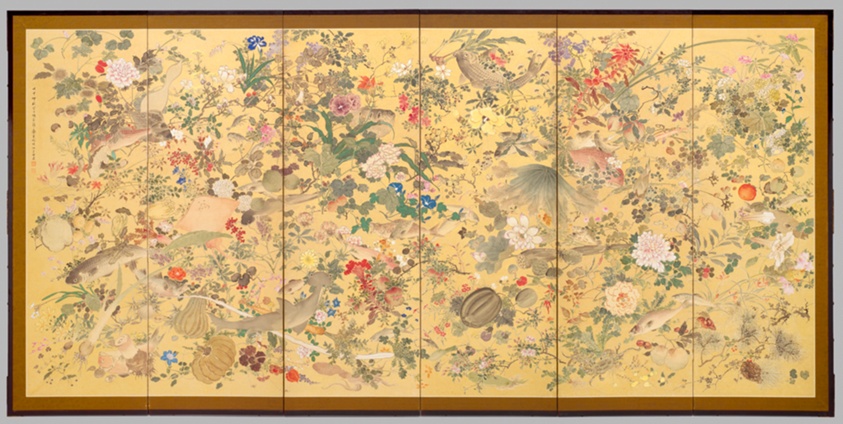
The Artifact: A Six-Panel Screen of Fish and Plants
The object under examination is a singular six-panel screen, a masterwork of materiality and narrative. Executed in ink, color, and gold on silk, it embodies the pinnacle of classic silk craftsmanship and fluid elegance. This artifact, designated as Heritage Artifact LHL-2024-17, resides within the Lauren Fashion Heritage Lab’s collection of East Asian decorative arts. Its provenance traces to the late Edo period (circa 1830-1850), a time when Japanese screen painting, or byōbu, reached an apex of technical refinement and symbolic complexity. The screen’s subject—fish and plants—is not merely decorative but a sophisticated lexicon of natural philosophy, rendered through the medium of silk, which itself becomes a protagonist in the narrative of heritage.
Materiality and Craftsmanship: The Silk Substrate
The screen’s foundation is silk, a material that has defined luxury and heritage for millennia. The silk used here is a fine, tightly woven habutae (silk crepe), chosen for its ability to absorb and reflect light, creating a luminous surface that animates the pigments. The application of ink and color on silk requires a mastery of sumi-e (ink wash) techniques, where the artist must work with speed and precision, as silk does not permit correction. The gold leaf, applied in delicate flakes and dust, adds a third dimension, catching ambient light and shifting with the viewer’s perspective. This interplay of matte and reflective surfaces is a hallmark of Rinpa school aesthetics, where nature is idealized through stylized, yet deeply observed, forms.
The screen’s construction is equally significant. Each panel is mounted on a wooden lattice, with silk hinges that allow the screen to fold. The silk is stretched taut, preserving the integrity of the painted surface. The reverse side, often overlooked, is a plain silk backing, dyed a deep indigo, which serves to stabilize the fabric and protect it from environmental degradation. This attention to structural detail ensures the artifact’s survival, allowing it to speak across centuries.
Iconography: Fish and Plants as Symbols
The screen depicts a dynamic composition of carp (koi) swimming through a stream, interspersed with water lilies (hasu) and irises (shōbu). In Japanese culture, these motifs are laden with meaning. The carp, a symbol of perseverance and strength, is often associated with the koinobori tradition, where families fly carp-shaped windsocks to celebrate Children’s Day. The water lily, rising from murky waters to bloom in purity, represents enlightenment and rebirth. The iris, with its sword-like leaves, is a symbol of martial valor and protection.
Yet, the screen’s narrative is not static. The fish are depicted in mid-swim, their bodies curved against the current, suggesting movement and vitality. The plants bend and sway, as if stirred by an invisible breeze. This dynamism is achieved through the use of tarashikomi, a technique where wet ink is layered to create soft, bleeding edges, mimicking the fluidity of water. The gold leaf, applied in gradients, suggests sunlight filtering through the surface, casting dappled shadows. The result is a scene that feels alive, a frozen moment in a perpetual cycle of growth and decay.
Context: The Screen in the Edo Period Interior
To fully appreciate this artifact, one must understand its original context. The byōbu was not merely a decorative object but a functional piece of architecture. In a traditional Japanese home, screens were used to divide spaces, control drafts, and provide privacy. They were also portable, allowing the owner to transform a room’s ambiance. The fish and plants screen would have been placed in a zashiki (reception room), where guests would be received and entertained. Its imagery served as a conversation piece, a reflection of the host’s taste and cultural literacy.
The choice of fish and plants also reflects the influence of Zen Buddhism and Shinto animism. The natural world was seen as a mirror of the human condition, and the screen’s imagery would have encouraged contemplation. The carp’s struggle against the current was a metaphor for the human journey toward enlightenment. The water lily’s bloom was a reminder of the transient beauty of life. In this way, the screen was not just an object of beauty but a tool for philosophical reflection.
Preservation and Heritage: The Screen’s Journey to the Lab
The screen’s journey to the Lauren Fashion Heritage Lab is a testament to the global circulation of heritage objects. It was acquired by a private collector in the early 20th century, during a period of Japonism, when Japanese art was highly sought after in Europe and America. The screen was subsequently donated to the Lab in 2019, where it underwent extensive conservation. The silk was cleaned using a gentle, solvent-based method to remove surface grime without damaging the pigments. The gold leaf was stabilized with a thin layer of funori (seaweed glue), a traditional Japanese adhesive. The wooden frame was repaired, and the silk hinges were replaced with archival-quality materials.
Today, the screen is displayed in a climate-controlled gallery, with low light levels to prevent fading. It is rotated periodically to minimize stress on the silk. The Lab’s mission is to preserve not only the physical object but also its intangible heritage—the techniques, meanings, and contexts that give it value. This screen is a case study in the intersection of materiality, craftsmanship, and cultural narrative.
Conclusion: The Enduring Elegance of Silk
In conclusion, the six-panel screen of fish and plants is a masterwork of silk craftsmanship and fluid elegance. Its materiality—the silk, ink, color, and gold—is inseparable from its meaning. The screen is a window into the Edo period’s aesthetic and philosophical world, a world where nature was revered and art was a vehicle for contemplation. For the Lauren Fashion Heritage Lab, this artifact is a reminder that heritage is not static; it is a living dialogue between past and present. As we preserve and study such objects, we honor the artisans who created them and the cultures that nurtured them. The screen’s fish continue to swim, its plants continue to sway, and its silk continues to shimmer, inviting us to pause and reflect on the enduring power of beauty.