A Scrutiny of the Artifact
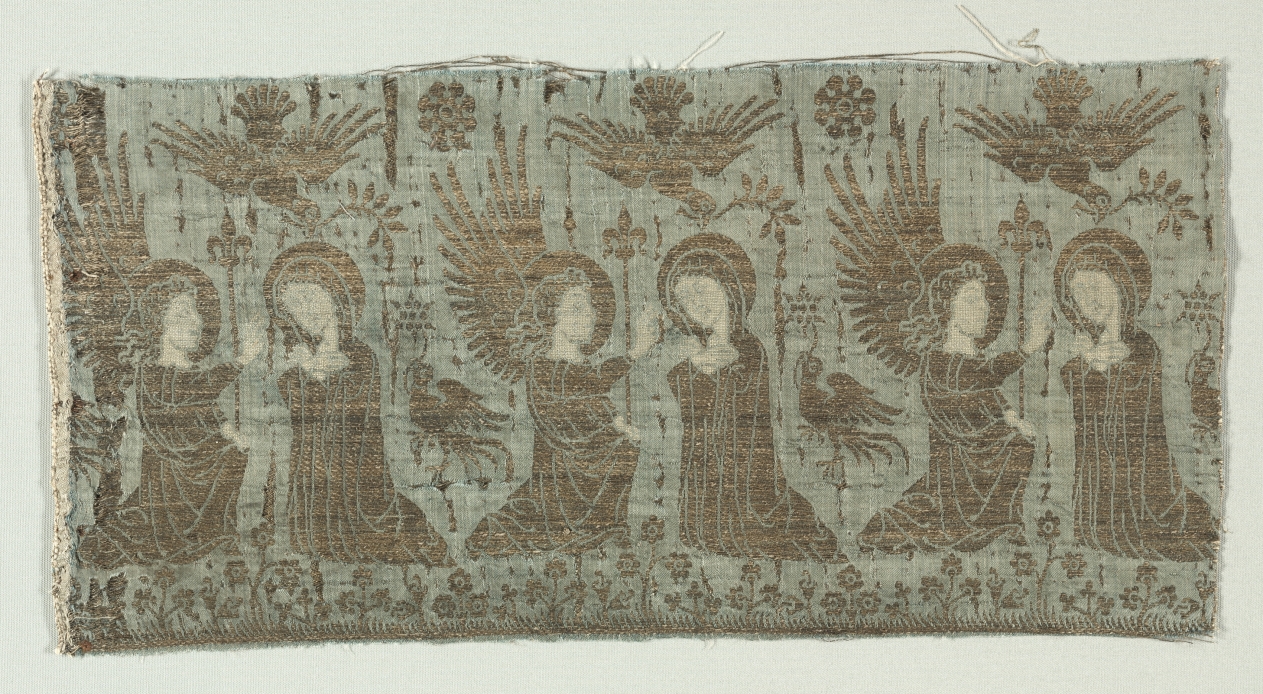
Presented for consideration is a textile fragment of considerable, if discreet, significance. The substrate is silk, a Zhengzhou satin-weave ground of a weight and hand that speaks unequivocally of imperial provisioning. The dimensions, now a modest 18 by 24 centimetres, suggest a far grander original context, likely a liturgical vestment or altar frontal. The palette, though faded, retains the authoritative echo of its provenance: deep, resonant blues derived from imported indigo, a regal crimson from cochineal, and a sparing but masterful application of gilded thread. The condition, while fragmentary, is instructive; the wear along one selvedge and the careful, deliberate cut of the other are narratives in themselves, hinting at preservation, repurposing, or perhaps a dignified decommissioning.
The Scene: A Moment of Supreme Interruption
The fragment depicts, with exquisite precision, the moment of the Annunciation. The Archangel Gabriel, a figure of dynamic yet contained poise, is captured mid-address. His drapery, carved from silk by the weaver’s art, falls in rhythms that suggest both celestial movement and immutable order. Opposite him, the Virgin Mary is rendered with an expression not of startlement, but of profound, dawning comprehension. Between them, the symbolic lily in its vase is not merely a decorative motif; it is the central pivot of the composition, a heraldic charge of purity and divine favour. The artistry is not that of the brush, but of the loom. Each figure, each fold of cloth, each delicate petal, is constituted by countless minute intersections of warp and weft, a feat of pre-meditated engineering as much as of devotion.
Material Provenance: The Loom of Empire
To comprehend this fragment is to understand the formidable apparatus behind its creation. This is not the product of a monastic workshop or a guild atelier of middling ambition. The technical execution—the density of the weave, the flawless integration of supplementary weft threads for the figurative elements, the sheer complexity of the draw-loom pattern—places its origin squarely within the orbit of an imperial silk workshop. In the context of the Byzantine or later Holy Roman Empire, such establishments were less manufactories and more instruments of state.
These workshops, often directly overseen by a court official, the vestiarius or his equivalent, served a dual purpose. Firstly, they produced the splendid vestments and regalia required to manifest the divine authority of the Emperor and the Church, a visual rhetoric of power woven in thread. Secondly, and crucially, they functioned as engines of economic and diplomatic policy. The control of silk, from the fraught importation of raw yarn to the secretive cultivation of sericulture, was a matter of strategic reserve. To bestow a length of such figural silk upon a cathedral, a favoured bishop, or a visiting potentate was not a gift; it was a calculated deployment of soft power, a tangible infusion of imperial prestige into the very fabric of the recipient's authority.
The Legacy of the Loom: A Continuum of Excellence
The legacy of this imperial textile paradigm is profound and, it may be argued, continuous. The insistence on the finest raw material, the subordination of individual artistry to a house style of impeccable technique, the understanding of the finished product as an emblem of a broader, governing philosophy—these are not antiquated concerns. They are the bedrock of any enduring heritage in craftsmanship.
Consider the Savile Row bespoke suit. The analogy, while crossing centuries and purposes, is structurally sound. Here, too, one finds an unwavering commitment to a superior substrate—in this case, rare woolens from specific British mills. The construction is a pre-meditated architecture of canvas, haircloth, and stitch, every line and drape engineered for a specific form and function. The cutter’s skill is legendary, but it is exercised within a strict canon of proportion and silhouette that defines the house. And ultimately, the garment is not merely attire; it is an artefact that communicates status, discernment, and an allegiance to a particular tradition of excellence. It is, in its way, a secular vestment. The imperial silk weaver, encoding theological and political authority into his loom, and the Savile Row cutter, translating personal stature and tradition into cloth, are engaged in cognate pursuits.
Conclusion: The Fragment as Testament
This textile fragment, therefore, transcends its role as a mere religious illustration. It is a concentrate of systemic value. It embodies the apex of a controlled, technologically advanced industry. It manifests the aesthetic language of a hegemonic power. It served as a lubricant for the machinery of state and faith. Its survival, albeit partial, is a testament to the enduring weight accorded to objects of such calibrated perfection.
In our contemporary analysis of heritage, we must look beyond the iconography. The true narrative is held in the sheen of the silk, the precision of the weave, the costliness of the dyes. This fragment whispers of imperial decrees, of guarded trade routes, of looms that were state secrets, and of a finished product so potent it could adorn an altar or bind an alliance. It reminds us that the most powerful legacies are often those woven not just with thread, but with intention, authority, and an unyielding commitment to the highest possible standard. That, gentlemen, is a legacy that demands not merely appreciation, but the most rigorous and respectful scrutiny.