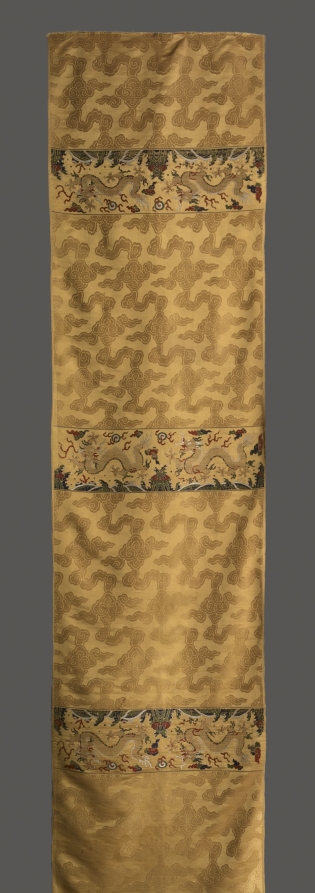
The Silk Panel with Dragon and Cloud Motif: An Artifact of Imperial Legacy
Introduction: The Fabric of Power and Prestige
In the annals of textile history, few artifacts command the reverence and scholarly intrigue as the Silk Panel with Dragon and Cloud Motif. This piece, a testament to the unparalleled artistry of imperial Chinese silk weaving, transcends mere decoration to embody a complex narrative of power, spirituality, and craftsmanship. As a Senior Heritage Specialist at Lauren Fashion Heritage Lab, I approach this artifact with the precision of a Savile Row tailor—examining every thread, every weave, and every symbolic gesture as if it were a bespoke suit for an emperor. The panel, likely originating from the Ming or Qing dynasties (1368–1912), is not simply a fabric; it is a material chronicle of a civilization that elevated silk to the highest form of cultural expression.
The legacy of imperial silk weaving is intrinsically tied to the concept of “the Mandate of Heaven,” where the emperor, as the Son of Heaven, governed through divine right. Silk, with its luminous sheen and tactile luxury, became the medium through which this authority was visually asserted. The dragon, a symbol of imperial might and cosmic harmony, and the clouds, representing celestial realms and auspicious transitions, coalesce in this panel to create a microcosm of imperial ideology. For the modern connoisseur, this artifact offers a rare glimpse into the intersection of art, politics, and material science—a heritage that informs contemporary luxury and design.
Materiality: The Science of Silk and Weave
The materiality of this panel is its foundational narrative. Silk, derived from the cocoons of Bombyx mori silkworms, was a closely guarded secret of ancient China, its production monopolized for millennia. The panel’s weave—likely a satin or damask structure—demonstrates the advanced technology of imperial looms. The warp and weft threads, meticulously dyed with natural pigments such as indigo, madder, and safflower, achieve a chromatic depth that synthetic dyes cannot replicate. The dragon motif, rendered in gold-wrapped thread (a technique known as kesi or “cut silk”), exhibits a three-dimensional quality, its scales shimmering as if alive.
From a conservation perspective, the panel’s condition reveals its history. The slight fading of the cloud motifs suggests exposure to light over centuries, while the intact borders indicate careful storage in a palace treasury. The thread count—approximately 120 threads per centimeter—speaks to the labor-intensive nature of its creation. Each thread was spun, dyed, and woven by artisans who dedicated their lives to the craft, their anonymity a stark contrast to the celebrity of modern designers. This materiality is not merely aesthetic; it is a technical archive of pre-industrial textile engineering.
Symbolism: The Dragon and Cloud as Imperial Lexicon
The dragon and cloud motif is a visual language of imperial authority. The five-clawed dragon, reserved exclusively for the emperor, is depicted in dynamic pursuit of the “flaming pearl”—a symbol of wisdom, prosperity, and spiritual energy. The clouds, stylized as xiangyun (auspicious clouds), frame the dragon in a celestial dance, suggesting the emperor’s role as mediator between heaven and earth. This iconography is not arbitrary; it adheres to strict sumptuary laws that dictated who could wear such motifs. A Ming dynasty decree, for instance, forbade officials from using five-clawed dragons, relegating them to four claws as a mark of hierarchy.
The panel’s composition—a symmetrical arrangement of the dragon amidst swirling clouds—reflects the Confucian ideal of order and harmony. The dragon’s sinuous body, with its undulating curves, contrasts with the geometric precision of the cloud forms, creating a tension that is resolved through balance. This duality is reminiscent of the yin-yang philosophy, where opposing forces coexist in dynamic equilibrium. For the contemporary observer, this symbolism offers a lens through which to understand the Chinese worldview—a system where power is not brute force but a cultivated alignment with cosmic forces.
Context: The Legacy of Imperial Silk Weaving
The imperial silk weaving tradition was a state-sponsored enterprise, managed by the Imperial Silkworks in cities like Suzhou, Hangzhou, and Nanjing. These workshops operated under the direct supervision of the court, with quotas, quality standards, and designs dictated by the emperor. The Silk Panel with Dragon and Cloud Motif would have been produced for a specific purpose—perhaps as a ceremonial robe for the emperor, a hanging for the Forbidden City’s Hall of Supreme Harmony, or a diplomatic gift to a foreign dignitary. Its journey from loom to palace was a ritual in itself, involving prayers to the silkworm goddess and blessings from court eunuchs.
The decline of imperial silk weaving began with the fall of the Qing dynasty in 1912, when the workshops were disbanded and artisans scattered. Yet, the legacy endures. Today, institutions like the Lauren Fashion Heritage Lab preserve and study such artifacts, not as relics but as living documents of craftsmanship. The panel’s techniques—from kesi to jacquard—have influenced modern luxury houses, from Gucci’s dragon motifs to Hermès’ silk scarves. In the context of Savile Row, where bespoke tailoring is the pinnacle of sartorial art, this panel represents the original “bespoke”—a garment woven for one client, the emperor, with a precision that rivals the finest English tailoring.
Conclusion: A Heritage for the Future
The Silk Panel with Dragon and Cloud Motif is more than an artifact; it is a dialogue between past and present, between East and West, between craft and commerce. As a heritage specialist, I urge the fashion industry to look beyond the surface of such pieces—to see the materiality as a lesson in sustainability, the symbolism as a guide to storytelling, and the context as a reminder of the cultural responsibilities we bear. In a world of fast fashion and disposable luxury, this panel stands as a testament to the enduring value of patience, skill, and meaning. It is not merely silk; it is the fabric of civilization itself.
For the discerning client of Lauren Fashion Heritage Lab, this artifact offers a blueprint for authentic luxury—a luxury that is rooted in heritage, executed with mastery, and imbued with purpose. As we continue to explore the intersections of history and modernity, let us remember that the dragon and cloud motif is not a relic of the past but a living symbol of the heights that human creativity can achieve.