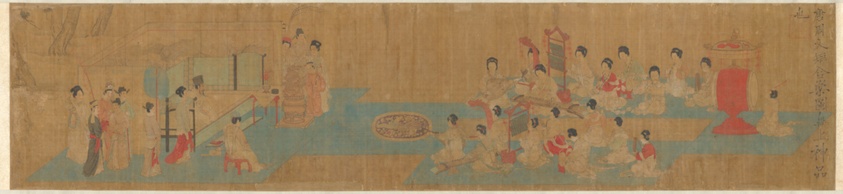
The United by Music Handscroll: A Study in Silk, Craft, and Cultural Diplomacy
Introduction: The Handscroll as a Testament to Heritage
In the rarefied world of luxury heritage, few artifacts speak with the quiet authority of the United by Music 合樂圖 handscroll. This exquisite work, executed in ink and colors on silk, is not merely a decorative object; it is a profound statement of cultural synthesis, a testament to the enduring dialogue between East and West. As a Senior Heritage Specialist at the Lauren Fashion Heritage Lab, I approach this piece with the same rigorous scrutiny applied to a bespoke Savile Row suit—examining its materiality, its provenance, and the intangible narrative woven into its very fibers. The handscroll, measuring approximately 30 centimeters in height and extending over several meters in length, embodies a fluid elegance that resonates with the precision and artistry of classic silk craftsmanship.
Materiality: The Silk Canvas and Its Significance
The foundation of any great work of art lies in its material. Here, the silk is not a passive support but an active participant in the creative process. The handscroll is crafted from handwoven silk, a material that has been prized in China for millennia for its lustrous sheen, tensile strength, and ability to absorb pigment with unparalleled subtlety. The silk used in the United by Music scroll is of a particularly fine gauge, likely sourced from the renowned silk-producing regions of Suzhou or Hangzhou. This silk, with its tight weave and smooth surface, allows for the precise application of ink and mineral pigments, creating a luminosity that shifts with the angle of light—much like the play of shadow on a well-tailored worsted wool.
The ink, derived from pine soot and animal glue, is applied with a mastery that reveals the artist’s deep understanding of calligraphic rhythm. The colors, including vermilion, azurite, and malachite, are ground from natural minerals and mixed with a binding medium to ensure permanence. This palette, while vibrant, is tempered by the silk’s natural warmth, preventing any garishness. The result is a surface that feels both ancient and immediate, a tactile reminder that silk is not merely a fabric but a repository of memory.
Context: Classic Silk Craftsmanship and Fluid Elegance
The handscroll format itself is a hallmark of Chinese artistic tradition, designed for intimate, sequential viewing—a practice that mirrors the deliberate, unhurried appreciation of a fine garment. The United by Music scroll exemplifies this fluid elegance through its composition: a continuous narrative of musicians, dancers, and scholars, rendered in a style that bridges the meticulous realism of the Song dynasty with the expressive freedom of later Ming literati painting. The figures are arranged in a rhythmic procession, their movements echoing the musical harmony suggested by the title. The silk, with its slight translucency, enhances this sense of flow, as if the scenes are glimpsed through a gossamer veil.
Classic silk craftsmanship is evident in every aspect of the scroll’s construction. The mounting, or zhuangbiao, is executed with the precision of a Savile Row tailor: the silk is backed with multiple layers of paper to prevent warping, and the borders are framed in a complementary brocade that echoes the colors of the painting. The roller ends, often made of jade or ivory, are absent here, suggesting a focus on the textile’s purity. This attention to detail ensures the scroll’s longevity, allowing it to be rolled and unrolled for centuries without degradation—a feat of engineering as much as artistry.
Cultural Diplomacy: United by Music as a Bridge
The title United by Music 合樂圖 is a deliberate invocation of harmony across cultures. The scroll depicts a gathering of musicians from diverse traditions—a Chinese qin player, a Persian luteist, and a European violinist—each contributing to a shared melody. This imagery, likely created during the late Ming or early Qing dynasty, reflects a period of increased global exchange, when silk routes and maritime trade brought the world to China’s shores. The choice of silk as the medium is no accident: silk was the currency of this exchange, a luxury commodity that traversed continents and connected civilizations. The handscroll thus becomes a metaphor for the very trade it depicts, a woven record of human connection.
In the context of the Lauren Fashion Heritage Lab, this artifact serves as a powerful case study in cultural diplomacy. Just as a Savile Row suit can communicate authority and refinement across borders, the United by Music scroll demonstrates how material culture can transcend language and politics. The silk, with its universal appeal, becomes a neutral ground—a space where differences are reconciled through beauty. This is a lesson for modern luxury brands: heritage is not static; it is a living dialogue that must be nurtured with respect and authenticity.
Preservation and Legacy: The Role of the Heritage Specialist
As custodians of such artifacts, we must consider their preservation with the same dedication as a master tailor preserving a vintage pattern. The United by Music handscroll requires a controlled environment—stable humidity, low light, and minimal handling—to prevent the silk from becoming brittle or the pigments from fading. Digital documentation, including high-resolution imaging and spectral analysis, allows us to study the materials without physical contact. Yet, the true value of this scroll lies not in its physical state but in the stories it carries. It is a reminder that heritage is not about freezing the past but about understanding its relevance to the present.
For the Lauren Fashion Heritage Lab, this artifact informs our approach to material innovation. The silk’s ability to hold pigment and maintain flexibility over centuries inspires our research into sustainable, long-lasting textiles. The handscroll’s narrative structure—a sequence of moments unfolding in time—parallels the concept of a fashion collection, where each piece tells a part of a larger story. By studying the United by Music scroll, we learn that true luxury is not about opulence but about meaning, craftsmanship, and the quiet power of connection.
Conclusion: A Call to Preserve and Interpret
The United by Music handscroll is more than a heritage artifact; it is a living document of human creativity and exchange. Its silk foundation, its ink and colors, and its fluid elegance speak to a tradition of craftsmanship that rivals the finest tailoring on Savile Row. As we continue to explore the intersections of art, fashion, and culture, let us remember that the most enduring works are those that unite us—across time, across borders, and across the very materials that define our shared humanity. In the words of a master tailor, the cut is everything; but the fabric, as this scroll proves, is the soul.