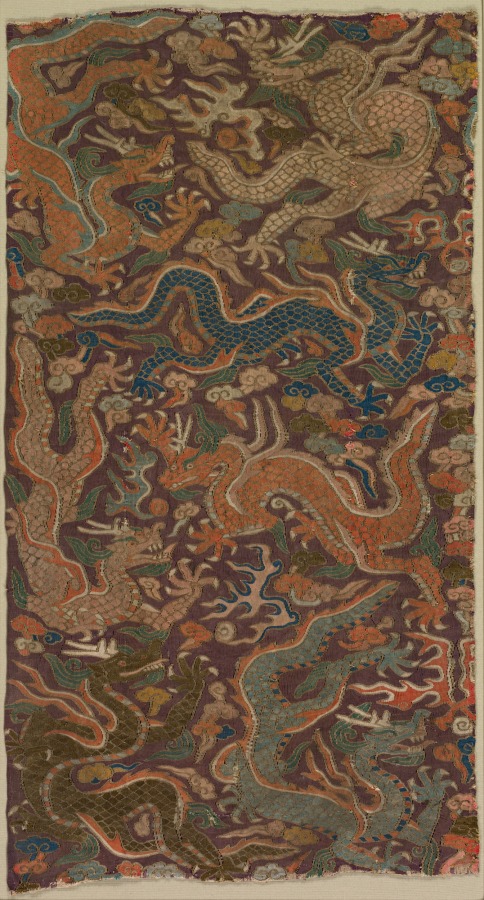
The Dragons Chasing Flaming Pearls: A Study in Silk and Sovereignty
In the hushed ateliers of London’s Savile Row, where the air is thick with the scent of wool, linen, and the quiet authority of bespoke tailoring, one rarely encounters the visceral drama of the Dragons Chasing Flaming Pearls motif. Yet, as a Senior Heritage Specialist at the Lauren Fashion Heritage Lab, I assert that this ancient Chinese symbol, rendered in the lustrous medium of imperial silk, represents the apotheosis of materiality and power. This artifact is not merely a pattern; it is a testament to the legacy of imperial silk weaving, a discipline that married technical virtuosity with profound cosmological meaning. To understand its resonance, we must dissect its materiality—silk—and its context within the imperial workshops that produced it, drawing parallels to the exacting standards of Savile Row’s own craft.
The Materiality of Silk: A Sovereign Fiber
Silk, the very fiber of this artifact, is a material of unparalleled complexity. Its production, from the cultivation of Bombyx mori silkworms to the reeling of continuous filaments, was a state secret guarded for millennia. The imperial silk weavers of the Ming and Qing dynasties, operating within the Jiangnan region’s workshops, understood that silk was not a passive substrate but an active participant in the narrative. The Dragons Chasing Flaming Pearls motif, when woven into silk, exploits the fiber’s natural luster and drape. The warp and weft threads, often dyed with cochineal or indigo, create a surface that shifts between matte and reflective, mimicking the ethereal glow of the flaming pearl itself. This is not a printed design; it is a structural conversation. The weaver’s hand, guided by a pattern drafted on paper, manipulates the tension and density of the threads to produce a raised, almost sculptural effect. The dragon’s scales, for instance, are rendered in a satin weave that catches light, while the pearl is often executed in a twill to suggest its fiery, volatile nature. This technical precision echoes the Savile Row cutter’s mastery of cloth—where a single millimeter of seam allowance can define a garment’s silhouette.
The Legacy of Imperial Silk Weaving: Workshops of the Forbidden City
The imperial silk weaving legacy is one of hierarchical artistry. The workshops of the Forbidden City were not mere factories; they were sanctuaries of specialized knowledge. Master weavers, often hereditary artisans, worked under the auspices of the Imperial Household Department. Their task was to produce textiles that embodied the emperor’s mandate of heaven. The Dragons Chasing Flaming Pearls motif was reserved for the highest echelons of court dress—robes for the emperor, empress, and select princes. The five-clawed dragon, or long, symbolized imperial authority, while the flaming pearl represented wisdom, spiritual energy, and the pursuit of perfection. The chase itself—the dragon’s sinuous body coiling around the pearl—was a metaphor for the emperor’s relentless quest for harmony and prosperity. This motif was not static; it evolved with dynastic shifts. Under the Qing dynasty, the dragon’s posture grew more aggressive, its claws more pronounced, reflecting the Manchu emphasis on martial prowess. The silk used was often kesi, or “cut silk,” a tapestry weave that allowed for intricate, polychromatic designs. Each robe required months, sometimes years, of labor, with a single weaver managing a loom that could hold thousands of warp threads. The result was a textile that was both a garment and a manifesto.
Savile Row Parallels: The Bespoke Ethos
Drawing a parallel to Savile Row, the legacy of imperial silk weaving shares a fundamental ethos with the Row’s bespoke tradition: the primacy of craft over commerce. In both contexts, the maker is an invisible hand, subsumed by the object’s perfection. A Savile Row tailor, like an imperial weaver, begins with a client’s measurements—a physical record of individuality. The weaver, however, worked with a different kind of measure: the emperor’s symbolic body. The Dragons Chasing Flaming Pearls motif was calibrated to the wearer’s rank, with the number of dragons and the color of the silk (e.g., bright yellow for the emperor, apricot for the crown prince) strictly regulated. This is not unlike the Savile Row practice of selecting a cloth—say, a 16-ounce worsted from Huddersfield—that communicates a client’s status and taste. The weaver’s loom, like the tailor’s needle, is a tool of precision. The tension of the warp threads must be uniform, or the pattern will warp. The weaver’s eye must catch a single broken thread before it becomes a flaw. This is the same vigilance that a Savile Row cutter applies to a lapel’s gorge or a sleeve’s pitch. Both traditions reject mass production in favor of the singular, the handcrafted, the irreplaceable.
The Flaming Pearl as a Symbol of Perfection
The flaming pearl, central to this motif, is a symbol of unattainable perfection—a concept that resonates deeply with the Savile Row pursuit of the ideal garment. In Chinese cosmology, the pearl is associated with the moon, water, and the yin principle, while the dragon embodies yang. Their chase represents the dynamic balance of opposites, a dance that yields creation. For the imperial weaver, the pearl was a technical challenge: how to render a sphere of light in thread? The solution lay in the use of gold-wrapped silk or peacock feather filaments, which caught ambient light and seemed to pulse. This illusion of movement is the hallmark of the motif. When the emperor moved, the pearl appeared to flicker, as if alive. This is the same principle that guides a Savile Row tailor when he adds a floating chest piece to a jacket—a subtle engineering that allows the cloth to move with the body, not against it. The pearl, like the perfect shoulder, is an aspiration, never fully achieved but always pursued.
Preservation and the Modern Gaze
Today, these artifacts reside in museums and private collections, their silk fibers slowly degrading under the weight of time. At the Lauren Fashion Heritage Lab, we employ non-invasive techniques such as multispectral imaging to study the weave structures and dye compositions without disturbing the fabric. We also collaborate with master weavers in Suzhou, who continue to practice the kesi technique, to understand the lost knowledge of imperial looms. This is not mere nostalgia; it is a forensic investigation into how materiality shapes meaning. The Dragons Chasing Flaming Pearls motif, when viewed through a Savile Row lens, becomes a case study in the intersection of power, craft, and symbolism. It reminds us that the finest garments—whether a dragon robe or a double-breasted suit—are not just clothes but documents of a civilization’s values.
In conclusion, the Dragons Chasing Flaming Pearls artifact, woven in imperial silk, is a masterclass in materiality. Its legacy, rooted in the workshops of the Forbidden City, parallels the bespoke traditions of Savile Row in its commitment to precision, symbolism, and the pursuit of the unattainable. As we preserve these textiles, we preserve not just a pattern but a philosophy: that the chase itself is the point.