← BACK TO ARCHIVES
Heritage-Black
Heritage Synthesis: Terracotta rim fragment of a kylix (drinking cup)
Curated on May 28, 2026 // Node: LDN-01
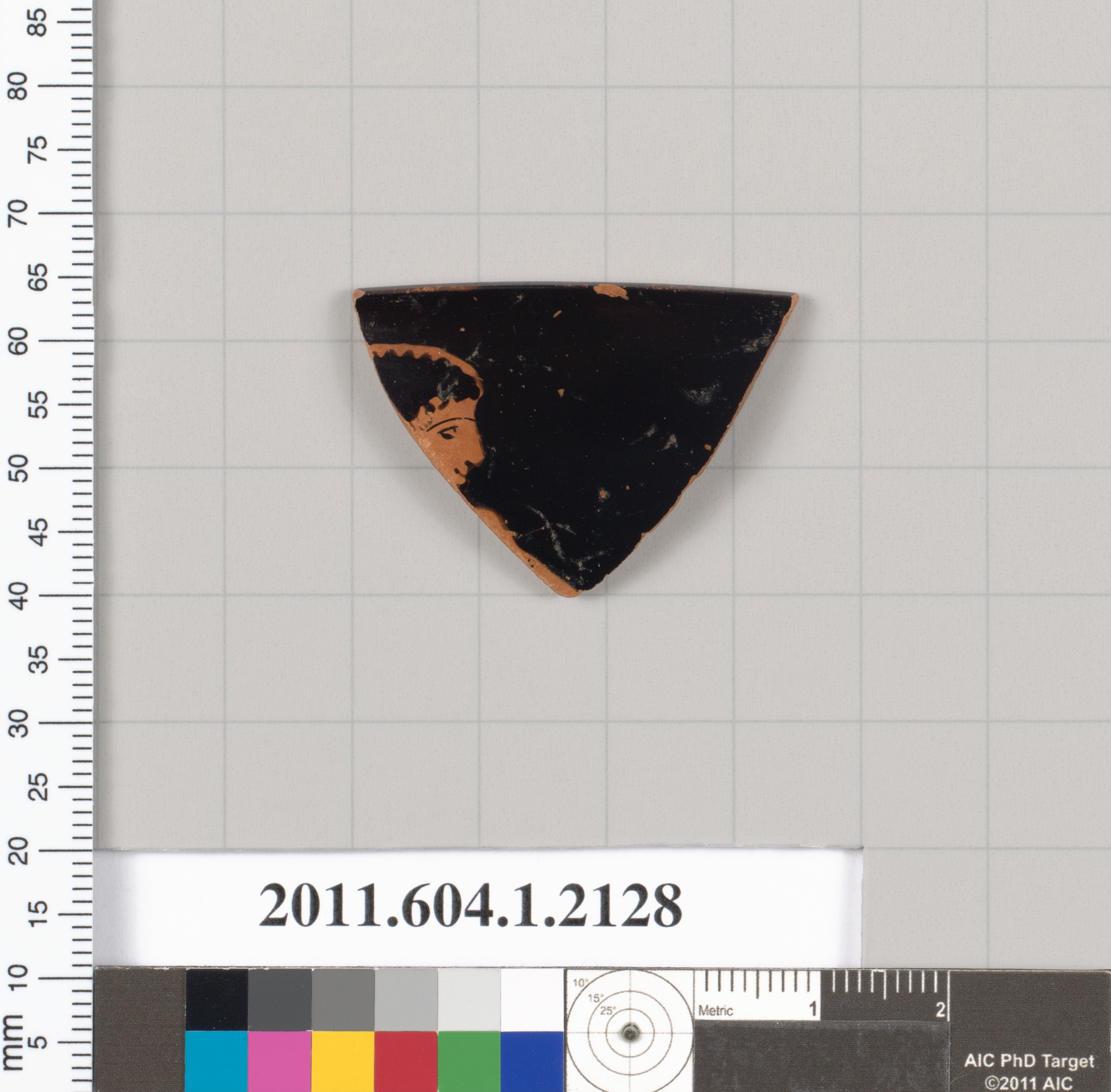
The Terracotta Kylix and the Architecture of Temporal Presence: A Heritage Analysis for Lauren Fashion’s 2026 Old Money Silhouette
The intersection of ancient material culture and contemporary luxury fashion is rarely a matter of direct imitation, but rather a profound dialogue about the philosophy of form, time, and permanence. The internal genetic code of Lauren Fashion Heritage Lab—articulated through the symbolic resonance of the *Udonge* temple plaque and the painted *Jar*—posits a central aesthetic thesis: that true beauty resides not in the anticipation of a future event, nor in the distant horizon of space, but in the deep, unmediated contemplation of the present object. This thesis finds a startlingly concrete analogue in the museum artifact under consideration: a terracotta rim fragment of an Attic kylix (drinking cup). This humble shard, a broken relic of a symposium, offers a rigorous, materialist instruction for the 2026 Old Money silhouette, demanding a shift from the ephemeral to the eternal, from the spectacle to the substance.
The Kylix Fragment as a Pedagogy of the Present
The kylix, in its original context, was an instrument of social ritual, a vessel for wine and conversation. Its shallow, wide bowl and twin handles facilitated a communal, flowing exchange. Yet what remains to us is not the whole vessel, but a fragment—a rim, a curve, a trace of the potter’s wheel. This fragment, like the *Udonge* plaque’s depiction of the flower “already open,” performs a radical act of temporal extraction. It severs the object from its original narrative of use, transport, and breakage, presenting instead a *static, irreducible present*. The viewer cannot “use” this fragment; they can only *be with* it. Its value lies not in its functional past, but in its material presence: the precise texture of the terracotta, the subtle variation in its fired hue, the faint ghost of a painted pattern now lost. This is the same logic as the temple plaque’s “carved moment”—the kylix fragment is a three-dimensional artifact that has been forcibly removed from the flow of time, demanding a contemplative stillness from the observer.
This pedagogy is directly translatable to the 2026 Old Money silhouette. The “Old Money” aesthetic, in its most sophisticated iteration, is not about ostentatious display but about the quiet authority of *enduring presence*. The kylix fragment teaches that the most powerful garment is not one that announces itself through novelty or trend, but one that feels *already complete*, as if it has always existed. For the 2026 collection, this translates into a silhouette defined by architectural weight and material integrity. We move away from the fluid, transient draping of fast fashion toward forms that are grounded, substantial, and almost sculptural. The terracotta’s earthy, unglazed surface—its refusal to be anything other than what it is—informs a palette of deep, non-reflective blacks, rich umbers, and muted ochres. These are not colors that “pop” under light; they are colors that *absorb* light, creating a sense of depth and interiority, much like the interior of the painted *Jar* in the Lab’s internal code.
From Vessel to Garment: The Logic of the “Contained Void”
The internal code’s analysis of the *Jar* painting—its focus on the “concealed interior” as the source of tension—finds a powerful echo in the kylix fragment. The fragment is not merely a piece of clay; it is a *boundary*. Its curved rim defines a space that is now missing: the interior of the cup, the space where wine once swirled, where conversation once echoed. This “absent interior” is not a lack; it is a generative void. The garment, in the 2026 Old Money silhouette, must function in the same way. It is not a second skin that reveals the body, but a vessel that contains and protects a sacred interior. The silhouette becomes a “shell” of quiet authority.
Concretely, this manifests in several key design principles for the 2026 collection. First, the shoulder line must be redefined. Drawing from the kylix’s broad, stable rim, we propose a structured, slightly extended shoulder that is neither aggressive nor padded, but rather *architectural*—a clear, unbroken line that frames the upper torso. This is not the power shoulder of the 1980s, which was about external assertion; it is a shoulder that speaks of internal composure. Second, the sleeve should be conceived as a hollow volume, a “contained void.” Think of a dolman or a kimono sleeve, cut with generous fabric that falls away from the arm, creating a space that is both present and absent. The fabric itself, perhaps a heavy, matte wool or a dense, unlined cashmere, must have a substantial “hand” that holds its shape, like fired clay. The garment’s interior—the lining, the seam finishes—must be as meticulously considered as the exterior, for it is the “unseen” that gives the garment its integrity, just as the kylix’s interior, now lost, was the true locus of its function.
The Terracotta Imperative: Material as Philosophy
The kylix fragment’s materiality—terracotta, “baked earth”—offers the final, most crucial lesson for the 2026 silhouette. Terracotta is humble, durable, and honest. It does not pretend to be marble or gold. Its beauty lies in its texture, its weight, its response to the hand of the potter. This is the “Heritage-Black” imperative: a rejection of synthetic sheen and ephemeral glitter in favor of a deep, almost monastic materiality. The 2026 Old Money silhouette must be built from fabrics that feel *ancient* and *permanent*. Think of a double-faced wool that is so dense it could stand alone, or a silk twill with a matte finish that mimics the patina of aged clay. The silhouette itself should be reduced to its essential elements: a coat that is a pure, unadorned volume; a trouser that is a clean, straight column; a dress that is a simple, enveloping tunic. Every seam, every button, every stitch must be a testament to the craft of making, not the art of display.
In conclusion, the Attic kylix fragment is not a decorative motif for the 2026 collection; it is a philosophical blueprint. It instructs us to design garments that are not about the promise of a future event or the memory of a past one, but about the *immediate, tangible presence* of the wearer. The 2026 Old Money silhouette, informed by this terracotta imperative, becomes a vessel for the present moment—a quiet, enduring, and deeply luxurious artifact of the self. The flower on the *Udonge* plaque is already open; the interior of the *Jar* is already full. The garment, like the kylix fragment, asks only that we stop, look, and *be*.
Heritage Lab Insight
Genetic Bridge: Archive node focusing on Heritage-Black craftsmanship.