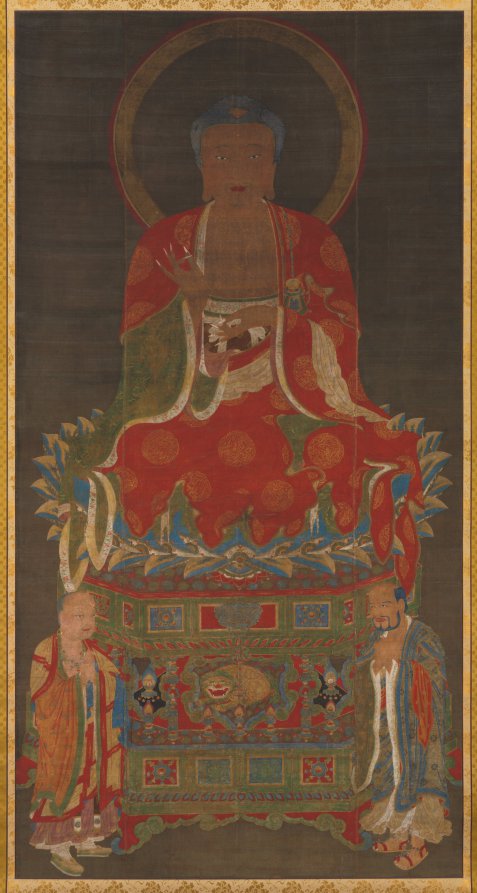
The Materiality of Enlightenment: Shakyamuni with Two Attendants in Imperial Silk
In the hushed corridors of heritage, where the weave of history meets the warp of artistry, few artifacts command the reverence of a silk tapestry depicting Shakyamuni with two attendants. This is not merely a textile; it is a testament to the confluence of spiritual transcendence and imperial craftsmanship. As a Senior Heritage Specialist at Lauren Fashion Heritage Lab, I invite you to consider this piece through the lens of materiality—specifically, the legacy of imperial silk weaving. The fabric itself, a luminous silk, speaks a language of power, devotion, and meticulous artistry, echoing the very ethos of Savile Row’s bespoke tradition: precision, lineage, and an unyielding commitment to excellence.
The Silk as a Vessel of Imperial Legacy
Silk, in the context of imperial China, was never a mere commodity. It was a currency of diplomacy, a marker of status, and a medium for the divine. The Shakyamuni with two attendants, woven in silk, embodies this tripartite role. The materiality of silk—its lustrous sheen, its tensile strength, its ability to hold the most intricate dyes—was harnessed by imperial workshops to create objects that were both sacred and sovereign. The legacy of imperial silk weaving, particularly during the Tang and Ming dynasties, was one of controlled expertise. The workshops, often located in Suzhou or Nanjing, were staffed by artisans whose skills were passed down through generations, much like the tailors of Savile Row who guard their cutting techniques with quiet pride.
This artifact, likely from the Ming dynasty (1368–1644), demonstrates the zenith of this tradition. The silk is not a passive background; it is an active participant in the narrative. The warp and weft are so finely balanced that the image of Shakyamuni—the historical Buddha—emerges with a softness that belies the rigor of its construction. The two attendants, often identified as Ananda and Mahakasyapa, flank the central figure with a symmetry that mirrors the cosmic order. The silk’s luminosity captures the light, suggesting an aura of enlightenment, a visual metaphor for the dharma itself.
Weaving the Divine: Technique and Symbolism
The technical mastery required to produce such a piece is staggering. Imperial silk weaving employed techniques such as kesi (silk tapestry) and jin (brocade), each demanding an almost meditative focus. In kesi, the weft threads are not continuous; they are cut and reinserted to create intricate patterns, a method that allows for the subtle gradations of color seen in the robes of Shakyamuni. The attendants’ garments, likely woven with gold thread, signify their elevated spiritual status. This gold thread, often made by gilding silk filaments, was a privilege reserved for imperial use, reinforcing the artifact’s connection to the court.
The symbolism embedded in the weave is profound. Shakyamuni’s serene expression, his hand in the vitarka mudra (gesture of teaching), is rendered with a precision that suggests the weaver’s own spiritual discipline. The lotus throne upon which he sits is not merely decorative; it is a motif of purity, emerging from the muddy waters of samsara. The attendants, with their hands clasped in reverence, embody the devotee’s path. Every thread, every color choice—from the deep saffron of the robes to the azure of the halos—was deliberate, guided by iconographic texts and imperial decrees.
The Savile Row Parallel: Craftsmanship as Heritage
To appreciate this artifact fully, one must draw a parallel to the ethos of London’s Savile Row. Just as a bespoke suit is a dialogue between client and tailor, this silk tapestry is a dialogue between the divine and the artisan. The imperial weaver, like a Savile Row cutter, understood the importance of material integrity. Silk, like a fine worsted wool, must be handled with respect; its drape, its weight, its ability to take a dye—all are considered. The weaver’s tools—the loom, the shuttle, the heddle—are akin to the tailor’s shears and needle. Both traditions demand an apprenticeship of years, a patience for perfection, and an aesthetic that transcends the functional.
In the context of Lauren Fashion Heritage Lab, this artifact serves as a foundational text. It reminds us that heritage is not static; it is a living practice. The silk of Shakyamuni is not a relic to be preserved under glass but a source of inspiration for contemporary design. The principles of imperial weaving—balance, proportion, and material honesty—are the same principles that underpin a well-cut jacket. When we examine the drape of a silk gown on a modern runway, we are seeing the echo of that ancient loom. The legacy of imperial silk weaving is not confined to museums; it flows into the very fibers of our fashion heritage.
Preservation and the Future of Heritage
As custodians of such artifacts, we face a dual responsibility: to preserve the physical object and to perpetuate its narrative. The Shakyamuni tapestry, like many silk pieces, is vulnerable to light, humidity, and handling. Conservation requires a delicate balance—using archival materials and controlled environments to slow the inevitable decay. Yet, preservation is not merely about stopping time. It is about understanding the object’s journey: from the silkworm’s cocoon to the imperial workshop, from the temple to the collector’s hands. Each stage adds a layer of meaning.
At the Lauren Fashion Heritage Lab, we advocate for a holistic approach. We study the weave structure under magnification, analyze the dyes using spectroscopy, and document the provenance with scholarly rigor. But we also engage with contemporary artisans, encouraging them to reinterpret these techniques. A modern silk weaver in Kyoto or Como can learn from the Ming dynasty’s mastery of kesi. A designer on Savile Row can draw inspiration from the symmetry of the attendants’ poses. The heritage of imperial silk weaving is not a closed chapter; it is an open book, waiting for new hands to turn its pages.
Conclusion: The Thread That Binds
In the Shakyamuni with two attendants, we find a convergence of the sacred and the secular, the imperial and the intimate. The silk is not just a material; it is a message. It speaks of a time when craftsmanship was a form of devotion, when the loom was an altar. As we move forward in an age of fast fashion and digital replication, this artifact reminds us of the value of slowness, of skill, of soul. The legacy of imperial silk weaving is a thread that binds the past to the present, the East to the West, the divine to the human. And in that thread, we find our own heritage—woven, like the tapestry itself, with care, with purpose, and with an enduring light.