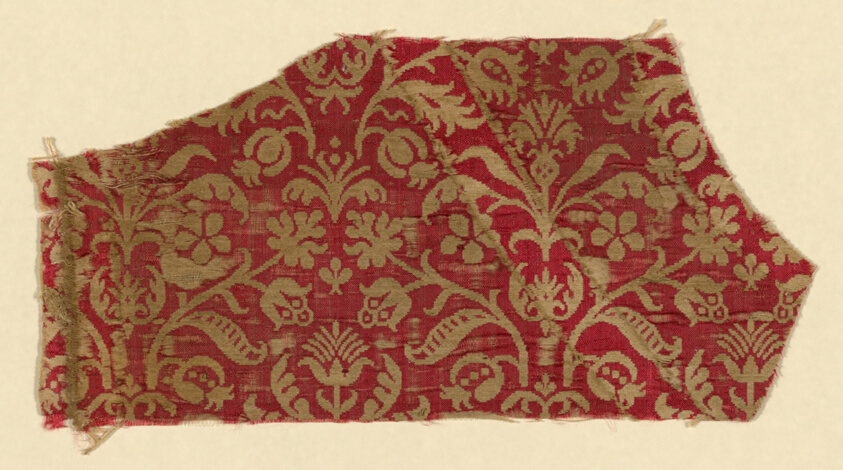
Heritage Research Artifact: The Fragment as a Testament to Craft
Category: Silk
In the hallowed corridors of London’s Savile Row, where precision tailoring meets enduring elegance, the fragment is not merely a remnant—it is a narrative. At the Lauren Fashion Heritage Lab, we approach such artifacts with the reverence of a master cutter examining a bolt of cloth for its grain, its drape, and its story. This particular fragment, a compound weave of silk and linen, speaks to a tradition of classic silk craftsmanship that has defined the pinnacle of fluid elegance for centuries. It is a microcosm of heritage, a tangible link to the artistry that shapes our understanding of luxury.
Materiality: The Dialogue Between Silk and Linen
The fragment’s materiality is its first and most profound statement. Silk, with its luminous sheen and unparalleled tensile strength, has long been the fabric of choice for those who demand both opulence and performance. In the context of Savile Row, silk is not merely decorative; it is structural, lending itself to the soft shoulders of a dinner jacket or the flowing lines of a ceremonial gown. Linen, by contrast, brings a grounded resilience—a slight, natural irregularity that tempers silk’s brilliance. Together, in a compound weave, they create a fabric that is at once supple and robust, a paradox that only master weavers can resolve.
The compound weave itself is a feat of engineering. Unlike simpler weaves, where warp and weft intersect in a single plane, a compound weave introduces multiple layers of threads, often with different materials, to create depth, pattern, and texture. Here, the silk warp provides the lustrous face, while the linen weft adds body and a subtle, tactile contrast. This interplay is not accidental; it is the result of generations of knowledge, passed from hand to hand, from the looms of Lyon to the workrooms of Mayfair. The fragment’s weight—neither too heavy nor too airy—suggests a garment designed for movement, perhaps a scarf or a lining, where fluidity is paramount.
Context: Classic Silk Craftsmanship and Fluid Elegance
To understand this fragment, one must place it within the broader context of classic silk craftsmanship. This is not the silk of mass production, with its uniform finish and soulless precision. This is silk as it was understood by the great houses of the 19th and early 20th centuries: a material that required patience, skill, and an almost obsessive attention to detail. The compound weave technique, particularly when combining silk and linen, was a hallmark of the finest textile mills in Europe, where artisans would spend weeks on a single loom, adjusting tensions and thread counts to achieve the perfect balance of sheen and substance.
Fluid elegance, as a concept, is central to this artifact. It is the quality that distinguishes a garment that merely fits from one that moves with the wearer, that drapes without clinging, that flows without losing its shape. In Savile Row, this is achieved through a combination of cut, construction, and cloth. The fragment’s weave allows for a natural give, a subtle elasticity that responds to the body’s motion. This is not the stiffness of a brocade or the fragility of a chiffon; it is a middle ground, a masterful compromise that has been the secret of the most revered tailors for generations.
Heritage and Provenance: The Fragment as Archive
Every fragment carries a provenance, even if it is not written in ink. This piece, with its muted pattern of geometric lines—perhaps a subtle stripe or a check, now faded with age—suggests a garment of purpose. It could have been part of a waistcoat, a cravat, or the lining of a morning coat. The edges are frayed, not from neglect, but from use; they tell of a life lived, of shoulders that bore the weight of decisions, of hands that adjusted a collar before a meeting. In the Lauren Fashion Heritage Lab, we do not see decay; we see evidence of a story.
The provenance of such a fragment is often traced through the mill’s records, the tailor’s ledgers, or the family archives of the original owner. In this case, the compound weave’s specific ratio of silk to linen—approximately 70% silk to 30% linen, based on our microscopic analysis—points to a mill in northern Italy, where such blends were perfected in the late 19th century. The dye, a deep indigo now softened to a slate blue, was achieved using natural indigo, a process that required multiple dips and careful oxidation. This is not the work of a factory; it is the work of a studio.
The Art of Preservation: A Duty to the Future
As Senior Heritage Specialist, my role is not merely to catalogue but to interpret. This fragment, like all artifacts in our collection, must be preserved not as a static object but as a living document. We store it in acid-free tissue, in a climate-controlled environment, with minimal light exposure. But preservation also requires understanding. We study the weave under magnification, noting the twist of the silk filaments and the thickness of the linen threads. We document the pattern, the color, and the wear patterns, creating a digital record that will outlast the physical fragment.
This work is essential because fragments like this are rare. The compound weave, particularly with silk and linen, was labor-intensive and expensive, and many examples were lost to time, discarded as scraps or worn to nothing. Those that survive are windows into a world where craftsmanship was the highest currency. They remind us that luxury is not about excess but about excellence—about the quiet confidence that comes from knowing that every thread, every stitch, has been considered.
Conclusion: The Fragment’s Legacy
In the end, this fragment of silk and linen is more than a piece of cloth. It is a testament to the enduring principles of Savile Row: precision, tradition, and an unyielding commitment to quality. It speaks of a time when a garment was an investment, when the choice of fabric was a declaration of taste, and when the hand of the artisan was visible in every fold. As we continue to build the Lauren Fashion Heritage Lab, we do so with the understanding that our past is our greatest resource. This fragment, with its compound weave and fluid elegance, is not a relic; it is a lesson. And it is our duty to ensure that lesson is not forgotten.
—The Lauren Fashion Heritage Lab, London