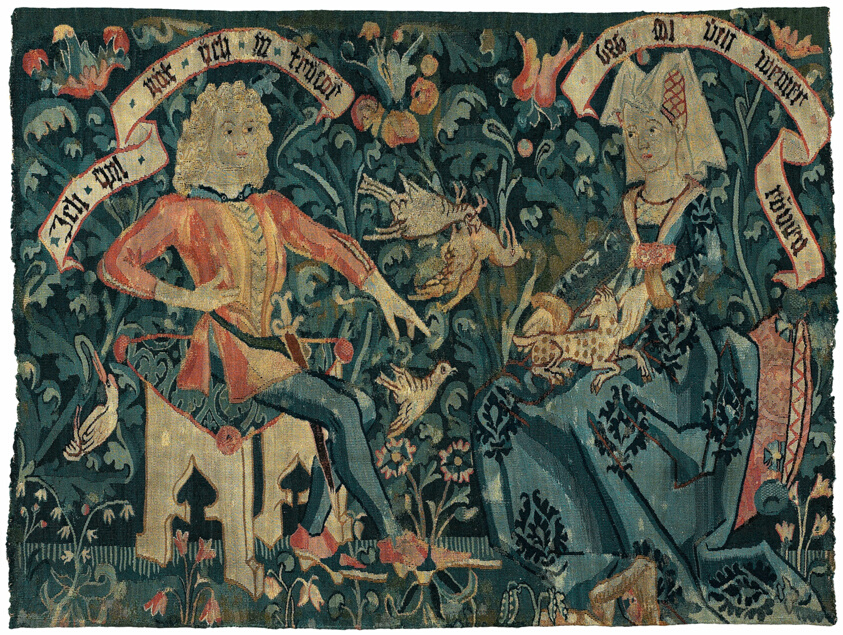
An Exegesis on Material Confluence: The Lovers
To apprehend the artifact designated The Lovers is to engage in a discourse not merely of textile, but of philosophical contradiction resolved through supreme technical command. It represents a deliberate and audacious confluence of three distinct material lineages—hemp, wool, and silk—each bearing its own historical weight and symbolic vernacular. The synthesis achieved here, through the exacting discipline of slit and double interlocking tapestry weave, transcends simple amalgamation. It is, rather, a sartorial treatise on the nature of union itself: the robust with the delicate, the rustic with the regal, the enduring with the ephemeral.
The Sovereign Fibre: Silk and Its Imperative of Fluidity
Any analysis must begin, as the artifact itself does, with silk. It is the foundational lexicon, the sine qua non of this particular narrative. Silk, in the classic canon, is synonymous with a specific, almost liquid, elegance. It is not simply a fabric; it is a behaviour. It possesses an innate propensity for drape, a luminous depth of colour, and a tactile sophistication that has dictated the protocols of luxury for millennia. In The Lovers, silk establishes the ground of being. It provides the essential warp, the longitudinal integrity, upon which the entire narrative is built. Its role is that of the silent, impeccable host—the Savile Row suit’s unseen canvas—offering a surface of inherent, fluid grace that accepts and elevates the more declarative fibres woven into it.
A Dialogue of Contrasts: Wool and Hemp as Counterpoint
Upon this silk foundation, the dialogue commences with the introduction of wool and hemp. Wool, the patrimony of the cooler climes, brings a narrative of structure, resilience, and tactile warmth. It is the fibre of the tweed jacket, the military greatcoat, the enduring hearth. Hemp, conversely, speaks of an earthy, utilitarian strength. It is the fibre of labour, of sails that conquered oceans, of a tensile, unyielding character. Individually, they occupy seemingly oppositional spheres to silk’s rarefied elegance. Their inclusion is neither accidental nor decorative.
In The Lovers, wool and hemp are deployed as the active weft, the transversal elements that articulate the pattern, the story, the very image of the lovers themselves. They are the bold, declarative strokes upon the silk canvas. This is where the conception reveals its genius. The design does not seek to soften these robust fibres, to make them mimic silk. On the contrary, it celebrates their inherent textural honesty—the blunt, nubby character of hemp, the fibrous, clinging presence of wool. They are present in their full, unapologetic materiality, creating a raised, painterly surface that catches the light and shadow with a vitality pure silk alone could never achieve.
The Arbiter of Union: The Tapestry Weave Discipline
The resolution of these material contradictions—the marriage, if you will—is accomplished through the austere, demanding discipline of the tapestry weave, specifically in its slit and double interlocking manifestations. This is the technical heart of the artifact, the mechanism of its philosophy.
Tapestry weave, at its essence, is a technique of discrete colour fields. Unlike a standard weave where the weft travels edge-to-edge, in tapestry, each colour area is built up independently with its own weft thread. This creates the potential for severe vertical separations, or slits, between colour blocks. The slit weave technique embraces this separation, using it to create sharp, graphic delineations—a crisp shadow between two forms, the stark edge of a silhouette. It speaks of clarity, of definition, of the respectful space maintained between distinct entities.
Conversely, the double interlocking technique is one of absolute fusion. Here, the weft threads of adjacent colour areas are looped around each other at the boundary, locking them together inseparably. This creates a seamless, uninterrupted surface, a blurring of edges where one fibre merges into another. It is the technical expression of inextricable bond.
In The Lovers, the master artisan has employed these two techniques in concert. One may observe areas where the hemp and wool define a form against the silk ground with the precise, sharp edge of a slit—maintaining their individual character. In the very next passage, these same fibres might be interlocked, their colours and textures blending to create a third, hybrid hue and tactility, a literal embodiment of union. This interplay is the artifact’s profound metaphor: a relationship articulated through both respectful distinction and profound connection.
Conclusion: A Legacy Reconfigured
The resultant artifact, therefore, stands as a peerless research piece within the Lauren Fashion Heritage Lab. It is a testament to the principle that true heritage is not a museum piece, but a living, argumentative dialogue. It takes the unimpeachable legacy of classic silk craftsmanship—its fluid elegance—and challenges it, fortifies it, and recontextualises it through deliberate, meaningful confrontation with other, sturdier lineages.
The Lovers is not a gentle romance. It is a robust, textured, and intellectually rigorous union. It possesses the fluidity of silk in its foundational drape, but also the architectural presence of a well-tailored garment built to last. It speaks in the refined, quiet tone of Savile Row’s lining, but carries the bold, narrative pattern of a bespoke tweed. In its very threads, it argues that the most elegant and enduring unions are those which acknowledge difference, celebrate contrast, and are bound together by the most skilled and intentional of hands.