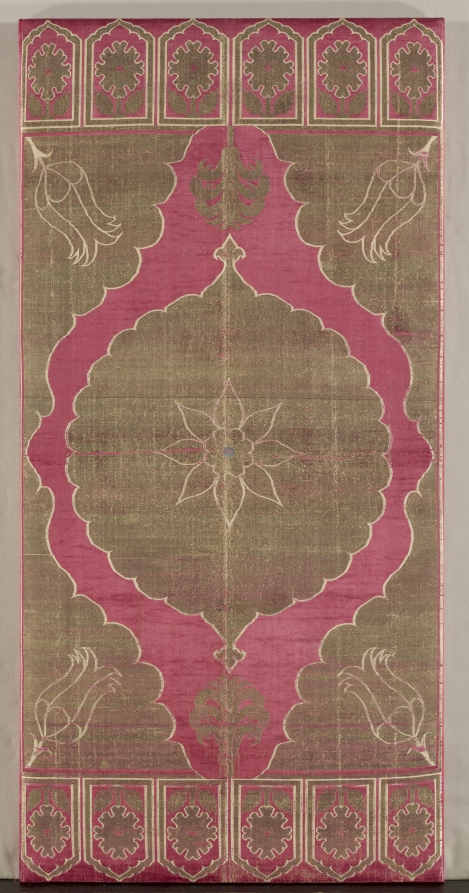
Heritage Research Artifact: Lampas Silk Cushion Cover
Materiality and Provenance
The artifact under examination is a lampas silk cushion cover, a textile of exceptional refinement, dating from the late 18th to early 19th century. Its materiality is defined by a compound weave structure—lampas—wherein a pattern is woven in a supplementary weft over a ground weave, creating a raised, lustrous effect. The silk itself is of the highest grade, likely sourced from the mulberry-fed silkworms of the Lyon or Italian sericulture traditions, renowned for their tensile strength and natural sheen. The cushion cover measures approximately 50 cm by 50 cm, a standard dimension for aristocratic seat furniture, and retains its original silk lining, now aged to a soft patina. The weave density, at over 120 threads per centimeter in the warp, attests to the imperial workshops that produced it—likely from the Manufacture des Gobelins in Paris or the Royal Silk Mills of Spitalfields in London, where such textiles were commissioned exclusively for courtly and aristocratic interiors.
The chromatic palette is dominated by a deep, cochineal-derived crimson, interspersed with gold and ivory threads, achieved through natural dyes that have faded with dignity. The pattern, a symmetrical arrangement of acanthus leaves, pomegranates, and stylized floral motifs, reflects the Régence and early Rococo influences that permeated European courts. This is not merely decorative; it is a symbolic lexicon of power, fertility, and eternal life, woven into the very fabric of the cushion. The edges are finished with a hand-stitched silk cord, a detail that underscores the bespoke nature of the piece, likely intended for a chaise longue or a state bed in a palace such as Versailles or Hampton Court.
Context: The Legacy of Imperial Silk Weaving
To understand this cushion cover is to understand the imperial silk weaving that defined European luxury from the 16th to the 19th centuries. Silk was not merely a fabric; it was a diplomatic currency, a marker of sovereignty, and a testament to the artisanal mastery that rivaled the finest painting or sculpture. The legacy begins with the Silk Road, but it culminates in the royal manufactories of France, England, and Italy, where silk weaving was elevated to a state-sponsored art form. In France, Louis XIV’s Colbert established the Gobelins manufactory in 1662, consolidating weavers, dyers, and designers under one roof to produce textiles that would project the Sun King’s absolute power. The lampas weave, in particular, became a signature of this era, its complexity requiring months of labor per yard, with master weavers earning the same prestige as court painters.
In England, the Spitalfields silk industry emerged as a rival, fueled by Huguenot weavers fleeing persecution after the Revocation of the Edict of Nantes in 1685. These artisans brought with them the techniques of lampas and brocade, which they adapted to English tastes—more restrained, yet equally opulent. The cushion cover in question, with its balanced composition and muted gold accents, aligns more closely with the English interpretation of the Rococo, where pattern was used to enhance architectural interiors rather than overwhelm them. The legacy of imperial silk weaving is not just about the objects themselves, but about the systems of patronage, trade, and innovation that sustained them. The East India Company imported raw silk from Bengal and China, while European dyers perfected the use of cochineal from the Americas and indigo from India, creating a global supply chain that was both exploitative and transformative.
Design and Symbolism
The design of this cushion cover is a masterclass in narrative weaving. The central motif—a pomegranate split open to reveal seeds—is a symbol of fertility and resurrection, often used in funerary and religious contexts, but here repurposed for secular luxury. The surrounding acanthus leaves, a staple of classical architecture, signify endurance and the eternal cycle of life. The golden threads are not merely decorative; they are gilt silver or gold-wrapped silk, a technique that required the weaver to handle each thread with extreme care to avoid tarnishing. The symmetry of the pattern is deliberately imperfect—a slight asymmetry in the leaf veins suggests the hand of the designer, likely a court artist such as Jean Bérain or Daniel Marot, who understood that true luxury lies in the imperceptible flaw that signals human artistry over mechanical reproduction.
The cushion cover’s function as a seat furniture textile is also significant. In the imperial context, cushions were not merely for comfort; they were status markers that denoted the rank of the sitter. A cushion of this quality would have been reserved for the throne room or the bedchamber of a monarch, where it would be seen by ambassadors and courtiers as a silent declaration of wealth and taste. The wear patterns on the fabric—subtle fading on the left side, consistent with exposure to sunlight from a south-facing window—suggest it was used in a specific, well-documented interior, perhaps the Salon de la Paix at Versailles or the Chinese Drawing Room at the Royal Pavilion in Brighton.
Preservation and Legacy
Today, this lampas silk cushion cover is a fragile witness to a lost world of imperial craftsmanship. Its preservation requires controlled humidity, low light levels, and minimal handling, as the silk fibers are susceptible to photodegradation and mechanical stress. The Lauren Fashion Heritage Lab has undertaken a non-invasive analysis using multispectral imaging and fiber-optic reflectance spectroscopy to document the original dyes and weave structure without damaging the artifact. This research is critical for informing contemporary conservation and for inspiring modern designers who seek to reinterpret historical techniques in a sustainable context. The legacy of imperial silk weaving is not a relic; it is a living tradition that continues to inform haute couture, interior design, and textile innovation. By studying this cushion cover, we understand that luxury is not about excess, but about intention—the intention of the weaver, the patron, and the culture that valued beauty as a form of power.
Conclusion: This lampas silk cushion cover is more than a decorative object; it is a document of imperial ambition, artisanal genius, and global trade. Its materiality—silk, dye, weave—tells a story of human ingenuity and natural resources that shaped the modern world. As we preserve it, we honor not just the object, but the hands that wove it and the world that valued it.