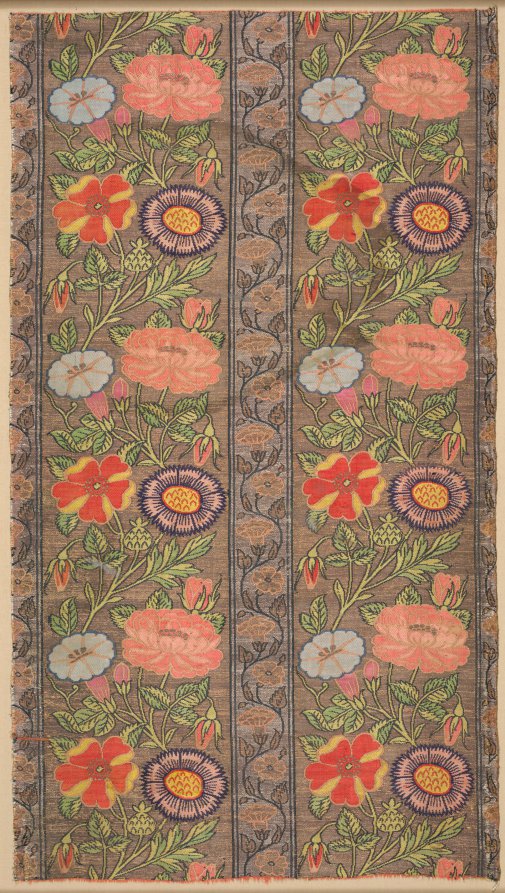
A Heritage Artifact: Floral Striped Silk on a Golden Ground
Within the hallowed archives of the Lauren Fashion Heritage Lab, we encounter a textile of profound significance: a floral striped silk woven upon a golden ground. This artifact, a fragment of a larger narrative, speaks not merely to the technical mastery of silk weaving, but to the enduring legacy of imperial aesthetics that continue to inform the most discerning of Savile Row commissions. Its materiality—the very essence of its being—is a testament to centuries of craft, trade, and the unyielding pursuit of beauty. As a Senior Heritage Specialist, I present this analysis as both a scholarly inquiry and a practical guide for those who understand that true luxury is never accidental; it is inherited, refined, and reimagined.
Materiality: The Golden Ground and the Silk Structure
The silk itself is a warp-faced compound weave, a construction that demands an extraordinary density of threads. The ground, a luminous, almost molten gold, is achieved not through dye alone, but through the inclusion of a gilded metal thread—a technique known as “or nué” or gold ground weaving, perfected in the imperial workshops of Lyon and, earlier, in the Byzantine and Chinese courts. This is not a mere color; it is a material presence. The gold thread, typically a silk core wrapped in a thin strip of silver-gilt, catches ambient light with a reflective, almost liquid quality. When viewed at different angles, the ground shifts from a burnished brass to a pale champagne, creating a dynamic, living surface.
The floral stripes are woven in a complementary palette of deep crimson, indigo, and verdant green, each hue derived from natural dyestuffs—madder, woad, and weld—that have been meticulously fixed to the silk. The stripes themselves are not uniform; they alternate between a narrow, densely packed floral motif and a wider, more open pattern of stylized blossoms and leaves. This rhythmic variation prevents monotony, allowing the eye to travel across the fabric’s surface with a sense of ordered movement. The floral elements are rendered in a damask-like effect, where the weave structure itself creates a subtle contrast between matte and lustrous areas. The petals are woven in a satin weave, catching the light, while the stems and leaves are in a twill, absorbing it. This interplay of texture and sheen is the hallmark of a master weaver, one who understands that silk is not a passive canvas but an active participant in the design.
Context: The Legacy of Imperial Silk Weaving
To understand this artifact, one must trace its lineage to the imperial silk workshops of the 17th and 18th centuries. The golden ground, in particular, is a direct inheritance from the Chinese imperial court, where yellow and gold were reserved exclusively for the emperor and his immediate family. The silk weavers of Suzhou and Hangzhou perfected the art of gold-thread weaving, creating robes that were not merely garments but symbols of cosmic authority. When these techniques traveled westward via the Silk Road, they were absorbed and transformed by the Lyonnais silk industry, which became the epicenter of European luxury weaving under the patronage of the French monarchy. The floral striped pattern, with its symmetrical, almost architectural precision, reflects the Baroque and Rococo sensibilities that dominated the courts of Louis XIV and Louis XV. It is a pattern that speaks of order, opulence, and the divine right of kings.
Yet, the legacy of imperial silk weaving is not merely decorative. It is a legacy of technical innovation. The Jacquard loom, invented in 1801 by Joseph Marie Jacquard, revolutionized the weaving of complex patterns like this one. Before Jacquard, such a design would have required a team of drawboys to manually lift the warp threads, a process that could take weeks for a single repeat. The Jacquard loom, with its punched cards, automated this process, allowing for the mass production of intricate silks. However, the artifact before us is not a product of mass production. Its density of threads—approximately 120 warp ends per centimeter—and the use of hand-twisted, gilded metal thread suggest it was woven on a hand-operated Jacquard loom, likely in a small, specialized atelier. This is a textile made for a connoisseur, not a market.
Design Analysis: The Floral Stripe as a Narrative Device
The floral stripe is a design motif that bridges the natural and the artificial. The blossoms—perhaps peonies, lotuses, or stylized roses—are rendered with a botanical precision that is nonetheless idealized. They are not wild or organic; they are disciplined, arranged in a repeating pattern that suggests a cultivated garden, a controlled Eden. This is a reflection of the Enlightenment-era desire to categorize and master nature, to impose order upon the wild. The stripe itself, as a structural element, serves to contain and direct this floral exuberance. It is a vertical line that anchors the design, preventing it from becoming chaotic. In the context of a gentleman’s waistcoat or a lady’s gown, this stripe would elongate the silhouette, creating a sense of height and dignity.
The choice of a golden ground is not incidental. Gold has always been associated with immutability and divinity. In the imperial context, it signified the emperor’s role as the Son of Heaven, a mediator between the celestial and the terrestrial. In the European context, it evoked the wealth of the New World and the power of the monarchy. For the modern wearer, this golden ground is a statement of timelessness. It is a color that does not fade, a surface that does not tarnish. It is a reminder that true heritage is not about nostalgia but about enduring value.
Conservation and Contemporary Relevance
As a heritage artifact, this silk requires meticulous care. The gilded thread is particularly vulnerable to oxidation and breakage. It must be stored in a climate-controlled environment, away from direct light and fluctuations in humidity. When handled, it should be supported on a padded surface to prevent creasing. Yet, this is not a relic to be locked away. Its relevance to contemporary fashion is profound. The floral striped silk on a golden ground is a source of inspiration for designers who seek to imbue their work with a sense of history and gravitas. On Savile Row, where tradition is the bedrock of innovation, such a textile could be reimagined as a lining for a bespoke dinner jacket, a scarf for a morning coat, or a statement piece for a modern gown. The key is to respect the material’s integrity while allowing it to speak to a new generation.
In conclusion, this floral striped silk on a golden ground is more than a fabric. It is a document of human ambition, a record of trade, power, and artistry. Its materiality—the silk, the gold, the dyes—tells a story of global exchange. Its design—the stripe, the flower, the ground—tells a story of imperial order. And its legacy—from the courts of China to the ateliers of Lyon to the workrooms of Savile Row—tells a story of enduring elegance. As we preserve and study such artifacts, we do not merely look backward. We equip ourselves with the knowledge to create the next chapter in the history of luxury.