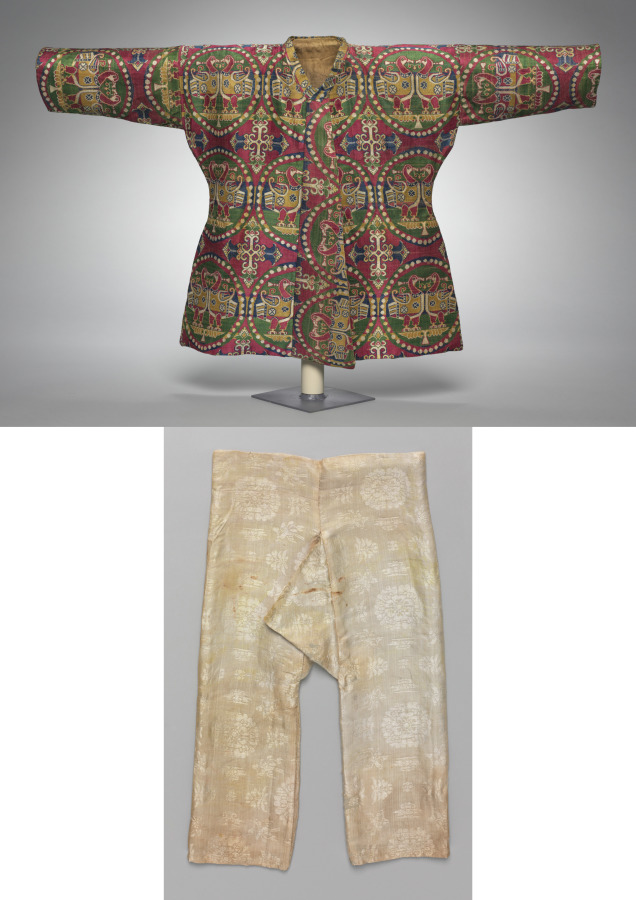
An Examination of Juvenile Silks: Imperial Legacy in Miniature
The study of sartorial heritage, much like the appreciation of a fine bespoke garment, demands a consideration of proportion, of line, and of the profound narrative woven into the very fibres. To encounter a child’s ensemble—specifically, a coat and trousers fashioned from silk of the most exacting quality, adorned with a motif of ducks encircled by pearl medallions—is to be presented with an object of considerable dialectical tension. Here, in a form intended for the most youthful and informal of human states, resides the apex of imperial textile technology and symbolic communication. It is a confluence of the domestic and the dynastic, rendered in a material that for centuries served as a global currency of power.
The Substrate of Sovereignty: Imperial Silk Weaving
One must first apprehend the foundation: the silk itself. This is no mere fabric, but the product of a complex, state-sanctioned industrial apparatus perfected in the great weaving centres of imperial China. The legacy referenced is one of monumental endeavour, encompassing the meticulous cultivation of the silkworm, the delicate reeling of filaments of astonishing length and strength, and the operation of vast, sophisticated looms—often draw-looms requiring multiple highly skilled operators. The resultant cloth possessed a density, a luminosity, and a tactile perfection that defined luxury across continents. To deploy such a resource for a child’s garment was an act of profound statement. It communicated not merely wealth, but a lineage steeped in the access to and control of this most coveted commodity. The silk is the silent, gleaming testament to a place within a hierarchy that extended from the imperial workshops to the nursery.
Motif and Meaning: Aviary Heraldry in Pearl-Bound Courts
The decorative scheme elevates the garment from a simple exercise in luxury to a nuanced text of cultural codes. The motif of ducks—most likely mandarin ducks—encased within medallions bordered by pearls is rich with intentionality. In the iconographic language of the East, mandarin ducks are a paramount symbol of conjugal fidelity and harmonious partnership, a pair forever bonded. Their application upon a child’s coat is far from incidental; it is a talismanic expression of hope for future marital bliss and the continuation of the family line. It speaks to the parents’ aspirations, embedding social and familial expectations upon the wearer from the earliest age.
The pearl-bordered medallion that frames each avian subject is equally significant. The pearl, in many traditions, represents purity, wisdom, and spiritual transformation. To encircle a symbol of domestic harmony with such a border is to sanctify the ideal, to frame it within an aura of perfection and value. Structurally, the medallion form itself is a borrowing from textile and decorative arts across Eurasia, a format that isolates and highlights the central motif, granting it a ceremonial focus. This is heraldry of the most intimate sort, a coat of arms for the cradle, asserting a family’s cultural literacy and their participation in a broader visual language of status and auspiciousness.
Juvenile Scale, Imperial Grandeur: The Paradox of Proportion
Herein lies the most compelling aspect of the artifact: the stark contrast between its function and its execution. A child’s garment is, by its nature, a transient object. It is subject to rapid growth, to the rigours of play, and to inevitable soiling. To craft such an ephemeral article from imperishable materials and with consummate artistry creates a powerful dissonance. The investment of hundreds of hours of specialised labour into an item with such a limited practical lifespan is a breathtaking demonstration of surplus. It declares that for this child, for this family, considerations of mere utility are entirely subordinate to those of display, legacy, and symbolic protection.
The cut, while simple in its juvenile lines, would have required a tailor’s precise hand to ensure the motifs were placed with propriety—centred, balanced, and respected by the garment’s seams. The trousers, a companion piece, would continue the theme, suggesting an ensemble of thorough coherence. This is not dressing; this is armouring the next generation in the finest cultural and material patrimony available.
Conclusion: A Legacy Woven in Double Helix
To conclude, this child’s silk coat and trousers represent a singular point of intersection in the grand narrative of textile heritage. They are a distillation of imperial ambition and technical mastery, filtered through the intimate lens of familial hope and social positioning. The silk whispers of trade routes, imperial decrees, and the hum of the loom. The ducks and pearls speak of age-old wishes for happiness and continuity. Together, wrapped around the form of a child, they embody the very essence of heritage: the transmission of the most valued materials and symbols from one generation to the next, ensuring that legacy is not merely inherited, but worn, and in being worn, understood as a mantle of identity. It is a quiet, exquisite masterpiece of applied art, proving unequivocally that the most profound statements of power and lineage are often made in a whisper, and in the smallest of sizes.