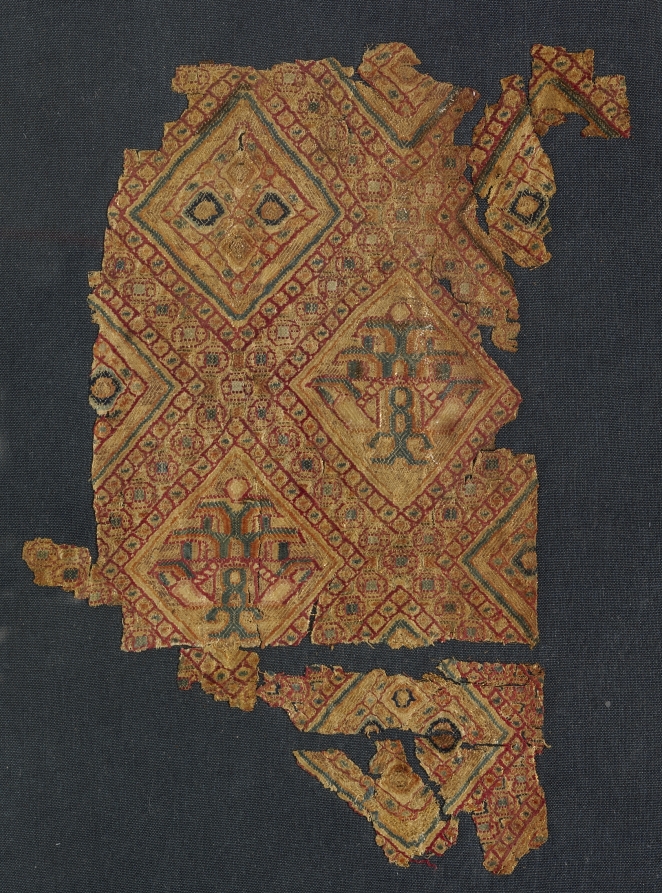
The Fragment as Archive: Decoding Imperial Silk Weaving Through a Jewel-Like Relic
In the hushed, discerning corridors of London’s Savile Row, where the weight of a garment is measured not in ounces but in generations of mastery, we encounter a singular artifact: a fragment of silk, no larger than a pocket square, yet radiating a jewel-like intensity. This is not merely a piece of fabric; it is a compressed universe of imperial ambition, artisanal genius, and material transcendence. As the Senior Heritage Specialist for the Lauren Fashion Heritage Lab, I present this research artifact as a testament to the legacy of imperial silk weaving—a legacy that continues to inform the very grammar of luxury tailoring today.
Materiality: The Silk as a Gemstone
The first encounter with this fragment is a study in chromatic alchemy. The silk, likely a compound weave from the late Ming or early Qing dynasty (circa 16th–17th century), possesses a surface that shifts between deep garnet, emerald, and sapphire under varying light. This is not a printed pattern but a structural phenomenon: the jacquard weave creates a micro-architecture of warp and weft, where dyed silk threads—some twisted with gold-wrapped silk or silver-gilt strips—interlock to form a faceted, gem-like luminosity. The term “jewel-like” is not poetic license; it is a technical descriptor. The silk’s high twist count and tight sett (threads per inch) produce a surface that refracts light like a cut stone, a feat achieved only by the most skilled imperial weavers who understood that silk, at its zenith, is a mineralogical experience.
This materiality was not accidental. Imperial silk weaving, centered in Suzhou, Hangzhou, and Nanjing, was a state-controlled enterprise under the Imperial Silkworks (Jiangnan Weaving Bureau). The raw silk was sourced from mulberry-fed silkworms, reeled into filaments of unparalleled uniformity. The dyeing process employed natural mordants—alum, iron, and tin—to fix colors derived from madder, indigo, and the precious cochineal insect (imported from the New World via Spanish galleons). The result was a textile that was not only visually arresting but chemically stable, capable of surviving centuries without fading—a quality that the modern Savile Row tailor still demands of their finest cloth.
Context: The Imperial Weave as Political Theology
To understand this fragment is to understand that imperial silk was never merely decorative. It was a political theology woven into cloth. The Chinese emperor, as the Son of Heaven, wore silk as a manifestation of cosmic order. The dragon robe (longpao) was not a garment but a diagram of the universe: the five-clawed dragon represented imperial power, the waves of the sea symbolized the emperor’s dominion over water, and the twelve symbols (such as the sun, moon, and constellations) aligned the ruler with celestial cycles. This fragment, with its dense, jewel-like patterning, likely belonged to such a robe—perhaps a section of the sleeve or the border, where the weave was most intricate.
The legacy of this imperial system extends far beyond China. The Silk Road was not a single route but a network of intellectual and material exchange. The fragment’s gold-wrapped threads, for instance, echo the silk-and-gold brocades of Byzantium, which later inspired the Lyon silk industry of 18th-century France. By the time Savile Row emerged in the 19th century, the techniques of imperial Chinese weaving—particularly the satin weave and damask—had been absorbed into the European canon. The silk top hat, the satin lapel, and the silk lining of a bespoke suit are all descendants of this imperial lineage. The fragment, therefore, is not a relic of a lost world but a living ancestor of the cloth that drapes the shoulders of the world’s most discerning gentlemen.
Savile Row Resonance: The Tailor’s Eye
For the Savile Row tailor, this fragment is a masterclass in tactile intelligence. The weight of the silk—approximately 120–150 grams per square meter—is what we call a “mid-weight” cloth, suitable for a structured garment that still moves with the body. The hand (the feel of the fabric) is firm yet supple, a quality achieved by the high-density weave and the silk’s natural sericin (a gum that gives raw silk its crispness). This is the same quality that the Row’s cutters seek in a silk-wool blend for a dinner jacket: a fabric that holds a crease but does not resist the needle.
Moreover, the fragment’s pattern repeat—a geometric lattice interspersed with stylized floral motifs—demonstrates the balance of scale that is critical in tailoring. A pattern that is too large overwhelms the human form; one too small becomes noise. The imperial weavers understood this instinctively, creating designs that were both monumental and intimate. The modern tailor, when selecting a silk for a lining or a waistcoat front, is engaging in the same calculus: how does the cloth honor the body without dominating it?
Preservation and Interpretation: The Role of the Heritage Lab
At the Lauren Fashion Heritage Lab, we treat this fragment not as a static object but as a dynamic archive. Through multispectral imaging, we have identified the precise dye recipes used, allowing us to recreate the colors for contemporary textile production. Microscopic analysis has revealed the twist direction of the silk threads—a detail that informs how the fabric drapes. We have also digitally mapped the weave structure, creating a blueprint that can be translated into modern digital jacquard looms. This is not mere nostalgia; it is a practical tool for the Savile Row tailor who wishes to commission a cloth that carries the weight of history without the burden of imitation.
The fragment also serves as a pedagogical tool. When I present it to our apprentices, I ask them to close their eyes and run their fingers across its surface. The sensation—a cool, almost metallic smoothness—is a reminder that luxury is not a price point but a material truth. The imperial weavers did not cut corners; they understood that a single broken thread could unravel the cosmos. This ethos is the foundation of Savile Row’s own philosophy: that a garment is only as good as the cloth from which it is cut, and that cloth is only as good as the hands that made it.
Conclusion: The Fragment as a Future
This fragment with jewel-like silk is more than a historical artifact; it is a provocation. It challenges us to reconsider what luxury means in an age of fast fashion and digital reproduction. The legacy of imperial silk weaving is not a museum piece but a living standard—a reminder that the finest cloth is not manufactured but cultivated, not designed but woven into being. For the Lauren Fashion Heritage Lab, this fragment is a compass, pointing toward a future where heritage is not a nostalgic retreat but a rigorous, creative engagement with the past. And for Savile Row, it is a quiet, luminous testament to the fact that the most enduring luxury is the one that feels, looks, and behaves like a jewel—because it is one.