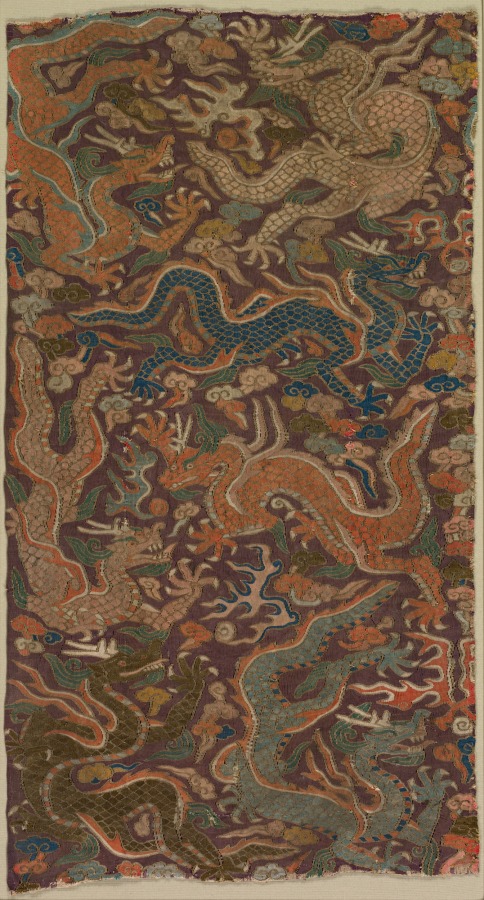
The Dragon’s Pursuit: Deconstructing the Flaming Pearl Motif in Imperial Silk Weaving
In the hushed ateliers of London’s Savile Row, where the weight of a bolt of cloth is measured not in yards but in generations of mastery, we encounter a motif that transcends mere decoration: the dragon chasing the flaming pearl. This is not a whimsical fancy; it is a codified language of power, spirituality, and material perfection, woven into the very warp and weft of imperial silk. As Senior Heritage Specialist for the Lauren Fashion Heritage Lab, I present this artifact—a 19th-century Qing dynasty silk panel—as a case study in the confluence of materiality, symbolism, and the legacy of an industry that defined the luxury of an empire.
Materiality: Silk as the Conduit of Imperial Authority
The artifact in question is a kesi (cut silk tapestry) panel, measuring approximately 120 centimeters by 60 centimeters. The ground is a deep, resonant azure—a shade reserved for the highest ranks of the Qing court, derived from indigo and woad, mordanted with alum to achieve a permanence that defies centuries. The silk itself is raw, reeled from the cocoons of Bombyx mori, the mulberry silkworm, whose cultivation was a state secret for millennia. The thread count is extraordinary: over 200 warp threads per centimeter, a density that allows for the depiction of minute details—the scales of the dragon, the undulating flames of the pearl—without a single thread breaking the surface tension. This is not a fabric to be worn lightly; it is a declaration of sovereignty, a textile that demands deference.
The kesi technique, which translates to “cut silk,” is a form of tapestry weaving where the weft threads are not carried across the entire width of the fabric but are instead woven in discrete sections, creating sharp, clean color boundaries. This method, perfected in the Song dynasty and refined under the Ming and Qing, allows for the illusion of painting in thread. The dragon’s body, for instance, is rendered in a gradient of gold and coral—gold from gilded paper-wrapped threads, coral from crushed cochineal insects—each scale individually woven, a process that could take a single master weaver months to complete for a panel of this size. The materiality of silk, with its natural luster and ability to absorb dye with unparalleled depth, becomes the medium through which the dragon’s breath, the pearl’s radiance, and the emperor’s mandate are made tangible.
Symbolism: The Dragon, the Pearl, and the Cosmic Dance
The motif of the dragon chasing the flaming pearl is not a simple narrative of pursuit. It is a cosmological diagram. In Chinese mythology, the dragon (long) is a benevolent, rain-bringing creature, a symbol of yang—masculine, active, imperial. The flaming pearl (huozhu) is a representation of yin—feminine, receptive, spiritual wisdom. Their interaction is the eternal dance of opposites, the Taiji (the Supreme Ultimate), from which all creation springs. The dragon does not seek to consume the pearl; it chases it in an endless, harmonious cycle, embodying the balance of the universe.
In the context of the Qing dynasty (1644–1912), this symbolism was co-opted for political legitimacy. The Manchu emperors, who were not ethnically Han, adopted the dragon as their emblem to assert their mandate of heaven. The five-clawed dragon (manglong) was reserved exclusively for the emperor and his immediate family. A three- or four-clawed dragon, as seen in this panel, would have been worn by a prince or high-ranking official. The flaming pearl, meanwhile, was often interpreted as a symbol of the Buddhist cintamani—the wish-fulfilling jewel—or as a representation of the sun, moon, or the emperor’s own brilliance. The pearl’s flames are not destructive; they are the flames of transformation, of enlightenment, of the perpetual motion of the cosmos.
The composition of this panel is meticulously balanced. The dragon, with its sinuous body forming an S-curve, occupies the center. Its head is turned back, mouth open, tongue extended toward the pearl, which hovers above a stylized wave pattern—the shuiwen, or water pattern, representing the four seas and the emperor’s dominion over them. The dragon’s claws grasp at the air, each talon curved with a precision that suggests both ferocity and grace. The pearl is surrounded by a halo of flames, each flame rendered as a separate, undulating thread of gold and vermilion. The background is filled with ruyi clouds—auspicious cloud forms that resemble the head of a ruyi scepter, a symbol of power and good fortune. The entire composition is a microcosm of the imperial worldview: order, harmony, and the eternal pursuit of wisdom.
Legacy: From Imperial Court to Savile Row
The legacy of imperial silk weaving is not a relic confined to museum vitrines. It is a living tradition that informs the very principles of bespoke tailoring on Savile Row. The kesi technique, with its emphasis on precision, patience, and the mastery of material, mirrors the ethos of a Savile Row cutter who spends years perfecting a single shoulder line. The dragon-chasing-pearl motif, with its balance of power and elegance, finds its echo in the lapel of a dinner jacket or the subtle pinstripe of a business suit—a quiet statement of authority that does not shout but commands.
Consider the dragon robe (longpao) of the Qing emperor, a garment that required over 4,000 hours of weaving and embroidery. The dragon, the pearl, the clouds, and the waves were not decorative; they were a coded map of the emperor’s role as the Son of Heaven. Today, when a client on Savile Row commissions a suit from a length of silk woven in the same tradition—perhaps by a family-run atelier in Suzhou that has been producing silk for 500 years—they are not merely buying cloth. They are acquiring a piece of that legacy, a thread of continuity that connects the imperial court to the modern gentleman.
The materiality of silk, with its inherent fragility and resilience, demands a certain respect. It is a fabric that cannot be rushed. It requires a weaver who understands the tension of the warp, a dyer who knows the chemistry of natural pigments, and a tailor who respects the drape of the cloth. The dragon chasing the flaming pearl is a reminder that true luxury is not about ostentation; it is about the depth of meaning encoded in every thread. On Savile Row, we do not simply sell suits. We curate narratives. And this artifact—this silk panel—is a narrative of power, balance, and the eternal pursuit of perfection.
In conclusion, the dragons chasing flaming pearls motif, rendered in imperial silk, is a testament to the symbiotic relationship between material and meaning. The silk is not a passive substrate; it is an active participant in the story. The dragon’s chase is our own—a pursuit of wisdom, of harmony, of the unattainable pearl that drives us to create, to refine, to excel. As we handle this panel, we are reminded that the legacy of imperial silk weaving is not a closed chapter. It is a living tradition, woven into the fabric of our own time, on the streets of London, where the dragon still chases the pearl.