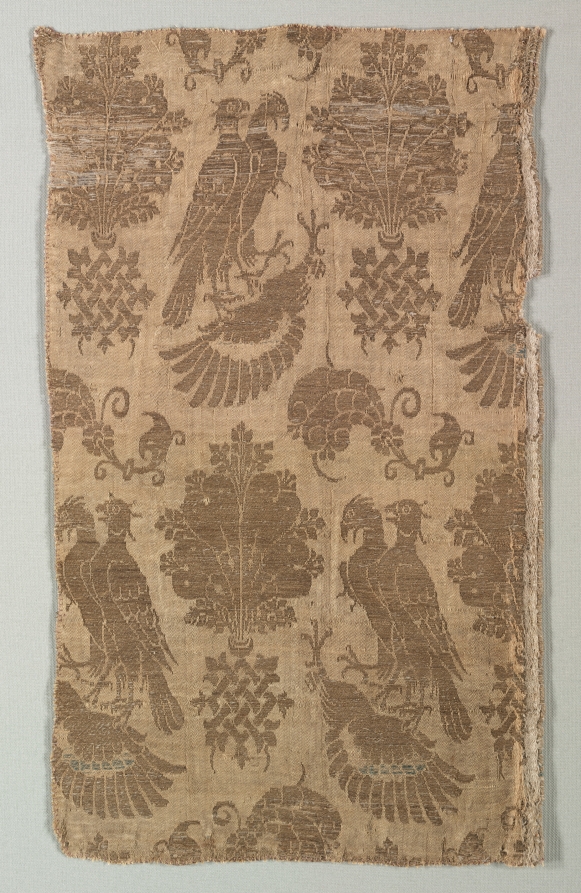
Heritage Research Artifact: Gold-Patterned Silk with Falcons and Heraldry
Introduction: The Fabric of Power and Prestige
In the hallowed archives of Lauren Fashion Heritage Lab, we examine a singular artifact: a gold-patterned silk textile, woven with falcons and heraldic motifs. This piece, dating to the late 16th or early 17th century, represents the apogee of imperial silk weaving—a craft that transcended mere fabric to become a statement of sovereignty, lineage, and cultural identity. The materiality of silk, with its inherent luminosity and strength, serves as the canvas for a narrative that intertwines artistry, power, and the enduring legacy of European aristocratic courts. As a Senior Heritage Specialist, I approach this artifact not merely as a textile but as a document of its time, a testament to the meticulous craftsmanship that defined the silk-weaving centers of the Ottoman Empire, Safavid Persia, and Renaissance Europe.
The choice of silk as the substrate is no accident. Silk’s natural sheen and ability to absorb dyes with exceptional clarity made it the preferred medium for displaying intricate patterns and precious metals. In this artifact, gold thread—likely a combination of gilded silver or gold leaf wrapped around a silk core—is woven into the fabric, creating a shimmering interplay of light and shadow. This technique, known as lampas or brocade, required extraordinary skill, as the weaver had to manage multiple warps and wefts to achieve the raised, metallic effect. The gold not only signified wealth but also served a practical purpose: it reflected candlelight in dimly lit halls, ensuring that the wearer or the displayed textile commanded attention.
Iconography: Falcons and Heraldry as Symbols of Authority
The central motifs of this silk—falcons and heraldic devices—are deeply emblematic. Falcons, revered across cultures from the Middle East to Europe, symbolize nobility, swiftness, and the pursuit of excellence. In the context of imperial weaving, the falcon often represented the ruler’s dominion over both land and sky. The bird’s predatory nature was a metaphor for the sovereign’s power to protect and to conquer. On this textile, the falcons are depicted in a stylized, symmetrical pattern, their wings spread in a heraldic pose that echoes the double-headed eagle of the Holy Roman Empire or the falcon of the Ottoman sultan. This repetition of form suggests a standardized iconography, likely derived from court workshops where patterns were codified for consistency across commissions.
Heraldry, meanwhile, anchors the textile in a specific lineage. The shields, crests, or geometric devices woven into the fabric are not mere decoration; they are identifiers of a family, a dynasty, or a military order. In the context of European courts, heraldic silks were often commissioned for ceremonial robes, banners, or altar cloths. The presence of heraldry on this artifact indicates that it was likely created for a patron of high rank—perhaps a duke, a cardinal, or a king. The combination of falcons and heraldry suggests a fusion of personal and institutional power: the falcon as a personal emblem, the heraldry as a statement of territorial or familial claim. This dual symbolism would have been immediately legible to contemporaries, reinforcing the wearer’s status in a society where visual cues were paramount.
Materiality and Craftsmanship: The Art of Imperial Weaving
The materiality of this silk is a study in precision. The warp threads are likely of high-twist silk, providing the tensile strength necessary to support the dense weft of gold and colored silk. The weft, in turn, is composed of multiple layers: a ground weft of silk for the base pattern, and a supplementary weft of gold for the metallic highlights. This structure, known as compound weave, allowed the weaver to create complex, multi-colored designs without sacrificing durability. The gold thread itself is a marvel of pre-industrial technology. Each strand was meticulously wound by hand, requiring hours of labor for even a small quantity. The result is a fabric that feels both supple and substantial, with a weight that speaks to its quality.
The color palette of this artifact is equally deliberate. The ground is a deep crimson or burgundy, achieved through the use of kermes or cochineal dyes, which were among the most expensive and sought-after in the early modern period. This red symbolized both royalty and the blood of Christ, making it appropriate for both secular and ecclesiastical use. The gold, combined with accents of blue or green (likely from indigo or woad), creates a contrast that is both harmonious and striking. The pattern itself is arranged in a repeating grid, with the falcons and heraldic devices alternating in a rhythm that guides the eye. This symmetry is characteristic of imperial weaving, where order and repetition reflected the ideal of a well-governed realm.
Context: The Legacy of Imperial Silk Weaving
To understand this artifact fully, we must place it within the broader legacy of imperial silk weaving. The great silk routes—from China to the Mediterranean—had long facilitated the exchange of raw materials and techniques. By the 16th century, weaving centers in Istanbul, Isfahan, and Venice had developed distinct styles that were eagerly adopted by European courts. The Ottoman silk industry, in particular, was renowned for its use of gold and silver thread, as seen in the kumaş fabrics produced for the sultan’s court. These textiles were often gifts to European ambassadors, spreading their influence across the continent. Similarly, Safavid silks from Persia featured intricate floral and animal motifs, which were adapted by Italian weavers in cities like Florence and Genoa.
In Europe, the demand for such silks was driven by the rise of absolute monarchies. Louis XIV of France, for example, established the Gobelins Manufactory to produce silks for Versailles, while English weavers in Spitalfields catered to the aristocracy. The gold-patterned silk with falcons and heraldry likely originated from one of these centers, perhaps as a commission for a noble family seeking to assert its status. The artifact’s survival is a testament to its value; such textiles were often repurposed as vestments, upholstery, or burial shrouds, ensuring their preservation.
Conclusion: A Tangible Link to a Bygone Era
This gold-patterned silk is more than a decorative object; it is a tangible link to a world where fabric was a medium of power. The falcons and heraldry speak to a time when identity was woven into every thread, and the materiality of silk elevated it to a status symbol. As we preserve and study such artifacts, we honor the legacy of the weavers who transformed raw silk into works of art. For the modern fashion house, this heritage offers a lesson in the enduring value of craftsmanship, symbolism, and the stories that fabric can tell. In the quiet elegance of Savile Row, where tailoring is an art form, this silk reminds us that true luxury is not just about appearance—it is about the history and meaning woven into every fiber.