The Gilded Threshold: Bronze, Myth, and the Architecture of Old Money in 2026
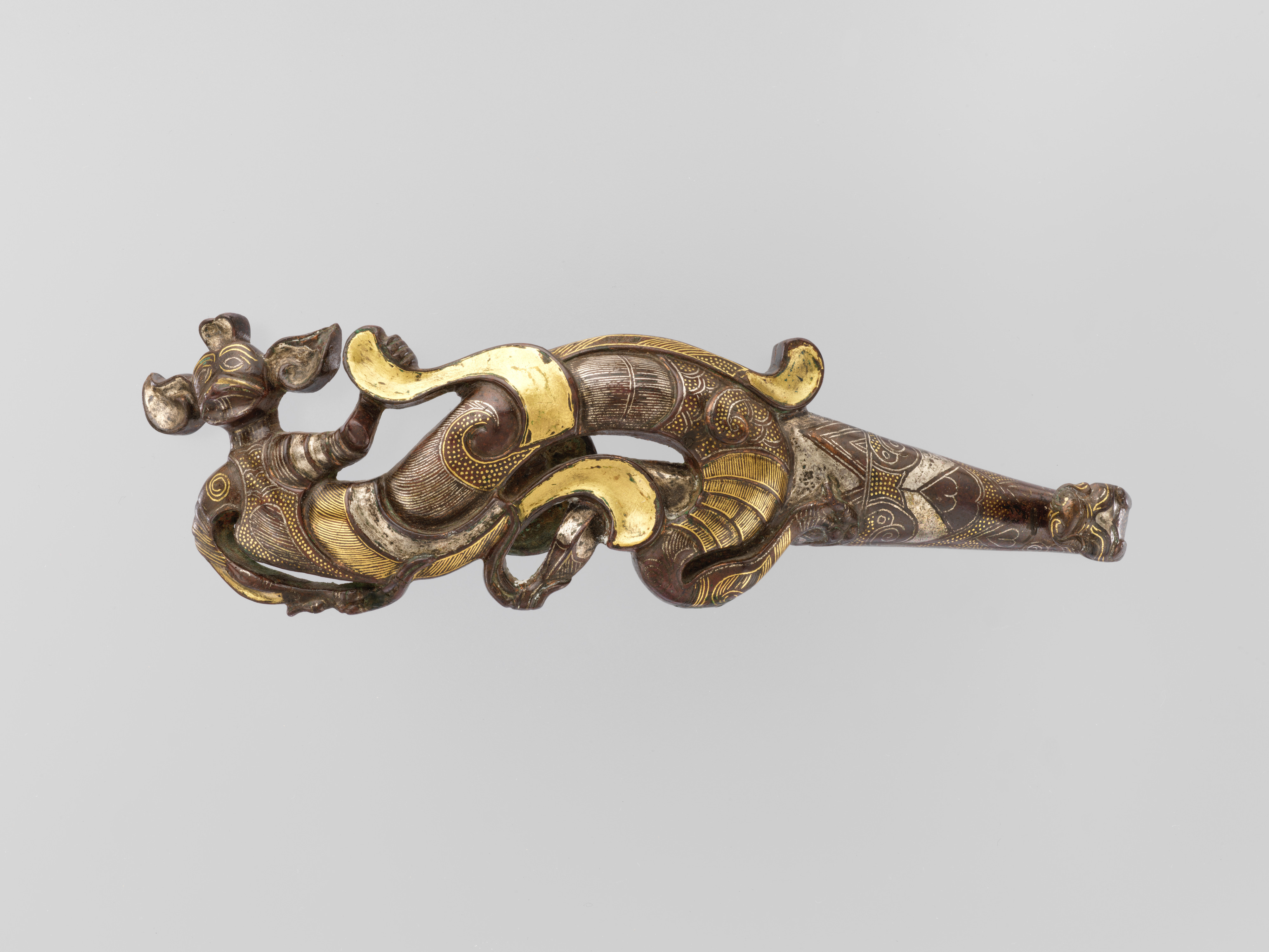
The internal genetic code of the Lauren Fashion Heritage Lab presents a dialectic of surfaces: the silver mirror inlaid with gold, facing the transient present, and the sarcophagus panel, facing eternity. Between these poles of reflection and memorialization lies a third artifact—a Bronze belt hook in the shape of a mythical creature, inlaid with gold and silver—which offers a synthetic resolution. This object, a functional clasp from ancient China, is neither a mirror of the ephemeral nor a monument to the dead. It is a threshold: a device that binds garment to body, mortal to myth, and—most critically for the 2026 Old Money silhouette—the private self to the public lineage. This paper argues that the belt hook’s fusion of zoomorphic power, precious inlay, and structural necessity provides a foundational aesthetic for the coming season’s heritage-driven tailoring, where wealth is not displayed but encoded into the very architecture of dress.
I. The Belt Hook as a Nexus of Time and Material
The bronze belt hook, dating from the Warring States period (475–221 BCE), is a masterwork of material alchemy. Its base metal—bronze—is an alloy of copper and tin, inherently strong and resistant to corrosion. Yet the artisan did not stop at utility. Into this durable matrix, they inlaid threads of gold and silver, forming the sinuous contours of a chimera: a creature with elements of dragon, tiger, and bird. This is not mere decoration. The gold and silver are narrative metals, their luminosity contrasting with the dark bronze to create a visual hierarchy. The beast’s eye might be a tiny gold bead; its scales, silver filigree. The effect is one of latent animation—the creature appears to move beneath the surface, as if the bronze itself were a frozen moment of transformation.
This object directly addresses the existential tension identified in the mirror and sarcophagus. The mirror’s silver back is a passive reflector; the sarcophagus’s stone is a passive container. But the belt hook is active. It was worn at the waist, the pivot point of the human body in motion. Each step, each turn, caused the gold and silver to catch light, shimmering against the dark bronze. The mythical creature was not merely a symbol; it was a guardian of the wearer’s vitality, a talisman against the entropy that the sarcophagus memorializes. In this sense, the belt hook is a portable threshold: it marks the boundary between the wearer’s mortal flesh and the immortal realm of myth, while simultaneously enabling the garment to function—to hold, to drape, to define the silhouette.
II. The 2026 Old Money Silhouette: Architecture Over Ornament
The Old Money aesthetic, as it evolves toward 2026, rejects the ostentation of logo-driven luxury. Instead, it embraces structural integrity and material truth. The belt hook offers a precise model. Its gold and silver are not applied as surface decoration; they are inlaid, fused into the bronze. This is the difference between a monogram printed on a T-shirt and a herringbone weave in a cashmere overcoat. The 2026 silhouette will be defined by hidden complexity: garments that appear simple at first glance but reveal intricate construction, rare materials, and subtle symbolism upon closer inspection.
Consider the double-breasted jacket—a cornerstone of Old Money wardrobes. In 2026, its lapels will be cut with a precision that echoes the belt hook’s geometric inlay. The gold-thread buttonholes, worked by hand, will mimic the gold filaments that outline the mythical creature’s eye. The shoulder line, structured but not padded, will reference the bronze’s tensile strength—a silhouette that holds its shape without rigidity, like the belt hook’s ability to clasp without breaking. The waist suppression, achieved through darts and seams, will create a visual pivot point analogous to the belt hook’s position at the hip. The garment becomes a body of armor, not for war, but for the social arena where lineage and taste are the only weapons.
III. The Mythic Code: Symbolism as Silent Status
The mythical creature on the belt hook is not identifiable as any single animal. This ambiguity is deliberate. It represents transcendence—a being that exists beyond the natural order. For the 2026 Old Money silhouette, this translates into symbolic motifs that are legible only to the initiated. A subtle gold-thread embroidery of a phoenix tail on a lapel’s underside. A silver-thread crest woven into the lining of a trench coat. A bronze-toned button engraved with a geometric beast that recalls the belt hook’s chimera. These are not logos; they are heraldic codes, passed down through generations, visible only when the garment is removed or turned inside out.
This approach aligns with the internal genetic code’s emphasis on “对抗时间” (resistance to time). The belt hook’s gold and silver have not tarnished; they remain as bright as the day they were inlaid. Similarly, the 2026 silhouette will use materials that age gracefully: linen that softens, wool that develops a patina, leather that darkens with wear. The gold-thread accents—on cuffs, collars, and pocket edges—will be the only elements that resist change, serving as constant reminders of the garment’s origin. The wearer becomes a living sarcophagus, not of death, but of living memory.
IV. The Threshold Garment: From Clasp to Silhouette
The belt hook’s most profound lesson for 2026 is its function as a threshold device. It connects the two ends of a belt, creating a continuous loop that encircles the waist. This act of closing is both practical and symbolic. It transforms fabric into garment, individual into silhouette. In the 2026 collection, this concept will manifest in key closure systems: gold-thread frogs on evening coats, silver-inlaid toggles on cashmere cardigans, bronze-finished zippers on tailored trousers. Each closure is a miniature sculpture, a belt hook in miniature, that demands the wearer’s engagement. The act of dressing becomes a ritual, a daily reenactment of the threshold crossing that the ancient Chinese belt hook once performed.
Furthermore, the silhouette itself will be threshold-shaped. The 2026 Old Money line will feature high-waisted trousers that cinch at the natural waist, echoing the belt hook’s position. Cropped jackets that end at the hip bone, leaving a gap of shirt or blouse. Asymmetric hems on skirts and coats, creating a visual tension between the structured top and the flowing bottom. These are not arbitrary cuts; they are spatial thresholds, marking the transition between the body’s zones—torso to leg, formality to ease, public to private. The mythical creature on the belt hook guarded the wearer’s spirit; the 2026 silhouette guards the wearer’s presence.
V. Conclusion: The Eternal Clasp
The bronze belt hook with gold and silver inlay is not merely an artifact; it is a philosophical instrument. It resolves the mirror-sarcophagus dialectic by offering a third path: not reflection, not memorialization, but integration. The gold-thread inlay is the mirror’s eternal garden, but it is embedded in the bronze’s durable reality. The mythical creature is the sarcophagus’s narrative, but it is worn on the body, alive and moving. For the 2026 Old Money silhouette, this means a wardrobe that is both armor and art, both functional and symbolic. The gold-thread accents, the bronze-toned closures, the mythic codes—these are not decorations. They are thresholds, marking the boundary between the transient and the eternal, the individual and the lineage. The wearer does not merely put on clothes; they clasp themselves to a heritage that stretches back to the Warring States and forward to the next generation. In that clasp, time is defeated.