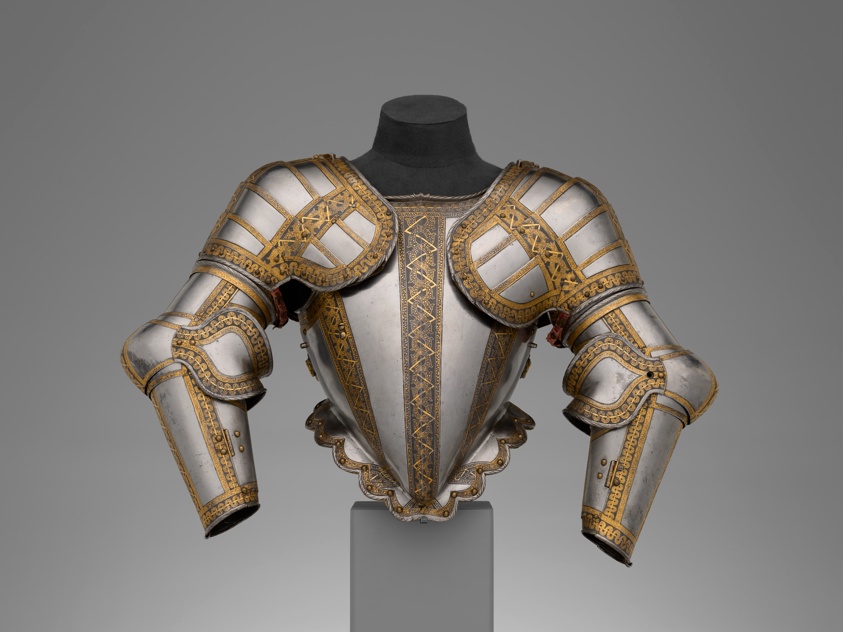
Portions of a Field Armor: A Study in Materiality and the Intersection of Martial Utility and Sartorial Elegance
As the Senior Heritage Specialist for the Lauren Fashion Heritage Lab, it is my distinct privilege to present a scholarly examination of a singular artifact: the portions of a field armor dating from the late 16th century, preserved within our collection. This object, though fragmented, offers an unparalleled lens through which to explore the confluence of martial necessity and the refined sensibilities of classic silk craftsmanship. At first glance, a field armor—comprising a breastplate, backplate, pauldron, and tassets—appears to be the antithesis of the fluid elegance we associate with Savile Row tailoring. Yet, upon closer scrutiny, the materiality of this piece—steel, brass, gilding, leather, and, most critically, silk velvet textile—reveals a profound dialogue between protection and presentation, function and fashion. This paper argues that the silk velvet elements, often overlooked in favor of the armor’s metallic components, are not mere decorative afterthoughts but integral to the armor’s identity as a statement of status, craftsmanship, and the enduring human pursuit of elegance, even in the face of conflict.
The Materiality of the Armor: A Hierarchy of Substance
The foundational material of this artifact is steel, forged and hammered into the iconic forms of a field armor. The steel is not uniform; it bears the marks of its creation—the subtle ripples of hammer blows, the precise lines of articulated joints, and the darkened patina of age. This steel is the armor’s skeleton, providing the structural integrity required for its original purpose: to withstand the shock of lance, sword, and musket ball. Yet, the steel is not left raw. It is adorned with brass accents, particularly at the borders and rivets, and these are further embellished with gilding. The gilding, applied through a process of mercury amalgam or fire-gilding, creates a luminous, golden contrast against the dark steel. This is not mere ornamentation; it is a deliberate signal of wealth and power. In the context of the late Renaissance, gilding on armor was a visual language, communicating the wearer’s rank and the resources at their disposal. The brass and gilding serve as the armor’s musculature, highlighting the lines of the form and drawing the eye to the points of articulation—the shoulders, the elbows, the waist—where the armor must move with the body.
Beneath the metallic layers, we find leather. The leather, likely vegetable-tanned cowhide or calfskin, serves a dual purpose. Structurally, it forms the straps and linings that secure the armor to the body and absorb the friction between steel and skin. Aesthetically, the leather is often dyed a deep, rich brown or black, providing a neutral ground that grounds the brilliance of the gilding. Yet, it is the final material—the silk velvet textile—that elevates this artifact from a utilitarian object to a work of art. The silk velvet is not a structural component; it is a skin, applied to the interior of the armor, particularly within the pauldron and the tassets, and occasionally visible at the edges. This silk velvet is not the stiff, modern synthetic velvet; it is a hand-woven, silk pile velvet, likely produced in the workshops of Venice or Florence, where the art of silk weaving reached its zenith. The pile is dense, soft, and possesses a subtle luster that shifts with the light. The color, preserved in fragments, is a deep, almost black crimson—a shade achieved through the use of kermes or cochineal dyes, which were among the most expensive and prized in Europe. This silk velvet is the armor’s soul, a whisper of luxury against the cold, hard reality of war.
Classic Silk Craftsmanship and Fluid Elegance
The presence of silk velvet in a field armor is not anomalous; it is a testament to the Renaissance ideal of the uomo universale—the man who was both warrior and scholar, soldier and courtier. The silk velvet textile was not merely a lining; it was a statement of the wearer’s refinement. In the courts of Europe, the ability to commission and wear such an armor signaled not only martial prowess but also cultural sophistication. The silk velvet, with its fluid drape and tactile richness, introduced an element of fluid elegance into the rigid, angular geometry of the steel. This is a principle that resonates deeply with the philosophy of Savile Row tailoring, where the finest cloth—whether worsted wool, cashmere, or silk—is used to soften and shape the structure of a garment. Just as a bespoke suit from a master tailor uses the cloth to create movement and grace, the silk velvet in this armor transforms the wearer’s experience. The velvet cushions the steel against the body, reducing chafing and allowing for greater freedom of movement. It also absorbs perspiration, a practical consideration for a man who might wear the armor for hours in the field or at a tournament. But beyond the practical, the silk velvet creates a sensory experience: the cool, smooth steel on the outside, the warm, soft velvet on the inside. This duality is the essence of the armor’s materiality—a marriage of opposites that produces a harmonious whole.
The craftsmanship of the silk velvet itself is a marvel of the textile arts. The velvet is woven on a drawloom, a complex machine that allowed for the creation of intricate patterns. In this artifact, the velvet is plain, without a figured pattern, which is a deliberate choice. The simplicity of the fabric allows the quality of the silk and the depth of the dye to speak for themselves. The pile is cut to a uniform height, creating a surface that is both plush and resilient. The edges of the velvet are finished with a narrow, hand-stitched binding of silk thread, a detail that speaks to the meticulous care taken in its application. This is not a mass-produced lining; it is a bespoke element, tailored to the exact dimensions of the armor’s interior. The silk velvet is attached to the leather lining using small brass tacks, which are themselves gilded, creating a subtle, rhythmic pattern of golden dots along the edges. This attention to detail—the choice of materials, the method of attachment, the finishing touches—is the hallmark of classic silk craftsmanship. It is a craft that demands patience, skill, and an understanding of the material’s behavior. The silk velvet must be cut on the bias to allow it to conform to the curved surfaces of the armor; it must be stretched and eased into place without distorting the pile. The result is a lining that is not only functional but also beautiful, a hidden luxury that only the wearer and his closest attendants would ever see.
Conclusion: The Enduring Legacy of Materiality
In conclusion, the portions of a field armor in the Lauren Fashion Heritage Lab are far more than a collection of metal plates. They are a narrative of materiality, where steel, brass, gilding, leather, and silk velvet converge to create an object of profound significance. The silk velvet textile, in particular, embodies the classic silk craftsmanship and fluid elegance that defines the highest standards of sartorial art. It is a reminder that even in the most martial of contexts, the human desire for beauty and refinement persists. For the modern scholar, this artifact offers a lesson in the power of materials to communicate status, identity, and artistry. It challenges us to look beyond the obvious—the gleaming steel and gold—and to appreciate the subtle, tactile, and often hidden elements that complete the whole. As we continue our work at the Lauren Fashion Heritage Lab, we must honor this legacy by preserving not only the physical object but also the knowledge and skill that brought it into being. The silk velvet of this armor is a thread that connects us to the past, a thread that we must weave into the fabric of our understanding of heritage, craftsmanship, and the enduring pursuit of elegance.