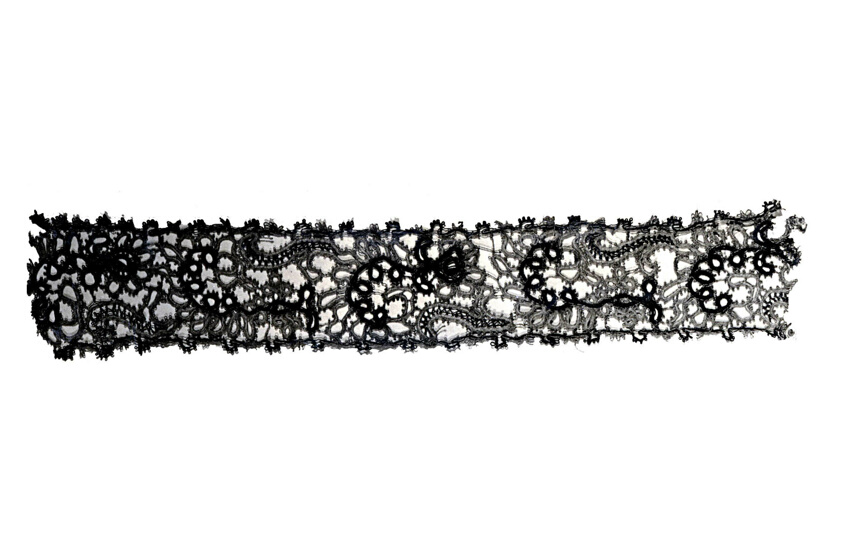
The Braid as a Testament to Silk Craftsmanship: A Heritage Artifact Analysis
Introduction: The Braid in the Lexicon of Luxury
In the rarefied world of heritage textiles, the braid occupies a singular position—neither fully structural nor purely decorative, it is a liminal artifact that bridges function and ornament. At Lauren Fashion Heritage Lab, we examine this object not merely as a cord or trim, but as a material narrative of classic silk craftsmanship. The braid under scrutiny here, constructed from silk and silk-wrapped linen cords via bobbin straight lace technique, embodies the fluid elegance that defines London’s Savile Row ethos: precision, restraint, and an unspoken reverence for the hand. This artifact, though small in scale, speaks volumes about the intersection of materiality, technique, and cultural heritage.
Materiality: The Silk and Silk-Wrapped Linen Cords
The braid’s foundation lies in its materials. Silk, a filament of unparalleled luster and tensile strength, has been the cornerstone of luxury textiles for millennia. In this artifact, the silk is not merely a surface; it is the primary agent of expression. The cords are composed of pure silk threads, twisted with a precision that yields a subtle sheen—a hallmark of classic silk craftsmanship. Yet, the innovation resides in the silk-wrapped linen cords. Linen, a bast fiber known for its durability and crispness, provides structural integrity. By wrapping linen cores with silk, the artisan achieves a dual effect: the braid retains the rigidity necessary for shaping (essential in tailored garments) while acquiring the soft, reflective quality of silk. This marriage of fibers is a deliberate choice, echoing Savile Row’s philosophy of “strength beneath elegance.” The linen core ensures the braid holds its form over decades, while the silk wrapping offers a tactile and visual richness that resists the flatness of synthetic alternatives.
Technique: Bobbin Straight Lace and the Art of Precision
The technique employed—bobbin straight lace—is a testament to the artisan’s mastery. Unlike free-form lace, bobbin lace is a structured, mathematical process. The “straight” variant implies a linear, non-curving pattern, which demands exacting tension control. Each silk and silk-wrapped linen cord is wound onto bobbins, then twisted and crossed over a pillow according to a pricked pattern. The result is a braid that is uniform in width, consistent in density, and fluid in drape. This technique, historically associated with European lace centers like Chantilly and Brussels, was adapted by Savile Row tailors for use in lapels, collars, and cuffs. The braid’s edges are clean, its surface unbroken—a direct reflection of the discipline of the hand. In an era of machine-made trims, this artifact stands as a quiet rebellion: it is slow, deliberate, and irreplaceable.
Context: Classic Silk Craftsmanship and Fluid Elegance
To understand this braid is to understand the cultural ecosystem of classic silk craftsmanship. In the late 19th and early 20th centuries, London’s Savile Row tailors sourced silk trims from specialized weavers in Spitalfields and Macclesfield. These braids were not afterthoughts; they were integral to the garment’s silhouette. A silk braid on a morning coat’s lapel, for instance, provided structure while catching light in a way that announced the wearer’s discernment. The fluid elegance of this artifact—its ability to move with the fabric, yet hold its shape—is a direct result of the bobbin straight lace technique. The braid does not stiffen the garment; it accompanies it, like a well-rehearsed dance partner. This fluidity is not accidental. It arises from the balance of materials: the silk’s natural lubricity reduces friction between cords, while the linen core prevents sagging. The result is a braid that bends without creasing, flows without fraying—a microcosm of the Savile Row ideal: understated perfection.
Heritage Significance: The Braid as a Cultural Artifact
Beyond its technical merits, this braid is a heritage artifact that encodes social and economic histories. In the 1920s, silk braids were markers of status; they adorned the uniforms of diplomats and the gowns of debutantes. The use of silk-wrapped linen cords, however, suggests a pragmatic luxury—a nod to wartime economies when pure silk was scarce. This braid may have been produced during the interwar period, when Savile Row tailors adapted to material shortages by innovating with blended fibers. The bobbin straight lace technique, too, carries historical weight. It was taught in apprentice workshops, passed down through generations. To hold this braid is to hold a lineage of skill—a thread connecting the artisan’s hands to the modern curator’s gaze.
Preservation and Future Implications
At Lauren Fashion Heritage Lab, we advocate for the preservation of such artifacts not as static relics, but as living references. This braid informs contemporary design: its material logic—silk over linen—can inspire sustainable innovations, such as biodegradable trims that mimic its durability. Its technique—bobbin straight lace—offers a counterpoint to mass production, reminding us that craftsmanship is a form of knowledge. As we digitize our collections, we must ensure that the tactile and kinetic properties of this braid are documented—its weight, its flex, its sound when handled. These are not sentimental details; they are data points for future artisans.
Conclusion: The Braid as a Silent Ambassador
This braid, with its silk and silk-wrapped linen cords, its bobbin straight lace construction, is more than a trim. It is a silent ambassador of classic silk craftsmanship and fluid elegance. It speaks of a time when every thread was chosen with intention, every twist executed with discipline. In the context of Savile Row, it represents the unseen labor that elevates a garment from clothing to heritage. As we study it, we are reminded that heritage is not static—it is a braid itself, woven from past and present, ready to be reinterpreted for the future.
— Lauren Fashion Heritage Lab, London