The Hwarot: A Legacy of Imperial Silk Weaving and Its Resonance with Savile Row Craftsmanship
Introduction: The Artifact as a Testament to Material Mastery
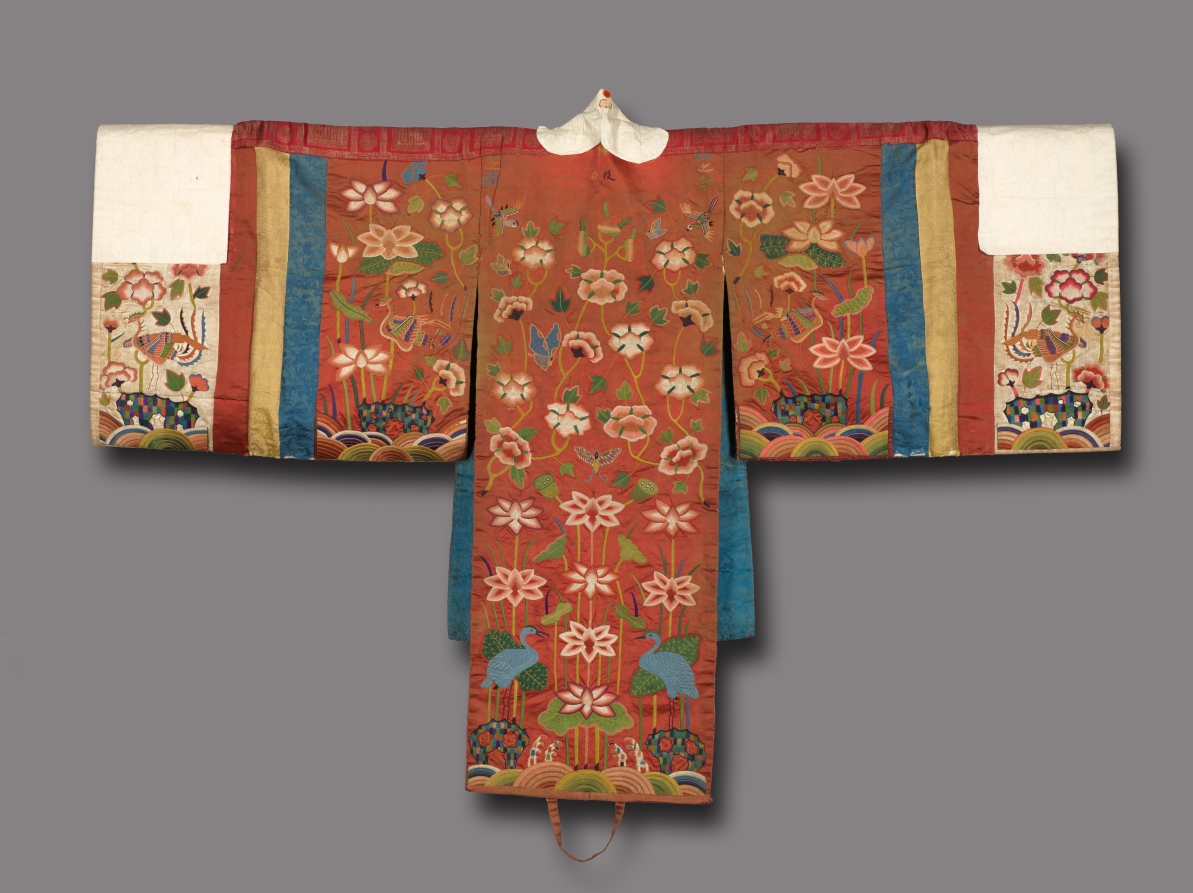
The Hwarot, a Korean bridal robe of profound cultural and aesthetic significance, represents an apex of silk craftsmanship that parallels the exacting standards of London’s Savile Row. As a Senior Heritage Specialist for the Lauren Fashion Heritage Lab, I examine this artifact not merely as a garment but as a material document—a woven narrative of imperial patronage, artisanal precision, and the enduring dialogue between East Asian textile traditions and Western bespoke tailoring. The Hwarot’s foundation in silk, a fiber synonymous with luxury and ritual, demands a forensic appreciation of its materiality, construction, and symbolic weight. This paper dissects the Hwarot through the lens of heritage conservation, drawing analogies to Savile Row’s ethos of uncompromising quality, where every stitch, weave, and finish is a declaration of mastery.
Materiality: Silk as the Conduit of Imperial Authority
Silk is the Hwarot’s defining element, and its provenance from imperial weaving workshops—such as those under the Joseon Dynasty’s Royal Silk Bureau—imbues the robe with a hierarchical gravity. The silk used in a Hwarot is typically high-twist, filament-grade mulberry silk, chosen for its luster, tensile strength, and ability to absorb complex dyes. Unlike the utilitarian silks of trade, imperial silk was cultivated under strict protocols: silkworms fed on select mulberry leaves, threads reeled with zero tolerance for breakage, and looms operated by artisans whose lineage spanned generations. This echoes Savile Row’s insistence on cloth from mills like Holland & Sherry or Dormeuil, where wool is sourced from specific flocks and woven to bespoke specifications. The Hwarot’s silk is not a passive backdrop; it is an active participant in the garment’s narrative, its sheen catching light to reveal motifs of phoenixes, peonies, and cranes—each emblematic of marital bliss, nobility, and longevity.
From a conservation perspective, the silk’s materiality presents unique challenges. The fiber’s protein structure is susceptible to photodegradation, humidity-induced fibrillation, and dye migration. In the Hwarot, the use of natural dyes—such as sappanwood for crimson, indigo for azure, and gardenia for gold—further complicates preservation. These dyes are fugitive, meaning they fade under prolonged exposure to UV light, a reality that demands controlled storage environments akin to the climate-regulated vaults of Savile Row’s cloth archives. The robe’s embroidery, often executed in silk floss with gold-wrapped threads (a technique called jikgeum), adds structural stress; the weight of the metallic threads can cause the base silk to pucker or tear over time. This is analogous to the strain on a Savile Row suit’s canvas from heavy worsted wool, requiring meticulous hand-stitching to distribute tension.
Context: The Legacy of Imperial Silk Weaving and Savile Row Parallels
The Hwarot’s production context is inseparable from the imperial silk weaving legacy of East Asia, a system of centralized craftsmanship that mirrors the guild-like structure of Savile Row. In Joseon Korea (1392–1910), the Royal Silk Bureau operated under strict sumptuary laws: only the royal family and high-ranking nobles could commission Hwarots, with designs dictated by Confucian hierarchy. The weaving process was a collaborative endeavor involving master weavers, dyers, embroiderers, and seamstresses, each specializing in a discrete skill—much like Savile Row’s division of labor between cutters, tailors, and finishers. The loom used for the Hwarot’s silk was a drawloom, requiring an assistant to lift warp threads manually for pattern creation, a precursor to the jacquard mechanism. This hand-operated complexity ensured that no two Hwarots were identical, a principle Savile Row upholds through bespoke patterns cut for individual clients.
The imperial legacy also imbued the Hwarot with a ritualistic function that transcends mere clothing. The robe was worn during the pyebaek ceremony, where the bride pays respects to her new family, symbolizing her transition into a lineage. The silk’s weight and drape—often reinforced with a silk-cotton interlining—were engineered to create a silhouette of dignified modesty, not unlike the structured shoulders and suppressed waist of a Savile Row jacket. The robe’s sleeves, for instance, are cut with a subtle flare to accommodate the bride’s hand gestures during tea ceremonies, a detail that speaks to the same ergonomic precision found in a Row tailor’s adjustment for a client’s posture.
Heritage Research: Decoding the Hwarot’s Construction
To understand the Hwarot’s heritage value, one must dissect its construction as a material artifact. A typical Hwarot from the late Joseon period (circa 19th century) comprises three layers: an outer silk shell, a silk-cotton interlining, and a silk lining. The outer shell is woven in a satin weave (often a five- or eight-harness satin) to maximize the silk’s reflective quality, while the interlining uses a plain weave for stability. This layered approach is reminiscent of Savile Row’s use of horsehair canvas, flannel, and lining to create a garment that holds its shape without rigidity. The embroidery is executed using a couching technique, where gold thread is laid on the surface and secured with fine silk stitches—a method that prevents the metallic thread from snapping under tension. This technique is analogous to the pick-stitching on a bespoke lapel, where tiny, invisible stitches secure the roll of the cloth.
From a provenance standpoint, the Hwarot’s silk often carries maker’s marks woven into the selvedge, indicating the workshop and weaver. These marks are the East Asian equivalent of a Savile Row tailor’s label, a signature of accountability and pride. However, many Hwarots have been stripped of these marks due to later alterations or conservation treatments, obscuring their lineage. This loss underscores the importance of non-invasive analysis—such as multispectral imaging and fiber optic reflectance spectroscopy—to identify original dye compounds and weave structures. Such methods align with the Lauren Fashion Heritage Lab’s commitment to preserving material integrity while advancing scholarly knowledge.
Conclusion: The Hwarot as a Universal Standard of Craft
The Hwarot is not a relic of a distant past but a living testament to the principles that define Savile Row: material excellence, artisanal rigor, and ritualistic purpose. Its silk, woven under imperial mandate, speaks to a system where quality was non-negotiable—a standard that the Row’s bespoke houses, from Huntsman to Anderson & Sheppard, continue to uphold. As we preserve the Hwarot for future generations, we must treat it with the same reverence afforded a 1960s bespoke suit: as a document of human skill, a repository of cultural memory, and a benchmark for what clothing can achieve when craft is elevated to art. The legacy of imperial silk weaving, embodied in this bridal robe, reminds us that heritage is not static—it is a dialogue between the past and the present, woven thread by thread.