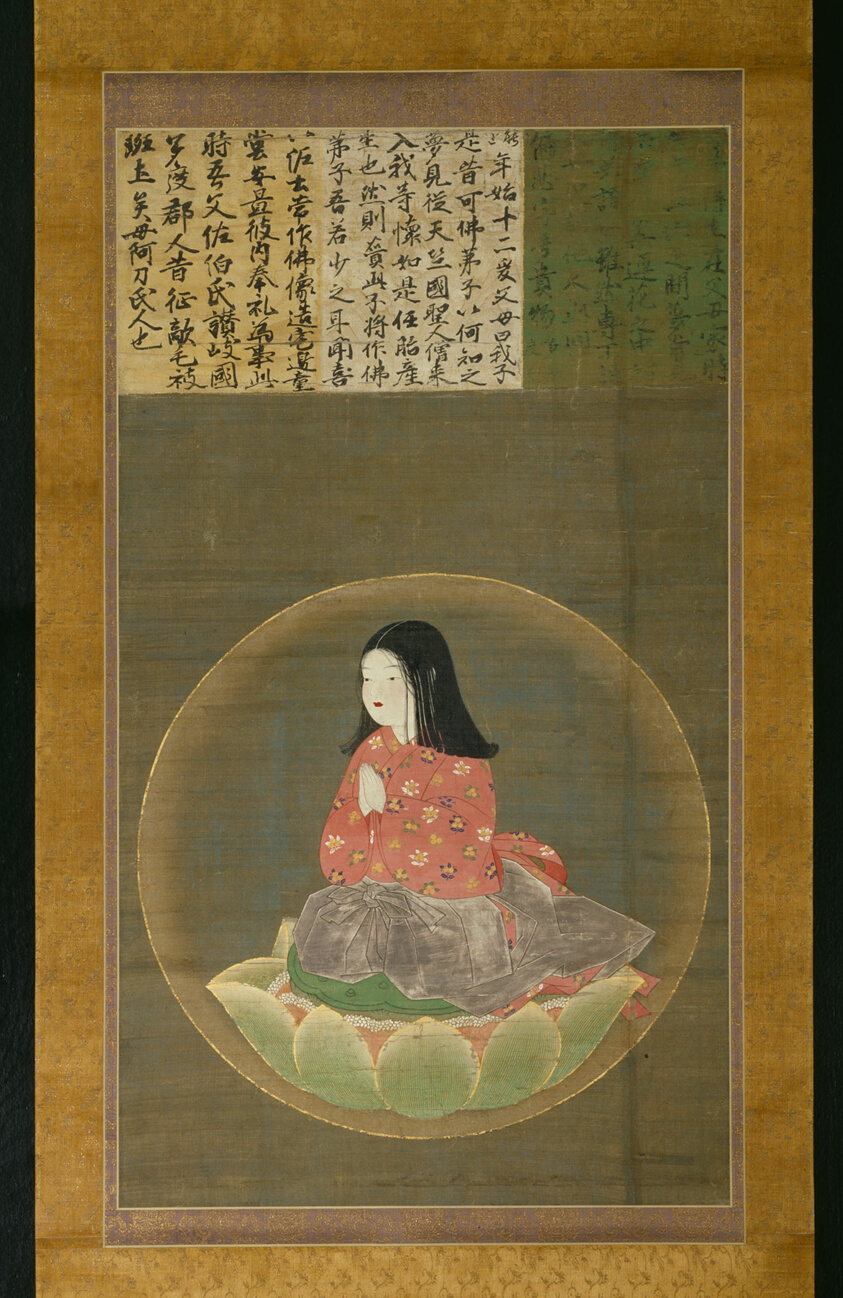
An Examination of Lineage and Form: The Chigo Daishi Scroll as Sartorial Heritage
To engage with this artifact is to undertake a consultation with history itself. One is presented not merely with a religious icon, but with a definitive statement of cultural lineage, rendered with a precision and material integrity that demands the most discerning eye. The subject—Kūkai, the venerated founder of Shingon Buddhism, depicted in his precocious childhood incarnation as Chigo Daishi—is, in itself, a profound narrative of potential. It speaks of a legacy in its nascent stage, a promise of doctrinal and aesthetic revolution yet to be fully unfurled. The medium, however, is where the conversation truly begins: silk. This is not a mere support; it is the foundational cloth from which the entire narrative is cut.
The Foundation: Silk as Bespoke Canvas
Consider first the ground. The silk chosen for a hanging scroll of this calibre is analogous to the most exclusive lengths of cloth reserved for a commissioning client on Savile Row. Its weave, its weight, its inherent luminosity—these are not accidental qualities. They are selected with exacting purpose. The silk provides a surface that is at once resilient and receptive, capable of holding the most delicate ink wash without bleeding, while imparting a subtle depth and warmth that paper cannot emulate. This material choice immediately establishes a hierarchy of value and permanence. The artwork is conceived as an heirloom, an object designed for contemplative encounter across generations, its very fabric ensuring it will outlast mere trends. The craftsmanship begins with this selection, a silent testament to the patron’s understanding that true quality is built from the ground up.
The Draughtsmanship: A Study in Fluid Elegance
Upon this impeccable ground, the artist’s hand executes a line of such assured fluidity that it belies the immense discipline required to achieve it. The depiction of the young Kūkai is characterised by an elegance that is both serene and dynamic. The lines describing the drapery of his robes are not mere outlines; they are studies in rhythm and fall. They possess the effortless flow of a perfectly tailored garment, where the cut allows the cloth to move with the form beneath. There is a synthesis here—the spiritual poise of the child prodigy is expressed through a physical poise in the rendering. The ink work, from the sharp, definitive lines of the features to the softer, modulated washes that suggest volume and shadow, demonstrates a mastery of the brush akin to a master cutter’s mastery of the shears. Each stroke is intentional, each gradient calculated to create form without heaviness. The overall effect is one of weightless authority, a visual representation of innate genius clothed in youthful innocence.
Color as Strategic Accentuation
The application of color in such a piece must be approached with the strategic restraint of a well-chosen pocket square or tie knot—it is an accent, not an overwhelm. The subtle mineral pigments applied to the silk serve to elevate and clarify, not to obscure the foundational drawing. Hues likely derived from azurite or malachite would be used with discretion to highlight ceremonial details, perhaps in the patterning of the robes or the attributes held. This restrained palette ensures the focus remains on the essential: the expression of the figure and the quality of the line. The color sinks into the silk, becoming one with the fabric rather than sitting superficially upon it, a technique requiring immense skill and patience. It is the antithesis of ostentation; it is quiet confidence rendered in pigment.
Composition and Mounting: The Final Presentation
Finally, one must consider the complete presentation—the mounting of the scroll. This is the final fitting, the pressing and finishing that transforms the garment from mere cloth into a definitive statement. The silks and brocades chosen for the borders are the complementary fabrics, selected to enhance the central image without competing for attention. Their texture and pattern provide a formal frame, a respectful perimeter that contains and directs the viewer’s gaze. The rollers, of seasoned wood, offer a satisfying heft, the final detail that confirms the object’s integrity. Every element, from the silk of the painting to the silk of the mount, works in concert to create an artifact of holistic harmony. It is designed to be unfurled, contemplated, and stored with care, a ritual of engagement that mirrors the respect due to its subject.
In conclusion, this hanging scroll depicting Chigo Daishi transcends its immediate religious function to stand as a peerless example of heritage craftsmanship. It is a masterclass in the use of material—silk—not as a passive backdrop, but as an active participant in the creation of meaning. The fluid elegance of its line, the strategic application of color, and the solemn dignity of its presentation all speak to a tradition where spiritual insight and aesthetic discipline are inseparable. To study it is to understand that true legacy is built upon an unwavering commitment to the quality of one’s materials, the precision of one’s execution, and the timelessness of one’s form. It is, in every sense, a bespoke masterpiece.