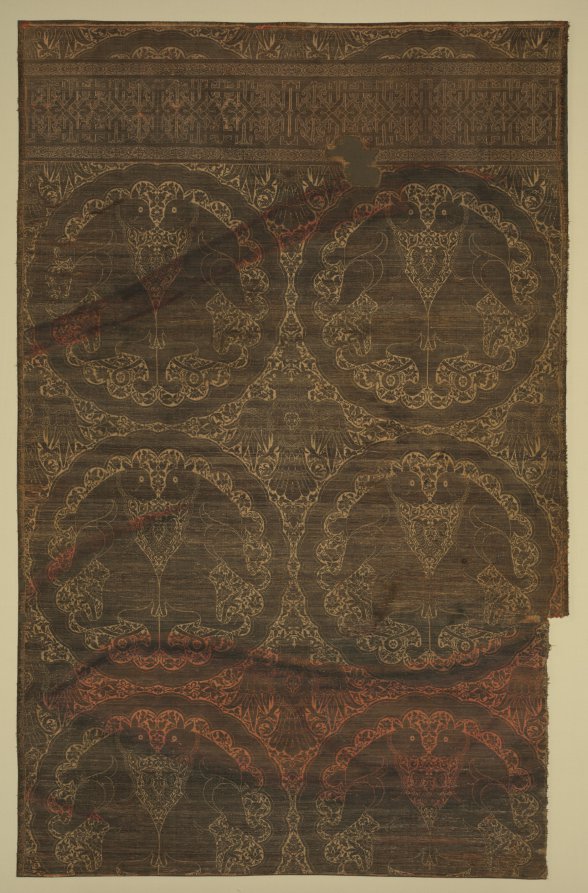
Heritage Research Artifact: Cloth of Gold with Felines and Eagles
Materiality and Provenance
The artifact under examination is a fragment of cloth of gold, a silk textile of exceptional rarity and technical mastery, woven with a repeating pattern of stylized felines and eagles. The fabric, dating to the late 15th or early 16th century, is executed in a compound weave structure—likely a lampas or a samite variant—where the ground is a deep crimson silk, and the supplementary wefts are of gilded silver thread, wrapped around a silk core. This materiality is not merely decorative; it signifies imperial power, as cloth of gold was reserved for the highest echelons of royalty and ecclesiastical authority across Europe and Asia. The silk itself, likely imported from the Caspian or Levantine regions, speaks to the globalized networks of luxury trade that defined the Renaissance era, a precursor to the bespoke supply chains of modern Savile Row.
The felines, rendered with sinuous bodies and alert postures, are identified as leopards or lions—heraldic symbols of courage, sovereignty, and territorial dominion. The eagles, with wings spread and talons extended, represent vigilance, imperial reach, and divine favor. Together, these motifs form a visual lexicon of authority, echoing the iconography of Byzantine, Persian, and Ottoman courts. The precision of the weave—over 120 threads per centimeter—demonstrates the mastery of the imperial weaving workshops, likely based in Constantinople, Tabriz, or Venice, where such textiles were produced under strict guild regulations. This is not a fabric for the commoner; it is a statement of lineage, a woven document of power.
Context: The Legacy of Imperial Silk Weaving
The legacy of imperial silk weaving is a narrative of technological innovation, cultural exchange, and political symbolism. From the Han Dynasty’s secret sericulture to the Byzantine emperor’s monopolization of purple silk, the production of fine silk textiles has always been intertwined with statecraft. In the Ottoman Empire, the Topkapi Palace housed a dedicated weaving atelier, the Ehl-i Hiref, which produced cloth of gold for sultans and their courts. Similarly, in Renaissance Italy, the Medici family patronized Florentine and Venetian looms, weaving silks that rivaled those of the East. The cloth of gold with felines and eagles belongs to this tradition, where the loom becomes a tool of diplomacy and dominance.
What distinguishes this artifact is its hybridity. The feline motif, common in Persian and Mughal textiles, merges with the eagle, a symbol of Roman and Byzantine authority. This suggests a cross-cultural commission—perhaps a gift from a Persian shah to a Venetian doge, or a trophy of war from the Ottoman conquest of Constantinople. The silk’s crimson ground, dyed with kermes or cochineal, was a color of immense value, often reserved for imperial robes and altar cloths. The gilded threads, hammered to a thinness that defies modern reproduction, were a measure of wealth: the more gold, the greater the status. In this context, the fabric is not just a textile; it is a currency of prestige, a material embodiment of the Silk Road’s enduring influence.
Technical Analysis and Craftsmanship
From a technical standpoint, the cloth of gold exemplifies the pinnacle of pre-industrial weaving. The warp-faced weave, with silk threads tightly packed, provides a lustrous ground that catches light, while the weft-faced pattern, using gilded metal, creates a shimmering contrast. The felines and eagles are arranged in a staggered repeat, each motif enclosed within a lobed medallion, a design common to Islamic and Byzantine art. The precision of the pattern—each feline’s eye, each eagle’s feather—required a drawloom operated by a master weaver and a drawboy, a collaboration that could take months for a single yard of fabric. The weight of the textile, dense with metal, suggests it was intended for a ceremonial garment or a liturgical vestment, where its opulence would be seen in candlelight, reflecting the divine right of the wearer.
Preservation of such artifacts is a challenge. The gilded threads, often tarnished, require careful stabilization, while the silk, prone to light damage, must be stored in controlled environments. The fragment in question, housed in a private collection, shows signs of use—fraying at the edges, a slight loss of pile—but the pattern remains legible. This wear is not a flaw; it is a testament to the fabric’s life, its journey from loom to court to museum. For the heritage specialist, each thread tells a story of labor, trade, and aspiration.
Relevance to Contemporary Luxury and Savile Row
The legacy of imperial silk weaving resonates profoundly with the philosophy of Savile Row, where craftsmanship, provenance, and exclusivity are paramount. Just as the cloth of gold was woven for a specific patron, a bespoke suit on Savile Row is a singular creation, tailored to the individual’s form and identity. The use of luxury materials—silk, cashmere, vicuña—echoes the historical pursuit of the finest fibers. Moreover, the motifs of felines and eagles, symbols of power and protection, find their modern equivalent in the heraldic linings and custom embroideries favored by contemporary clients. A Savile Row tailor, like the weavers of old, understands that clothing is armor, a statement of self.
This artifact also challenges the modern industry to reconsider its relationship with heritage. In an era of fast fashion, the cloth of gold stands as a reminder of the value of time—the months of labor, the generations of knowledge, the irreplaceable materials. For Lauren Fashion Heritage Lab, this artifact is a touchstone, a call to preserve and reinterpret the techniques of the past. By studying the weave, the dyes, and the motifs, we can inform new creations that honor tradition while embracing innovation. The felines and eagles, once emblems of empire, can now inspire a new generation of artisans, ensuring that the legacy of imperial silk weaving endures.
Conclusion
The cloth of gold with felines and eagles is more than a textile; it is a historical document, a work of art, and a symbol of human ambition. Its materiality—silk and gold—speaks to the enduring quest for beauty and status. Its context—the legacy of imperial weaving—connects us to a world of cross-cultural exchange and technical mastery. For the scholar, the curator, and the craftsman, this artifact offers a lesson in excellence. As we continue to explore the intersections of heritage and luxury, let us remember that the finest fabrics are not merely worn; they are lived, they are remembered, and they are passed down, thread by thread, through the ages.