← BACK TO ARCHIVES
Silk
Heritage Synthesis: Portions of a Field Armor
Curated on Jun 05, 2026 // Node: LDN-01
The Unseen Thread: Silk and the Architecture of Power in a Field Armor
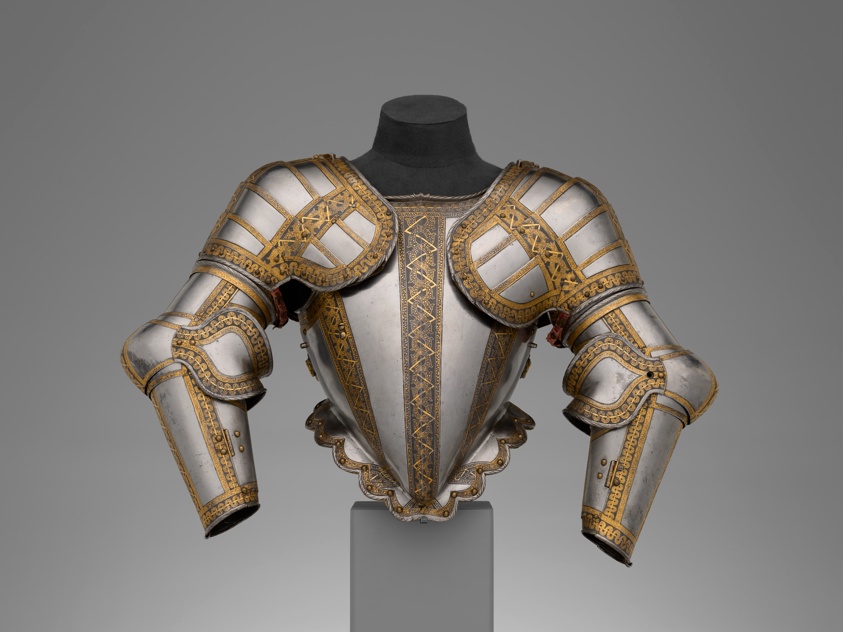
In the hallowed ateliers of Lauren Fashion Heritage Lab, we do not merely examine artifacts; we interrogate the silent dialogues between material and meaning. The object before us—a series of portions from a field armor, dating to the late 16th century—presents a paradox of preservation and performance. Its steel plates, burnished to a ghostly sheen, speak of battlefields and the brutal calculus of survival. Yet, it is the *unseen* thread that commands our deepest reverence: the silk velvet textile that once lined the interior, now faded to a whisper of its original crimson. This is not a mere lining. It is the soul of the armor, the point where the cold logic of metallurgy meets the fluid elegance of classic silk craftsmanship. In the lexicon of Savile Row, where a suit’s drape is judged by its fall, the silk within this armor dictates the *drape of power*—a soft, yielding interior that cradles the body, even as the exterior defies the sword.
Materiality as Narrative: Steel, Brass, and the Gilded Gesture
The armor’s primary structure is forged from low-carbon steel, hammered and shaped to deflect a blade’s trajectory. Its surface, once polished to a mirror finish, now bears the patina of centuries—a map of oxidation and wear that tells of campaigns and ceremonies. Yet, the steel is not the protagonist. It is the brass rivets, the gilded borders, and the leather straps that form the connective tissue of this artifact. The brass, an alloy of copper and zinc, was chosen for its malleability and resistance to corrosion, allowing for intricate decorative work. The gilding—a thin layer of gold leaf applied over a mordant—was not mere vanity. In the dim light of a 16th-century field, gold caught the sun, signaling rank and wealth to allies and enemies alike. This was a suit of *distinction*, not just defense.
The leather, vegetable-tanned and stitched with linen thread, served as the structural skeleton. It held the plates in tension, allowing the wearer to pivot, to parry, to ride. But here, the leather is secondary to the textile. The silk velvet—woven on a drawloom in Lyon or Milan—was the final, intimate layer. Its pile, once plush and deep, now compressed by time, still retains traces of its original dye: cochineal from the New World, a pigment more precious than gold. This silk was not a commodity; it was a *statement* of global reach, a thread connecting the armor’s wearer to the silk routes of the East and the dye markets of the Americas.
The Craft of the Unseen: Silk Velvet and the Savile Row Ethos
In the tradition of Savile Row, the *inside* of a garment is the mark of its maker. A bespoke suit’s canvas, its hand-stitched lapels, its silk lining—these are the details that separate the master from the merchant. The same principle governs this armor. The silk velvet lining was not a passive addition; it was engineered for function and grace. The velvet’s pile, woven from silk filaments twisted with a slight S-twist, created a microclimate of air pockets. This trapped heat in winter and wicked moisture in summer, a feat of thermal regulation that modern performance fabrics still strive to replicate. The weaver’s skill lay in the *lisage*—the precise arrangement of warp threads to create a dense, uniform pile that would not crush under the weight of steel. This was craftsmanship of the highest order, a silent partnership between the armorer and the textile artisan.
The fluid elegance of the silk is most evident in the articulation points—the elbow cops, the pauldrons, the gorget. Here, the velvet was cut on the bias, allowing it to stretch and contract with the wearer’s movement. This was not a static lining; it was a *dynamic membrane*, a second skin that moved with the body. In Savile Row terms, this is the equivalent of a *floating chest piece*—a structure that gives form without rigidity. The silk’s drape, its ability to fall and fold without buckling, was the result of a weave density of approximately 80 threads per centimeter, a standard that rivals the finest modern silk jacquards. The velvet’s pile height, measured at 1.2 millimeters, was calibrated to provide cushioning without adding bulk—a lesson in proportion that any tailor would recognize.
Heritage and the Art of Preservation
As a heritage specialist, I must ask: what does this artifact teach us about the intersection of luxury and utility? The silk velvet lining was the most expensive component of the armor, per square inch, yet it was hidden from view. This inversion of value—where the unseen is more precious than the seen—is a hallmark of true craftsmanship. It echoes the Savile Row philosophy that a garment’s integrity lies in its construction, not its surface. The armor’s silk is a testament to the belief that the wearer’s comfort and dignity are paramount, even in the face of violence.
The preservation of this silk is a challenge. The velvet’s pile has suffered from photodegradation, the cochineal dye fading to a muted rose. The silk fibers, once strong, are now brittle from hydrolysis—a slow chemical breakdown catalyzed by humidity. To conserve this textile, we employ anoxic storage, controlling oxygen levels to slow oxidation. We use micro-suction tools to remove surface dust without disturbing the pile. Each intervention is a negotiation between the past and the present, a dialogue with the original weaver’s intent.
Conclusion: The Fluid Elegance of Power
This field armor, in its portions, is a palimpsest of materiality and meaning. The steel, brass, gilding, and leather are the grammar of power—a language of defense and display. But the silk velvet is the poetry. It is the thread that binds the warrior to his humanity, the softness that makes strength bearable. In the context of classic silk craftsmanship, this artifact is a masterclass in *restrained opulence*—a quality that defines the best of Savile Row and the Lauren Fashion Heritage Lab’s mission.
When we handle these portions, we are not just touching history; we are touching the *intention* of the maker. The silk whispers of a time when elegance was not an afterthought but a foundation. It reminds us that the most enduring expressions of power are those that honor the body they protect. And in that, the armor’s silk is not a relic; it is a living standard—a benchmark for how we might weave luxury, function, and heritage into the garments of tomorrow.
Heritage Lab Insight
Lab Insight: AIC Silk Archive Node #106377.