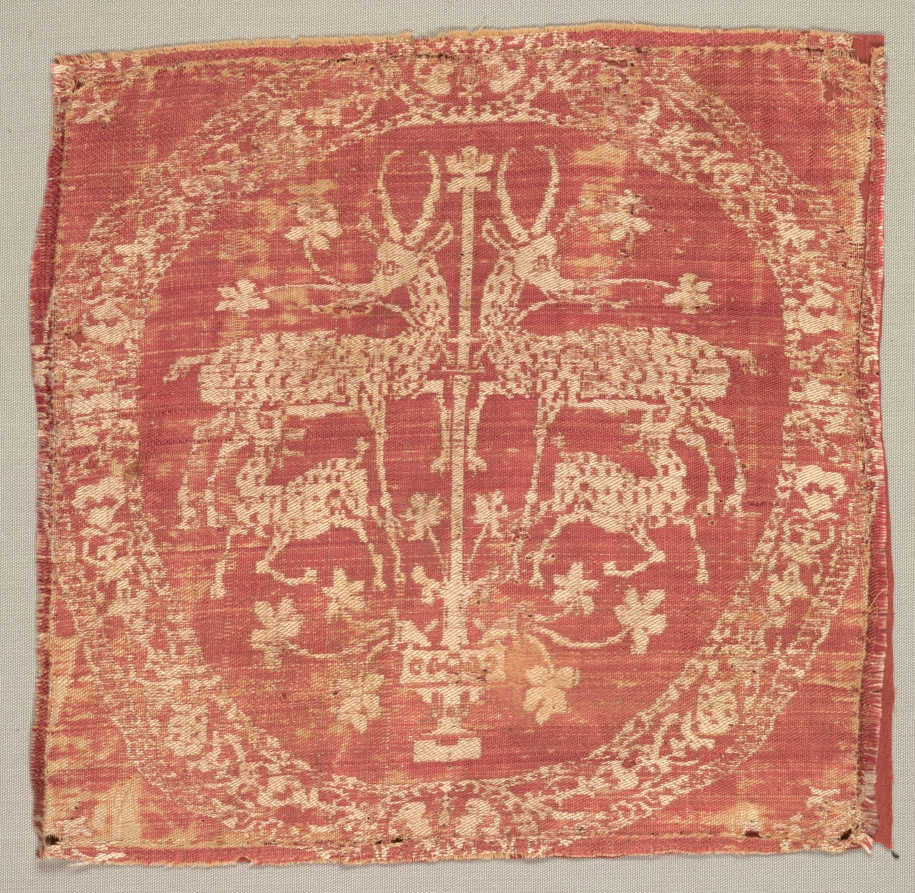
An Examination of the Square Ornament: A Testament to Imperial Patronage and Technical Mastery
To the discerning eye, the object in question—a square silk ornament, intended for application upon a tunic of state—transcends its modest dimensions. It is not merely a fragment of embellishment but a concentrated archive. Within its precise, geometric confines resides the entire legacy of imperial silk weaving: a narrative of absolute power, consummate craftsmanship, and a supply chain of unparalleled rigour. Its materiality, pure silk, is the foundational premise. This is not a fibre of mere utility, but the chosen medium of sovereignty, a tangible expression of celestial mandate and terrestrial order.
The Substrate of Sovereignty
Consider, first, the foundation. The cultivation of the silkworm, Bombyx mori, was an affair of state secrecy and imperial monopoly. The very production of the raw material was a guarded ritual, its protocols as fixed as those governing the court itself. This was not agriculture; it was alchemy. The resulting filament, a continuous protein thread of remarkable tensile strength and latent luminosity, provided the perfect canvas. Its inherent capacity to absorb dye with a singular depth and clarity was paramount. The colours one observes—the enduring vermilion, the profound azure—were not simply hues. They were codified expressions of rank, philosophy, and cosmology, derived from mineral and vegetable sources whose procurement and preparation were themselves specialised arts. The silk thread, therefore, arrived at the loom already imbued with layers of sanctioned meaning.
The Architecture of the Loom: A Regimented Universe
The translation of this prepared thread into a complex ornamental field was an exercise in pre-ordained geometry, executed on a scale of mechanical sophistication that bordered on the authoritarian. The imperial drawloom, a formidable apparatus of cords, heddles, and pulleys, required a team: a master weaver orchestrating the pattern from above, and a drawboy executing his commands below. This was not a process conducive to improvisation. The pattern for our square ornament—likely a symmetrical arrangement of phoenixes amidst scrolling clouds, or perhaps a stringent geometric fretwork—was pre-determined, its every intersection plotted with mathematical precision.
The technique employed, almost certainly that of kesi or slit-tapestry weaving, is of particular note. Here, the weft threads of various colours are built up in discrete areas, creating the pattern without the continuous back-and-forth motion of standard weaves. This method allows for sharp, painterly delineation and the subtle shading of motifs, granting an unparalleled pictorial quality. Yet, it is a demanding and time-intensive discipline. Each colour change represents a deliberate interruption, a calculated decision. The resulting small slits in the fabric where colours meet are not flaws, but the signature of the technique—a testament to a system that valued pictorial fidelity over expediency. The structural integrity of the ornament, its ability to lie flat and resist distortion, speaks to a mastery that managed these inherent tensions with absolute authority.
The Ornament as Instrument of State
The ultimate function of this artefact must be rigorously appraised. This square was not conceived for casual adornment. It was a badge, a heraldic device rendered in silk, destined to be applied to a tunic worn at court or during significant ceremony. Its placement—perhaps at the breast, or upon the shoulder—was dictated by sumptuary laws as intricate as the weave itself. In its fixed position, it communicated a silent, immediate lexicon of information about the wearer’s status, affiliation, and rank within the rigid hierarchy of the imperial system.
Furthermore, its very existence was a political act. The imperial workshops, often located within the precincts of the palace or under its direct supervision, were less manufactories and more instruments of soft power. The production of such textiles absorbed vast resources, employed legions of skilled artisans, and stimulated trade along the routes that supplied exotic dyes and materials. To bestow a garment bearing such ornaments was an act of immense favour, binding the recipient to the throne through a gift of incalculable material and symbolic value. The ornament, therefore, served as a node in a vast network of patronage and control.
Enduring Legacy: A Standard for Contemporary Excellence
What, then, is the enduring pertinence of this legacy? For the modern purveyor of bespoke attire, the imperial silk ornament offers profound object lessons. It speaks to the irreplaceable value of material integrity—the understanding that excellence begins with the fundamental quality of the fibre. It champions the virtue of technical rigour—a respect for process so deep that it becomes a philosophy, not merely a method. Most importantly, it embodies the principle of cohesive narrative. Every element of the ornament, from its dye to its draft, was in service to a singular, authoritative vision.
In an age of accelerated production and compromised substance, the square silk ornament stands as a silent arbiter of taste. It reminds us that true luxury is not defined by ostentation, but by this very confluence of perfect material, flawless execution, and intentional meaning. The legacy it carries is not one of mere antiquity, but of a standard—a reminder that to clothe the powerful is to engage in an act of profound cultural and technical statement. The loom may be silent, but the principles it wove into being continue to resonate with formidable clarity.