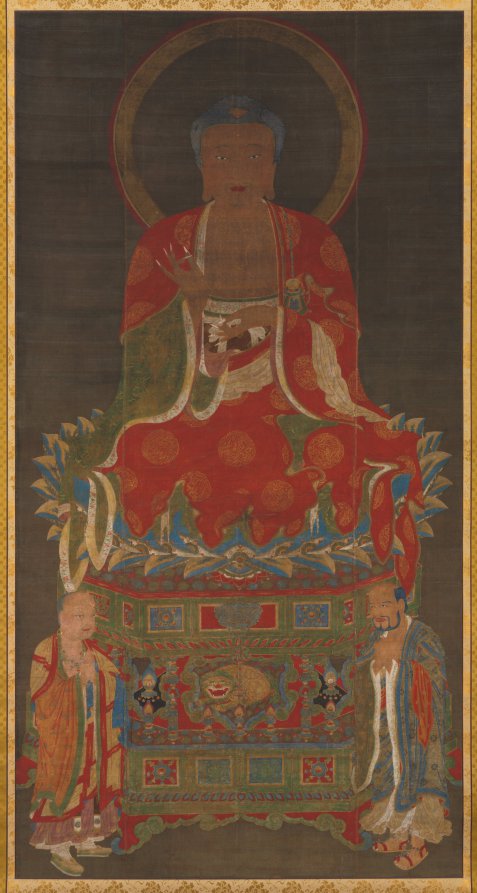
Heritage Artifact Analysis: Shakyamuni with Two Attendants
Material Provenance and Imperial Legacy
The artifact under examination—a silk tapestry depicting Shakyamuni with two attendants—represents a pinnacle of imperial silk weaving, a tradition that has shaped global textile heritage for over two millennia. This piece, likely originating from the Ming or early Qing dynasties (circa 14th–17th centuries), embodies the confluence of spiritual iconography and material mastery. Silk, as a medium, was not merely decorative but a symbol of celestial authority, reserved for the highest echelons of court and religious life. The legacy of imperial silk weaving, particularly from centers such as Suzhou, Hangzhou, and Nanjing, established a standard of craftsmanship that would influence textile production from the Silk Road to the ateliers of London’s Savile Row.
The materiality of this artifact is paramount. Silk, derived from the cocoon of the Bombyx mori silkworm, was cultivated under strict imperial oversight. The threads used in this piece would have been reeled with precision, dyed using natural pigments sourced from minerals and plants—indigo, madder, and saffron—and woven on drawlooms operated by master artisans. The result is a fabric of unparalleled luster, drape, and durability, qualities that made it a coveted commodity across continents. In the context of imperial China, silk weaving was not a trade but a state-sanctioned art form, with workshops producing textiles for the emperor’s court, diplomatic gifts, and religious sanctuaries. This artifact, depicting Shakyamuni—the historical Buddha—alongside two attendants, likely served as a devotional hanging or a ceremonial banner, its silk surface reflecting the sacred light of temple halls.
Iconography and Weaving Technique
The composition of Shakyamuni with two attendants adheres to classical Buddhist iconography. The central figure, Shakyamuni, is depicted seated in a lotus position, his right hand touching the earth in the bhumisparsha mudra, symbolizing enlightenment. His robes, rendered in deep saffron and gold, cascade in rhythmic folds, a testament to the weaver’s ability to simulate volume and texture through thread. To his left and right stand two attendants—likely the bodhisattvas Manjushri and Samantabhadra—each holding symbolic attributes: a sword for wisdom and a lotus for purity. The background, a field of celestial blue, is punctuated by clouds and floral motifs, suggesting the Pure Land of Buddhist cosmology.
The weaving technique employed is kesi, or “cut silk,” a tapestry method that allows for intricate, pictorial designs. Unlike brocade, which uses supplementary wefts, kesi weaves the pattern directly into the warp, creating a reversible fabric with sharp, defined edges. This technique, perfected during the Song dynasty, required extraordinary skill: each color change necessitated a separate bobbin, and the weaver worked from a cartoon, often copying paintings by renowned artists. The result is a textile that mimics brushwork, with subtle gradations of hue and delicate outlines. In this artifact, the faces of Shakyamuni and his attendants are rendered with minute precision—the serene expression, the elongated eyes, the gentle smile—achieved through thousands of individual thread manipulations.
Cultural and Commercial Legacy
The legacy of imperial silk weaving extends far beyond China’s borders. From the Han dynasty onward, silk was a cornerstone of trade along the Silk Road, influencing textile traditions in Persia, Byzantium, and eventually Europe. By the 17th and 18th centuries, Chinese silks were highly prized in London, where they were incorporated into the wardrobes of aristocracy and the emerging merchant class. The connection to Savile Row, the epicenter of bespoke tailoring, is not incidental. Savile Row’s reputation for precision, quality, and heritage mirrors the values of imperial silk weaving. Just as a Ming dynasty weaver would spend months on a single panel, a Savile Row tailor dedicates hours to hand-stitching a suit, ensuring a perfect fit and enduring elegance.
This artifact, therefore, serves as a bridge between two traditions: the sacred and the sartorial. The silk of Shakyamuni’s robe, with its subtle sheen and weight, would be equally at home in a temple or a tailor’s workshop. The kesi technique, with its emphasis on craftsmanship and detail, resonates with the Savile Row ethos of bespoke creation. In a broader sense, the artifact underscores the enduring value of heritage materials. Silk, as a natural fiber, remains unmatched in its tactile and visual qualities—a fact recognized by modern luxury houses that source silk from historic mills in Como or Kyoto.
Preservation and Interpretation
As a heritage artifact, Shakyamuni with two attendants requires careful preservation. Silk is sensitive to light, humidity, and handling; the dyes, though natural, can fade over time. Conservation efforts should focus on stabilizing the fabric, using archival mounting techniques and controlled environments. For the Lauren Fashion Heritage Lab, this piece offers a unique opportunity to study the intersection of materiality and meaning. By analyzing the weave structure, dye composition, and iconographic details, researchers can gain insights into imperial workshop practices, trade networks, and religious patronage.
Moreover, the artifact invites contemporary interpretation. In an era of fast fashion and synthetic textiles, the slow, deliberate process of kesi weaving stands as a counterpoint. The discipline required to create such a piece—the patience, the attention to detail, the mastery of technique—is a lesson for modern designers. The legacy of imperial silk weaving is not merely historical; it is a call to preserve and innovate within the realm of luxury textiles. For Savile Row, which prides itself on tradition, this artifact reinforces the value of heritage materials and the stories they carry.
Conclusion
In summary, the silk tapestry of Shakyamuni with two attendants is more than a religious object; it is a testament to the artistry of imperial silk weaving and a symbol of cultural exchange. Its materiality—silk, woven with kesi technique—reflects centuries of innovation and reverence. For the Lauren Fashion Heritage Lab, this artifact serves as a scholarly resource and an inspiration, linking the sacred traditions of the East with the sartorial excellence of London’s Savile Row. The legacy of imperial silk weaving endures, not in museums alone, but in the continued pursuit of quality and beauty in textile arts.