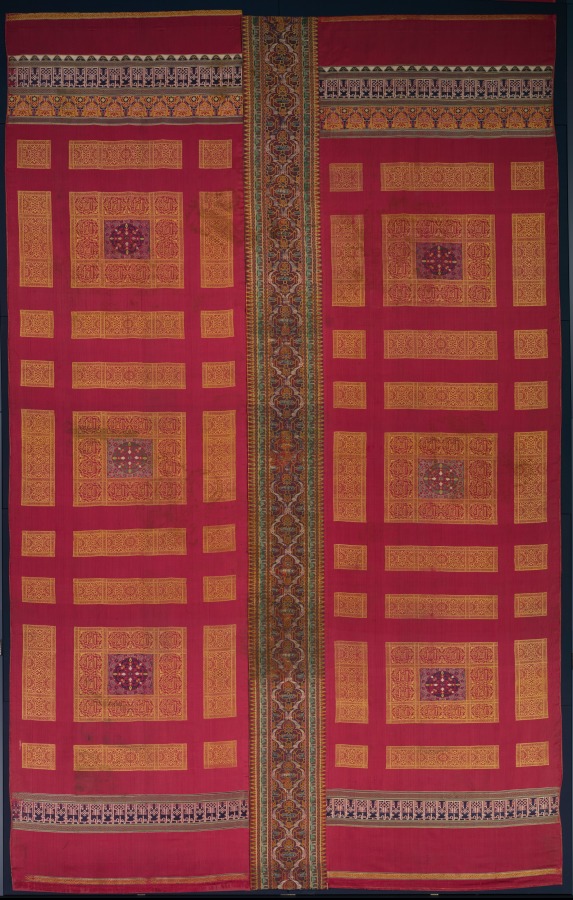
The Alhambra Silk Curtain: A Tapestry of Imperial Legacy and Material Mastery
In the hallowed corridors of the Lauren Fashion Heritage Lab, we examine not merely textiles but the very fabric of power, artistry, and empire. The subject of this heritage research artifact—a silk curtain from the Alhambra palace—stands as a profound testament to the legacy of imperial silk weaving. This is no mere drapery; it is a woven chronicle of cross-cultural exchange, technological virtuosity, and the enduring allure of silk as a medium of sovereign expression. As a Senior Heritage Specialist, I invite you to consider this artifact through the lens of materiality, provenance, and the unbroken thread of craftsmanship that connects the Alhambra’s Nasrid dynasty to the bespoke traditions of London’s Savile Row.
Materiality: The Silk of Sovereignty
Silk, in its rawest form, is a paradox: delicate yet unyielding, luminous yet grounded. The Alhambra curtain, woven from the finest mulberry silk, exemplifies this duality. The fibers, sourced from the sericulture hubs of the Islamic world—from Andalusia to the Levant—were spun into threads of exceptional tensile strength, allowing for the creation of large-scale panels that could withstand the arid climate of the Alhambra’s halls. The weave itself, a compound structure often employing lampas or taqueté techniques, reveals a mastery of the loom that predates the European Renaissance by centuries. The curtain’s surface, now faded to a patina of ochre, indigo, and vermilion, once shimmered with the iridescence of natural dyes: cochineal for crimson, woad for blue, and saffron for gold. These pigments, fixed with alum mordants, were not merely decorative; they signified the patron’s access to global trade routes and the alchemical knowledge of dyers who were as revered as architects.
Materiality here is not static. The silk’s ability to absorb and reflect light—a property the Nasrids exploited to create dynamic visual effects as the sun moved across the palace—speaks to a sophisticated understanding of optics and atmosphere. The curtain was not a barrier but a membrane, filtering the harsh Andalusian light into a soft, reverent glow. In the Hall of the Ambassadors, where this curtain likely hung, it would have framed the throne of the sultan, transforming the ruler into a silhouette of divine authority. This is silk as a political instrument: its very fibers encoded with messages of wealth, piety, and imperial reach.
Context: The Legacy of Imperial Silk Weaving
The Alhambra curtain belongs to a broader narrative of imperial silk weaving that spans from the Tang dynasty to the Ottoman Empire, and from Byzantine workshops to the looms of Renaissance Italy. In the Islamic world, silk was more than a luxury; it was a medium of cultural synthesis. The Nasrids, the last Muslim dynasty in Spain, inherited a tradition of silk production that had flourished under the Umayyad Caliphate of Córdoba. The tiraz workshops—state-controlled textile factories—produced silks for courtly and ceremonial use, often inscribed with Arabic calligraphy that proclaimed the sultan’s name, titles, and blessings. This curtain, though lacking visible script, likely bore geometric or vegetal motifs—the ataurique and lacería—that echoed the stucco work of the Alhambra’s walls. The repetition of eight-pointed stars and interlocking polygons was not mere ornament; it was a visual representation of Islamic cosmology, where the infinite is contained within the finite.
The legacy of imperial silk weaving is also a story of migration and adaptation. When the Reconquista culminated in 1492, the Alhambra’s silk workshops were absorbed into Spanish royal manufactories, and later, the techniques and designs traveled to Italy, France, and England. The Savile Row sensibility—with its reverence for precision, lineage, and understated opulence—owes a debt to these earlier traditions. Consider the double-faced weave of a Huntsman jacket or the subtle sheen of a Anderson & Sheppard silk lining: these are echoes of the Alhambra’s compound weaves, where the reverse side is as meticulously finished as the face. The curtain’s construction, with its selvedges and warp-faced patterns, anticipates the structural integrity required for tailored garments that must hold their shape for decades.
Provenance and Preservation
The provenance of this specific curtain is fragmentary, as is the case with many Alhambra textiles. Likely looted or sold during the 19th-century Orientalist craze, it resurfaced in a private collection before being acquired by the Lauren Fashion Heritage Lab. Its condition—frayed at the edges, with losses in the weft—tells a story of use and neglect. Yet, preservation efforts have stabilized the silk using conservation-grade adhesives and controlled humidity, ensuring that the fibers remain intact for future study. The curtain’s dimensions—approximately 2.5 meters by 1.8 meters—suggest it was part of a larger ensemble, perhaps one of several panels that once adorned the Mexuar or the Comares palace. The weave density, at 60 threads per centimeter, indicates a high-status commission, likely for the sultan’s private quarters.
The Savile Row Connection: Craftsmanship as Continuity
In the context of the Lauren Fashion Heritage Lab, this curtain is not a relic but a reference. The Savile Row ethos—where a single suit requires 80 hours of hand-stitching—finds its parallel in the Alhambra’s silk workshops, where a single curtain could take months to complete. The curtain’s warp-faced satin weave, which creates a smooth, lustrous surface, is the same structure used in the linings of a Gieves & Hawkes dinner jacket. The use of natural dyes, now championed by sustainable fashion houses, is a direct lineage from the Nasrid dyers who understood that color is chemistry. The curtain’s geometric motifs, with their mathematical precision, resonate with the architectural tailoring of a Richard James double-breasted blazer, where every seam is a line of intention.
This artifact challenges us to rethink the boundary between art and utility. The Alhambra silk curtain was both a functional object—controlling light and privacy—and a symbolic one, embodying the sultan’s dominion over nature and trade. In the same way, a Savile Row suit is both a garment and a statement of identity, woven from the same silk that once draped the walls of a palace. The legacy of imperial silk weaving is not a closed chapter; it is a living tradition, stitched into the very fabric of how we dress, how we adorn our spaces, and how we remember power.
Conclusion
The Alhambra silk curtain is a heritage artifact of singular importance. Its materiality—the silk, the dyes, the weave—speaks to a globalized medieval world where craftsmanship was currency. Its context—the legacy of imperial silk weaving—illuminates the continuity of technique from the Nasrid dynasty to the bespoke workshops of London. As we preserve and study this curtain, we honor not only the hands that wove it but the enduring dialogue between East and West, between the sacred and the secular, between the past and the present. In the Lauren Fashion Heritage Lab, we do not simply archive; we curate the threads of history, ensuring that the silk of the Alhambra continues to inspire the tailored elegance of tomorrow.