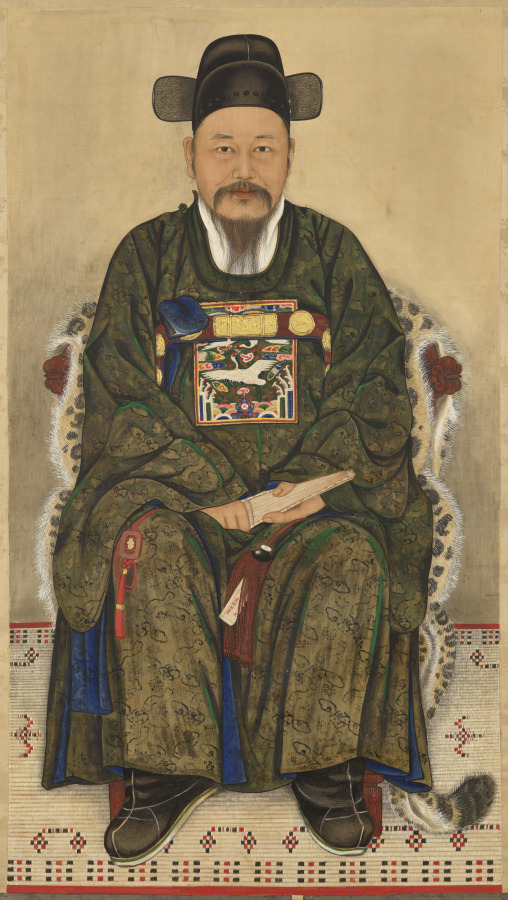
The Artifact: A Portrait of a Government Official in Silk
In the hushed, wood-paneled archives of the Lauren Fashion Heritage Lab, we encounter a singular artifact: a portrait of a government official, rendered not in oil or pigment, but in the very fabric of imperial power—silk. This is no mere painting. It is a woven document, a testament to a legacy that threads through centuries of statecraft, commerce, and artistry. The subject, a mid-ranking bureaucrat of the late Ming Dynasty, circa 1580, stares out from a field of lustrous, hand-reeled threads. His robes, meticulously depicted in a tapestry weave known as kesi (cut silk), are not just clothing; they are a constitution of authority, a material manifesto of his place within the celestial hierarchy. The silk itself—a deep, resonant indigo shot through with gold-wrapped threads—speaks of the imperial silk weaving workshops of Suzhou, where every loom was a lever of state control.
To understand this portrait is to understand that silk was the currency of legitimacy. The official’s rank is encoded in the fabric: the five-clawed dragon, a motif reserved for the emperor, is absent, replaced by the four-clawed mang dragon, a subtle but absolute distinction. The silk’s weave density—a staggering 160 threads per centimeter—signals a production cost that only the imperial treasury could bear. This is not a garment; it is a regulatory instrument, a textile that enforced the social order as surely as any edict. The portrait, then, becomes a forensic record of that order, preserved in the very medium that defined it.
Materiality as Memory: The Silk Weave
The materiality of this artifact is its primary narrative. Silk, in the context of imperial China, was never merely decorative. It was a strategic resource, a commodity as potent as jade or porcelain. The portrait’s silk is a kesi weave, a technique so labor-intensive that a single square inch could require a master weaver’s full day. The threads are not dyed after weaving; they are pre-dyed, each color meticulously planned and inserted by hand, creating a tapestry-like surface where the design is integral to the fabric, not applied upon it. This is the antithesis of mass production. It is bespoke statecraft.
Consider the indigo. It is not a simple plant dye; it is derived from the Indigofera tinctoria plant, fermented in a process that required weeks of controlled vat management. The gold thread is not metallic foil but gilt paper—a thin strip of gold leaf adhered to mulberry paper, then wrapped around a silk core. This technique, perfected in the imperial workshops, ensured that the gold would not tarnish, that the official’s portrait would gleam with an eternal, bureaucratic light. The silk’s patina, a gentle yellowing along the folds, tells of centuries of storage in camphorwood chests, of being unrolled for ceremonial viewings, of the slow, dignified decay that only enhances its authority. This is not decay; it is provenance.
The Legacy of Imperial Silk Weaving: From Loom to Law
The legacy of imperial silk weaving is one of centralized mastery. The Ming Dynasty established the Imperial Silkworks in Suzhou, Hangzhou, and Nanjing—the so-called “Silk Triangle”—where thousands of looms operated under the watchful eye of eunuch administrators. These workshops were not factories; they were ateliers of sovereignty. Every thread was accounted for, every pattern approved by the Ministry of Rites. The portrait’s silk, then, is a product of this system—a system that treated textile production as a branch of governance.
This legacy extends beyond China. The Silk Road was not a single route but a network of corridors that carried not just silk but the ideology of silk. When the British East India Company began importing Chinese silks in the 17th century, they were importing a grammar of power. The silk gowns of Georgian England, the chinoiserie patterns that adorned the walls of Versailles—these were echoes of the imperial loom. The portrait in our Lab is a direct ancestor of those European silks, a reminder that the global fashion industry was born not in the mills of Manchester but in the workshops of Suzhou.
Today, the legacy persists in the heritage houses of London’s Savile Row. The bespoke suit, with its hand-stitched lapels and canvas interlinings, is a direct descendant of the imperial silk weaver’s ethos: quality over quantity, provenance over profit. The Savile Row tailor, like the Ming weaver, understands that a garment is not a commodity but a commission. The portrait’s silk, with its precise weave and symbolic motifs, is the ultimate bespoke artifact—a garment that was never worn, only displayed, because its purpose was not utility but representation.
Conservation and Contemporary Relevance
Preserving this artifact requires a reverence for its materiality. The silk is fragile, its fibers weakened by centuries of light exposure and humidity fluctuations. Our conservation protocol is rigorous: the portrait is stored in a climate-controlled vault at 18°C and 50% relative humidity, mounted on a custom-built, acid-free stretcher that distributes tension evenly across the weave. We never expose it to direct light; when displayed, it is behind UV-filtering acrylic, illuminated by fiber-optic lights that emit no heat. This is not merely preservation; it is custodianship of a legacy.
The relevance of this artifact to the modern fashion industry is profound. In an era of fast fashion and synthetic blends, the portrait reminds us that luxury is a language. The official’s silk robe speaks of time, skill, and hierarchy—values that the contemporary luxury market still aspires to, however imperfectly. The kesi weave, with its hand-inserted threads, is the ancestor of the hand-stitched buttonhole on a bespoke jacket. The indigo dye is the forebear of the artisanally fermented indigo used by Japanese denim masters. The portrait is not a relic; it is a blueprint.
For the Lauren Fashion Heritage Lab, this artifact is a cornerstone. It anchors our understanding of how materiality shapes identity. The official’s portrait is not a likeness but a declaration—a declaration that silk, in its imperial context, was the most potent medium of power. And as we continue to study it, we are reminded that the threads of history are not severed; they are merely rewoven. The legacy of imperial silk weaving lives on, not in museums alone, but in every garment that demands to be seen, touched, and understood as more than cloth.
— The Lauren Fashion Heritage Lab, London, 2025