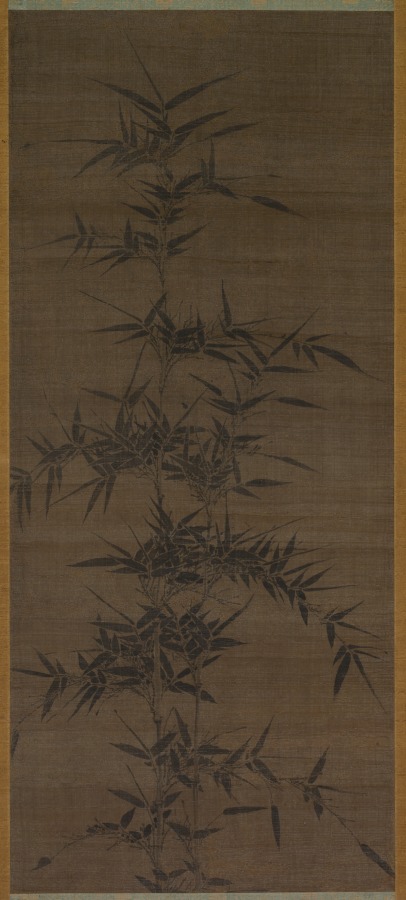
On the Material Confluence of Ink Bamboo and Imperial Silk
To comprehend the subject at hand—the rendering of Ink Bamboo upon silk of an imperial grade—one must first appreciate the profound dialogue it represents. This is not mere decoration; it is a confluence of two distinct, yet profoundly complementary, legacies of craftsmanship. On one hand, the ink bamboo, a motif born of scholarly introspection and philosophical depth, a testament to the literati’s pursuit of essence over mere form. On the other, the imperial silk loom, an engine of state-sponsored magnificence, representing the zenith of technical precision, opulent materiality, and consummate skill. Their union is, in the most refined sense, a negotiation between the expressive, individualistic brushstroke and the exacting, collaborative discipline of the weave.
The Substrate: A Foundation of Authority
Let us first establish the foundation: the silk itself. Imperial silk weaving, particularly as perfected during the Ming and Qing dynasties, was less an industry and more a rigorously governed protocol. State-controlled workshops in Nanjing, Suzhou, and Hangzhou operated with a precision that would satisfy the most exacting of modern auditors. The threads, derived from the finest Bombyx mori, were selected with a fastidiousness bordering on the obsessive. The resulting fabric was not simply a material; it was a canvas of latent potential, possessing a luminosity, a tensile strength, and a receptive surface that declared its pedigree before a single additional element was applied.
This was a material reserved for the dragon robes of emperors, the ceremonial garments of the court, and diplomatic gifts of the highest significance. Its very presence communicated authority, stability, and a command over the natural world. To propose applying the ostensibly modest, monochromatic theme of ink bamboo to such a regal substrate is an act of deliberate intellectual and aesthetic audacity. It elevates the motif from the scholar’s paper to the realm of symbolic power, while simultaneously tempering the silk’s innate opulence with a note of philosophical restraint.
The Motif: The Bamboo, Rendered in Essence
Turning to the motif, the Ink Bamboo tradition is an exercise in controlled expressionism. It eschews the polychrome realism of courtly decoration for a monochrome palette where depth, texture, and spirit are conveyed through the masterful manipulation of ink dilution and brush pressure. The bamboo is never merely depicted; it is evoked. Its joints signify integrity; its resilient, bending form in the wind represents humility and endurance; its evergreen nature speaks to constancy. For the scholar-official, painting bamboo was a meditative practice, a cultivation of one’s own character mirrored in the swift, sure strokes that captured the plant’s qi, or vital spirit.
The challenge, and the genius, of translating this onto silk lies in the transposition of a spontaneous, individual gesture into the pre-meditated, collective execution of the loom. The weaver cannot afford the improvisation of the literati painter. Each gradation of ink—from the deepest, wettest black to the most ephemeral, dry-brush grey—must be meticulously planned, translated into counts of warp and weft, and executed through a complex vocabulary of weave structures. The “brushstroke” becomes a carefully engineered interplay of satin and twill, its edges defined not by the flick of a wrist, but by the precise lifting of heddles.
The Synthesis: Where Philosophy Meets Mechanism
This synthesis is where the true heritage artifact is forged. The imperial silk loom, often a sophisticated draw-loom operated by a master weaver and an assistant pulling the pattern cords, was capable of extraordinary pictorial subtlety. To render ink bamboo, the weaver would employ a technique such as kesi (slit-tapestry) or, more commonly for pictorial silks, a satin-weave ground with supplementary weft patterning. This allowed for the creation of nuanced, shaded areas that could mimic the tonal washes of ink.
Consider the execution: the stark, confident line defining a bamboo stalk might be rendered in a dense, raised satin weave, catching the light differently from the matte ground. The delicate leaves, suggesting movement, could be executed with finer, staggered supplementary wefts to create a sense of feathery transparency. The empty space—the crucial negative space so vital to Chinese aesthetics—is not an absence, but is actively formed by the uninterrupted, lustrous flow of the plain silk ground. The result is a tactile translation of a philosophical ideal. The motif retains its scholarly resonance, but gains a new dimension of tactile luxury and permanence. It is no longer a painting susceptible to the ravages of time and humidity; it is a woven monument, its integrity locked into the very structure of the cloth.
A Legacy in Cloth
Thus, the heritage artifact of Ink Bamboo on imperial silk stands as a peerless exemplar of material and conceptual harmony. It represents the apotheosis of two parallel traditions: the introspective world of the scholar and the magnificent apparatus of the state. The silk confers dignity and durability upon the bamboo; the bamboo imbues the silk with soul and intellectual gravitas. This is not a garment for ostentatious display, but for considered appreciation. It would be worn by the courtier who is also a poet, displayed in the hall that values cultivation as much as power.
In preserving and studying such an artifact, we do not merely conserve a textile. We maintain an understanding of how the highest forms of material production can be placed in service of the most refined philosophical concepts. It is a testament to the fact that true luxury lies not in abundance alone, but in the authoritative synthesis of meaning, material, and masterful execution—a principle as applicable to the historical ateliers of Suzhou as it is to the bespoke workshops of today. The legacy is clear: excellence endures where profound intent is woven into the very fabric of creation.