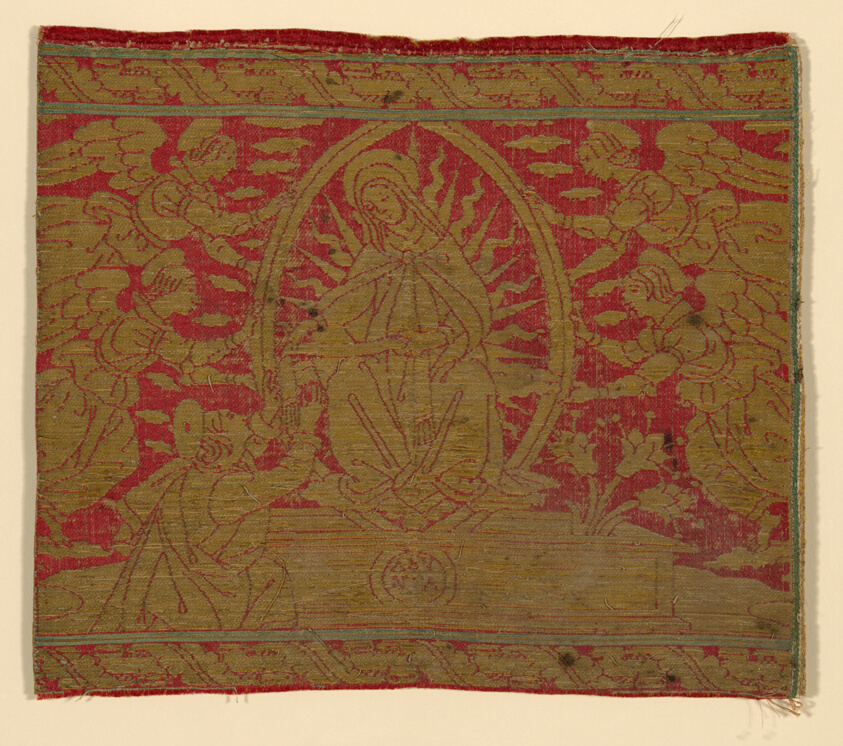
Heritage Research Artifact: Fragment (From an Orphrey Band)
Provenance and Context
This fragment, excised from an ecclesiastical orphrey band, represents a pinnacle of medieval silk craftsmanship, likely originating from the workshops of Lucca or Venice in the late 14th to early 15th century. Orphrey bands, embroidered or woven bands applied to liturgical vestments such as chasubles and copes, served both functional and symbolic roles: they delineated sacred spaces on garments while showcasing the technical mastery of their creators. The fragment’s survival—a mere whisper of its original form—offers a rare window into the intersection of artistry, trade, and ritual. Its materiality, as defined by the complex weave structure, underscores the global networks that supplied raw materials, from Chinese silk to gilt-animal-substrate-wrapped linen, a testament to the pre-industrial luxury economy.
Materiality and Weave Analysis
The fragment’s construction is defined by a warp-float faced satin weave, a technique that prioritizes the luster and smoothness of the silk warp threads. In a satin weave, the warp floats over multiple weft threads, creating a reflective surface that catches light with a fluid elegance. Here, the primary warp threads are silk, dyed in deep crimson and azure—colors derived from kermes and woad, respectively, both costly imports. The weft, by contrast, is a gilt-animal-substrate-wrapped linen, a composite thread where a linen core is wrapped in strips of animal membrane (likely vellum or goldbeater’s skin) gilded with gold leaf. This technique, known as or nué or “shaded gold,” allowed for subtle tonal variations, as the gold’s reflection could be modulated by the density of the wrapping.
The weave incorporates twill interlacings of secondary binding warps, which function as a structural counterpoint to the satin’s fluidity. These binding warps, typically of a finer silk or linen, create a twill pattern that anchors the supplementary patterning wefts. The supplementary patterning wefts are additional threads introduced to form the decorative motifs—likely heraldic beasts, floral scrolls, or geometric patterns—that would have adorned the orphrey. These wefts are not part of the ground weave; instead, they float on the surface, creating a raised, textured effect that contrasts with the satin’s smoothness. The twill interlacings ensure that these supplementary threads are securely bound, preventing snagging while maintaining the fabric’s drape.
Technical Mastery and Craftsmanship
The fragment’s weave is a masterclass in tension management. The warp-float faced satin requires a high warp tension to achieve its characteristic sheen, yet the introduction of gilt-animal-substrate-wrapped linen wefts—which are stiffer and less pliable than silk—demands a delicate balance. Too much tension, and the gold wrapping fractures; too little, and the satin loses its gloss. The secondary binding warps, interlaced in a 2/1 twill, act as a stabilizing force, distributing stress across the fabric. This interplay between the satin’s fluidity and the twill’s rigidity is the hallmark of a skilled weaver, likely a master in a guild-controlled workshop.
The use of gilt-animal-substrate-wrapped linen is particularly noteworthy. Unlike gold thread wrapped around a silk core, which was common in Byzantine and Islamic textiles, the animal substrate offered a lighter, more flexible alternative. The membrane, often sourced from calf or goat, was treated with alum to receive the gold leaf, then cut into fine strips and wound around the linen. This process, documented in medieval treatises like the De Diversis Artibus by Theophilus, required precision: the gold leaf had to be applied while the membrane was still moist, ensuring adhesion without cracking. The resulting thread, though less durable than solid gold, allowed for intricate patterning without excessive weight, making it ideal for orphrey bands that needed to drape elegantly over vestments.
Symbolism and Aesthetic
The fragment’s design, though incomplete, suggests a narrative or heraldic function. Orphrey bands often depicted saints, biblical scenes, or donor coats of arms, serving as both devotional aids and status markers. The crimson and azure silk, combined with the gold wefts, would have created a visual hierarchy: the gold catching the light during liturgical processions, while the satin’s depth of color evoked the richness of heaven. The twill interlacings, visible only on close inspection, added a subtle texture that invited tactile engagement—a reminder that medieval textiles were experienced not just visually but through touch, as vestments were handled during rituals.
This fragment also reflects the fluidity of cultural exchange. The satin weave, perfected in China, was adapted by Italian weavers who integrated Islamic and Byzantine motifs. The gilt-animal-substrate technique, meanwhile, has parallels in Central Asian and Persian textiles, suggesting a diffusion of knowledge along the Silk Road. The orphrey band, as a liturgical object, thus embodies a synthesis of global traditions, all funneled through the lens of Christian iconography.
Preservation and Legacy
Today, this fragment is a rare survivor. The fragility of the gilt-animal-substrate—prone to oxidation and delamination—means that many such textiles have been lost to time. Its preservation, likely in a climate-controlled archive, allows for continued study. Conservators must handle it with care: the gold leaf can flake, and the silk warps are susceptible to light damage. Yet, even in its fragmented state, the artifact offers invaluable data for historians of technology, art, and religion. It challenges the notion of medieval textiles as mere decoration, revealing them as complex systems of material, technique, and meaning.
For the Lauren Fashion Heritage Lab, this fragment serves as a benchmark for understanding pre-industrial luxury. Its weave structure—warp-float faced satin with twill interlacings and supplementary patterning wefts—remains a reference for contemporary textile designers seeking to replicate its fluid elegance. The gilt-animal-substrate-wrapped linen, meanwhile, inspires modern innovations in sustainable luxury, where natural materials are combined with artisanal techniques. In preserving and studying this fragment, we honor the anonymous weavers whose hands transformed silk, gold, and linen into objects of enduring beauty.
Conclusion
This fragment from an orphrey band is not merely a relic; it is a testament to the ingenuity of medieval craftsmanship. Its materiality—silk and gilt-animal-substrate-wrapped linen, woven in a warp-float faced satin with twill interlacings—speaks to a global economy of luxury, a technical mastery of tension and texture, and a symbolic language of faith and power. As a heritage research artifact, it invites us to look beyond the fragment and imagine the whole: the vestment it adorned, the hands that wove it, and the rituals it served. In doing so, it reminds us that heritage is not static; it is a dialogue between past and present, woven thread by thread.