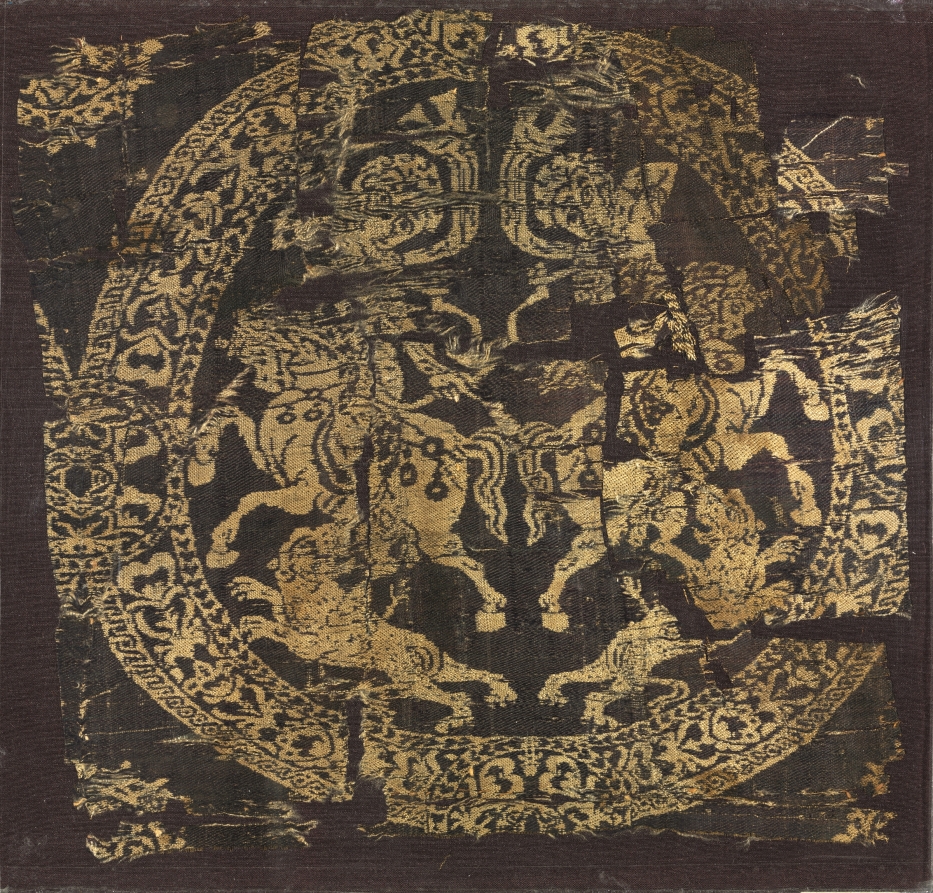
The Roundel with Amazons: A Testament to Imperial Silk Weaving’s Enduring Legacy
In the hushed, wood-paneled ateliers of London’s Savile Row, where the whisper of shears against cloth is a sacred ritual, we understand that fabric is never merely material. It is narrative, it is power, it is the tangible echo of a civilization’s ambition. The Roundel with Amazons, from a tunic, a fragment of silk dating from the late antique or early Byzantine period, is precisely such an artifact. It is not simply a decorative textile; it is a masterclass in the legacy of imperial silk weaving, a discipline that married technological prowess with ideological messaging. As we examine this roundel, we must approach it with the same exacting eye we would apply to a bespoke suit: appreciating the weave, the pattern, the provenance, and the profound statement it makes about the society that produced it.
Materiality and the Imperial Monopoly of Silk
The roundel’s materiality—its very substance—is its first and most commanding declaration. Silk, in the late Roman and Byzantine empires, was not a commodity of casual trade. It was a state-controlled treasure, a strategic resource as coveted as gold. The legacy of imperial silk weaving begins with the monopolization of sericulture, a secret guarded by the Chinese for millennia, and later, through a combination of espionage and trade, harnessed by the Byzantine state under Emperor Justinian in the 6th century. This silk, likely woven in a state-run workshop in Constantinople or a major Syrian center like Antioch, was a currency of power. To wear it was to be draped in the empire’s economic and diplomatic might. The roundel’s survival as a fragment from a tunic reminds us that this was a garment of status—perhaps a military commander’s ceremonial dress or a high-ranking official’s uniform. The silk itself, with its fine, lustrous threads, speaks of a weaving tradition that demanded precision and patience. The weaver’s hand, guided by a pattern drawn from classical mythology, transformed a raw, organic fiber into a statement of imperial identity.
Iconography: The Amazon as a Symbol of Imperial Virtue
The choice of the Amazon motif is no mere decorative whim. In the classical and late antique imagination, the Amazons were warrior women, figures of martial prowess, discipline, and otherness. They represented a controlled chaos, a formidable force that could be both feared and admired. On a tunic worn by a Roman or Byzantine elite, the Roundel with Amazons serves as a visual allegory. The Amazon, often depicted in combat or in a stance of victory, mirrors the empire’s own narrative of conquest and order. She is a symbol of virtus—courage and military excellence. The roundel’s circular form, or orbiculus, is itself a deliberate design choice. In the lexicon of imperial weaving, the circle is a symbol of eternity, of the unbroken cycle of imperial rule. The Amazon, contained within this perfect geometry, becomes a controlled emblem of strength. She is not a wild, untamed figure; she is a curated image of power, woven into the very fabric of the state. This iconographic program was not accidental. It was a sophisticated form of soft power, reinforcing the wearer’s alignment with the empire’s martial and civilizing mission.
Weaving Technique: The Art of the Tapestry Weave
To appreciate the legacy of imperial silk weaving, one must understand the technical mastery required to produce such a roundel. This artifact was likely created using a tapestry weave, a technique where the weft threads are discontinuous, allowing for intricate, multi-colored patterns. The silk threads, dyed with precious substances like madder for red, woad for blue, and perhaps even Tyrian purple for the most elite garments, were woven on a vertical loom. The weaver worked from the back, following a cartoon or pattern, and the result is a fabric that is both supple and dense. The roundel’s design, with its detailed human figures and geometric borders, demanded an extraordinary level of skill. Each thread had to be manipulated individually, creating a surface that is as much a painting as it is a textile. This is not mass production; it is bespoke artistry. The weaver, likely a master artisan in a state workshop, was a silent collaborator in the imperial project. Their hands translated political ideology into a wearable form, ensuring that every thread reinforced the empire’s narrative of power and permanence.
Context: The Tunic as a Mobile Canvas of Empire
The roundel was not an isolated object; it was part of a larger garment, a tunic that served as a mobile canvas. In the late antique world, the tunic was the universal garment, but its decoration signaled rank and allegiance. A tunic adorned with roundels featuring Amazons would have been worn by a figure of authority—a general, a governor, or a member of the imperial court. The roundel, positioned at the shoulder or the hem, was a focal point, drawing the eye and demanding recognition. This practice of using woven imagery to communicate status is a direct antecedent to the heraldic and regimental insignia that would later define European military and aristocratic dress. The legacy of imperial silk weaving thus extends beyond the Byzantine era. It establishes a template for how textiles can encode power, a template that would be refined in the silk workshops of medieval Sicily, Renaissance Italy, and ultimately, the bespoke tailoring houses of modern London. When a Savile Row tailor selects a silk lining for a jacket, they are participating in a lineage that stretches back to these imperial workshops.
Preservation and the Modern Gaze
Today, the Roundel with Amazons is a fragment, a survivor of time, climate, and neglect. Its preservation is a testament to the durability of silk and the reverence with which such objects were treated. As a heritage specialist, I view this artifact not as a relic of a bygone era, but as a living document. It challenges us to consider the relationship between material and message, between craft and power. In the context of Lauren Fashion Heritage Lab, this roundel is a case study in how heritage informs contemporary design. The Amazon’s fierce elegance, the discipline of the weave, the imperial ambition—all of these are threads that can be woven into modern collections. The legacy of imperial silk weaving is not a closed chapter; it is an ongoing dialogue. The roundel reminds us that the finest textiles are never just about aesthetics. They are about identity, authority, and the enduring human desire to leave a mark on the fabric of history.
Conclusion
The Roundel with Amazons is more than a beautiful object. It is a strategic artifact of the legacy of imperial silk weaving, a discipline that elevated textile production to a state art. Its silk speaks of monopoly and trade; its iconography speaks of power and virtue; its weave speaks of mastery and precision. For those of us on Savile Row, where every stitch is a commitment to quality and narrative, this roundel is a profound ancestor. It teaches us that a garment can be a declaration, that a thread can carry the weight of an empire. And in that lesson, we find the enduring relevance of heritage, woven into the very fabric of our craft.