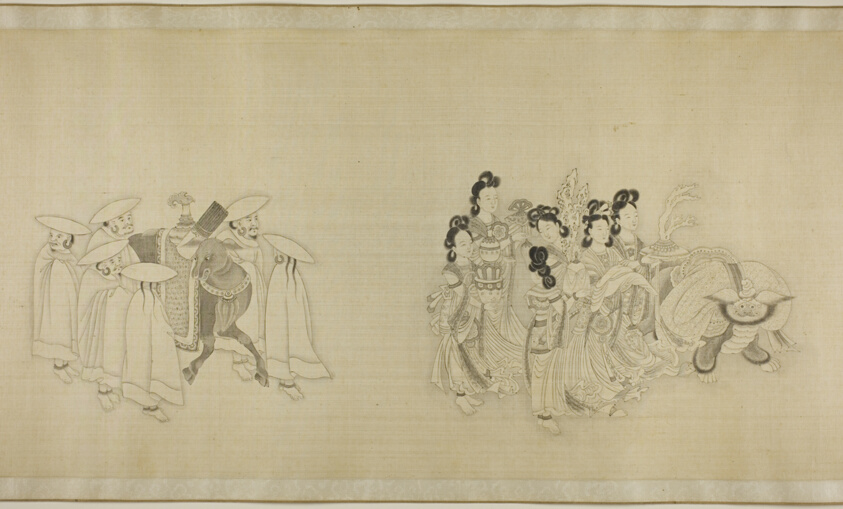
The Art of Diplomacy: Deconstructing the “Envoys Presenting Tribute” Handscroll
In the hushed, wood-paneled ateliers of London’s Savile Row, where the cut of a lapel is a statement of lineage and the drape of a fabric a testament to centuries of mastery, we understand that true luxury is never merely decorative. It is a language. It is a chronicle of power, patience, and provenance. The heritage artifact before us—a handscroll executed in ink on silk, titled “Envoys Presenting Tribute”—is not simply a painting. It is a sartorial and diplomatic document of the highest order, a silent negotiation conducted through the medium of the loom and the brush. For the Lauren Fashion Heritage Lab, this piece is a foundational text, a masterclass in how materiality and elegance communicate status, intent, and cultural fluency.
Materiality as Message: The Silk Substrate
The choice of silk as the support for this handscroll is the first and most profound declaration. Silk, in the classical Chinese context, was not a mere commodity; it was a currency of civilization, a symbol of refinement so potent that its production was a state secret for millennia. To render a diplomatic scene on silk is to elevate the transaction from the political to the aesthetic. The handscroll format itself—unfurled horizontally, segment by segment—mirrors the slow, deliberate pace of courtly ritual. It demands a sequential, intimate viewing, much like the careful appraisal of a bespoke suit’s stitching or the weight of a cashmere shawl.
The ink on silk technique is a feat of controlled tension. Silk, unlike paper or cotton, possesses a natural, fluid elasticity. The brushstroke does not rest; it glides. The ink bleeds with a soft, organic precision, creating a luminosity that is impossible to replicate on a more absorbent surface. In this artifact, the silk ground is not passive. It is an active participant, its weave catching the light to create a subtle, shifting topography beneath the figures. This is the equivalent of a master tailor selecting a Super 150s wool—the foundation itself exudes a quiet authority. The fluid elegance of the line, the way the robes of the envoys and courtiers seem to breathe and flow, is a direct consequence of the silk’s responsive hand. It is a dialogue between the artist’s intention and the material’s inherent grace.
Narrative of Nuance: The Envoys and Their Attire
The subject, “Envoys Presenting Tribute,” is a perennial theme in Chinese court painting, but this specific iteration speaks to a sophisticated understanding of hierarchy through dress. The envoys, likely from Central Asian or Southeast Asian tributary states, are depicted in the act of offering exotic goods—perhaps a bolt of patterned silk, a jade vessel, or a rare animal. Yet the true tribute being presented is not the object, but the acknowledgement of the imperial center’s cultural and political supremacy. The painting is a frozen moment of protocol, and every fold of fabric is a clause in that protocol.
Observe the differentiation in the drapery. The Chinese court officials are rendered in robes of a heavier, more structured silk, with precise, geometric folds that suggest a rigid, codified formality. Their sleeves are broad, their sashes tied with exacting symmetry. In contrast, the foreign envoys wear garments that are more fluid, often with asymmetrical closures, narrower sleeves, or patterns that betray a nomadic or regional influence. The artist uses the ink wash to create depth and texture—a darker, denser stroke for the Chinese silks, a lighter, more ethereal line for the foreign textiles. This is not a judgment of quality, but a visual lexicon of difference. The tribute is not just given; it is performed, and the costume is the script.
This is where the Savile Row sensibility becomes critical. We do not merely see clothing; we see construction. The handscroll format allows us to trace the line of a collar, the fall of a sleeve, the precise point where a belt cinches the waist. These are not generic garments. They are specific, tailored responses to climate, culture, and ceremony. The fluid elegance of the silk is not a happy accident; it is the result of a deep, almost architectural understanding of how fabric behaves under the constraints of ritual movement. The envoys bow, they kneel, they present their gifts—and their clothing responds with a grace that is both natural and highly engineered.
The Heritage of the Hand: Craftsmanship as Diplomacy
To produce a handscroll of this caliber, the artisan—whether painter or weaver—must possess a discipline that borders on the monastic. The silk must be prepared, sized, and stretched with a patience that mirrors the diplomatic negotiations it depicts. The ink must be ground to a precise consistency, the brush loaded with a controlled amount of liquid. There is no room for error; a single errant stroke on silk is a permanent scar. This is the same ethos that governs the cutting of a bespoke jacket on Savile Row: the first cut is the most important, and it must be made with absolute conviction.
The classic silk craftsmanship evident in this artifact is a form of soft power. The Chinese court was not just displaying its wealth; it was displaying its mastery over nature and time. Silk production—from the cultivation of the silkworm to the weaving of the thread—was a complex, labor-intensive process that required generations of knowledge. By presenting tribute on silk, the envoys were acknowledging that they were entering a sphere of superior craftsmanship. The painting itself, as an object, becomes a tribute to that mastery. It is a self-referential artifact: a depiction of tribute made from the very material that was often the most coveted tribute of all.
Implications for the Lauren Fashion Heritage Lab
For the Lauren Fashion Heritage Lab, this handscroll is a repository of principles. It teaches us that materiality is narrative. The choice of silk is not decorative; it is declarative. It reminds us that the most powerful garments are those that understand their own history—the weight of a fabric, the fall of a drape, the way a sleeve moves when a hand is extended in greeting or supplication. The “Envoys Presenting Tribute” handscroll is a testament to the fact that elegance is never accidental. It is the result of a rigorous, often silent, dialogue between the maker, the material, and the moment.
In the context of modern luxury, where speed often undermines substance, this artifact stands as a corrective. It argues for a return to fluid elegance—not as a style, but as a philosophy. The ink on silk is a metaphor for the relationship between heritage and innovation: the ink provides the definition, the silk provides the life. The handscroll is a reminder that the most enduring statements are those that are crafted with patience, worn with purpose, and understood as part of a larger, unbroken lineage of human expression. It is, in the truest sense, a tribute to the art of being present.