Introduction: The Thread of Imperial Legacy
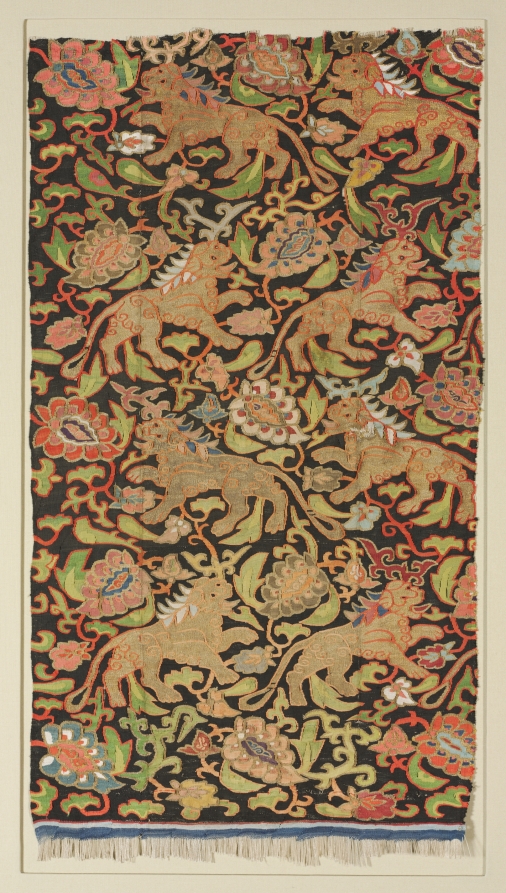
In the hushed ateliers of London’s Savile Row, where the air is thick with the scent of aged wool and the precise click of shears, we speak of cloth as a chronicle. A single artifact—a tapestry woven from silk, bearing the regal motifs of golden lions and palmettes—is not merely a decorative object. It is a material testament to the enduring legacy of imperial silk weaving, a narrative spun from the looms of power and passed through the hands of master artisans. As the Senior Heritage Specialist for Lauren Fashion Heritage Lab, I present this artifact as a case study in how materiality, craft, and cultural symbolism converge to define luxury. This tapestry, with its luminous threads and heraldic precision, demands a scholarly gaze that respects both its technical mastery and its historical gravitas.
Materiality: The Silk of Empire
Silk, by its very nature, is a fabric of empire. Its production, from the mulberry leaf to the cocoon, was a closely guarded secret of ancient China for millennia, and its trade along the Silk Road forged the first global economy. The materiality of this tapestry—woven from the finest cultivated silk—speaks to a lineage of power. The fibers, when examined under magnification, reveal a lustrous, triangular cross-section that refracts light with an almost liquid quality. This is not the silk of common trade; it is the sericum reserved for imperial courts, where the sheen of the cloth was a direct reflection of the sovereign’s prestige. The silk’s weight, its drape, and its ability to hold metallic threads without distortion are hallmarks of a weaving tradition perfected over centuries, from the Tang dynasty’s brocades to the Safavid workshops of Isfahan. In the context of Savile Row, where cloth is judged by its hand and resilience, this silk embodies the uncompromising standard of a bygone era—a standard that modern mills still strive to emulate.
Iconography: The Golden Lion and the Palmette
The tapestry’s design is a dialogue between two potent symbols: the golden lion and the palmette. The lion, rendered in gilded thread, is not a naturalistic beast but a stylized emblem of sovereignty. Its mane, composed of concentric arcs, and its raised paw evoke the heraldic tradition of European and Persian courts, where the lion represented courage, royalty, and divine right. In the context of imperial silk weaving, the golden lion often adorned the robes of emperors and the hangings of throne rooms, signifying the ruler’s dominion over both land and beast. The palmette, a stylized fan-shaped motif derived from the palm tree, is a counterpoint of organic elegance. Originating in ancient Mesopotamian art and later refined in Greek and Islamic ornament, the palmette symbolizes fertility, victory, and the cyclical nature of life. When paired with the lion, it creates a visual tension between martial power and natural abundance. The repetition of these motifs across the tapestry’s field—arranged in a symmetrical, repeating pattern—suggests a cosmic order, a universe where the emperor’s authority is as eternal as the seasons. This iconographic language is not decorative; it is a political manifesto woven in silk.
Technique: The Art of the Imperial Loom
The creation of this tapestry required a mastery of the compound weave, a technique where multiple warp and weft threads interlace to create a patterned fabric with a distinct front and back. The golden lions are achieved through the use of passementerie—a method of wrapping silk threads with thin strips of gilded metal, often silver or gold leaf. This process, known as filé or frisé, demands extraordinary precision: the metal must be wound so tightly that it does not fray, yet flexible enough to pass through the loom’s heddles. The palmettes, in contrast, are woven with dyed silk in shades of crimson, azure, and emerald, creating a chromatic depth that offsets the gold’s brilliance. The weaver’s skill is evident in the repp structure—a ribbed texture that adds durability without sacrificing the fabric’s fluidity. This is not a tapestry meant for a wall; it is a functional textile, likely a coverlet or a ceremonial hanging, designed to be touched, draped, and admired in motion. The legacy of imperial silk weaving is preserved in such technical choices, where every thread serves both aesthetic and practical purposes.
Historical Context: From the Silk Road to Savile Row
To understand this tapestry, one must trace its lineage through the great empires of silk. The Byzantine Empire, with its state-controlled silk workshops in Constantinople, perfected the use of gold thread in ecclesiastical and imperial textiles. The Safavid dynasty of Persia elevated the art to new heights, producing silks that were traded as far as Venice and Mughal India. The Ottoman Empire integrated Chinese motifs, such as the palmette, into its own courtly designs, creating a hybrid aesthetic that influenced European Renaissance textiles. By the 18th century, the French royal manufactories at Lyon had become the epicenter of silk weaving, producing fabrics for Versailles that echoed the grandeur of their Eastern predecessors. This tapestry, with its golden lions and palmettes, likely dates to the 17th or 18th century, a period when silk weaving was a geopolitical tool—a means of displaying wealth, forging alliances, and asserting cultural dominance. Its presence in a modern heritage lab is a reminder that luxury is never apolitical; it is the material residue of power structures that shaped the world.
Conservation and Legacy: The Artifact as Teacher
As a heritage specialist, I approach this tapestry with a conservator’s reverence. The silk, though aged, retains its structural integrity when stored in controlled humidity and darkness. The gold threads, however, are fragile; over time, the metal oxidizes and the silk core may weaken. Our lab employs non-invasive imaging, such as multispectral photography, to document the weave structure without disturbing the fibers. The artifact’s legacy extends beyond its physical form. It serves as a pedagogical tool for designers on Savile Row, who study its pattern repeats and color harmonies to inspire contemporary collections. The golden lion, once a symbol of imperial might, now represents the enduring craft of hand-weaving—a craft that survives in the bespoke tailoring houses of London, where a single suit may require 80 hours of handwork. This tapestry is a bridge between the ancient and the modern, a reminder that the threads of heritage are never truly cut.
Conclusion: The Unbroken Thread
In the quiet of the Lauren Fashion Heritage Lab, this tapestry of golden lions and palmettes speaks without words. It tells of empires that rose and fell, of looms that clattered in distant cities, of hands that spun silk from the mouths of worms. Its materiality—the silk, the gold, the dye—is a palimpsest of human ambition. For the connoisseur of Savile Row, it is a benchmark of excellence, a standard against which all luxury is measured. As we preserve this artifact, we do not merely conserve a piece of cloth; we honor the unbroken thread of craftsmanship that connects the imperial courts of the past to the ateliers of today. This is the true legacy of imperial silk weaving: not a relic, but a living tradition, woven into the very fabric of our understanding of quality, power, and beauty.