Heritage Research Artifact: The Fragment as a Testament to Silk Mastery
Introduction: The Fragment’s Narrative in Savile Row Context
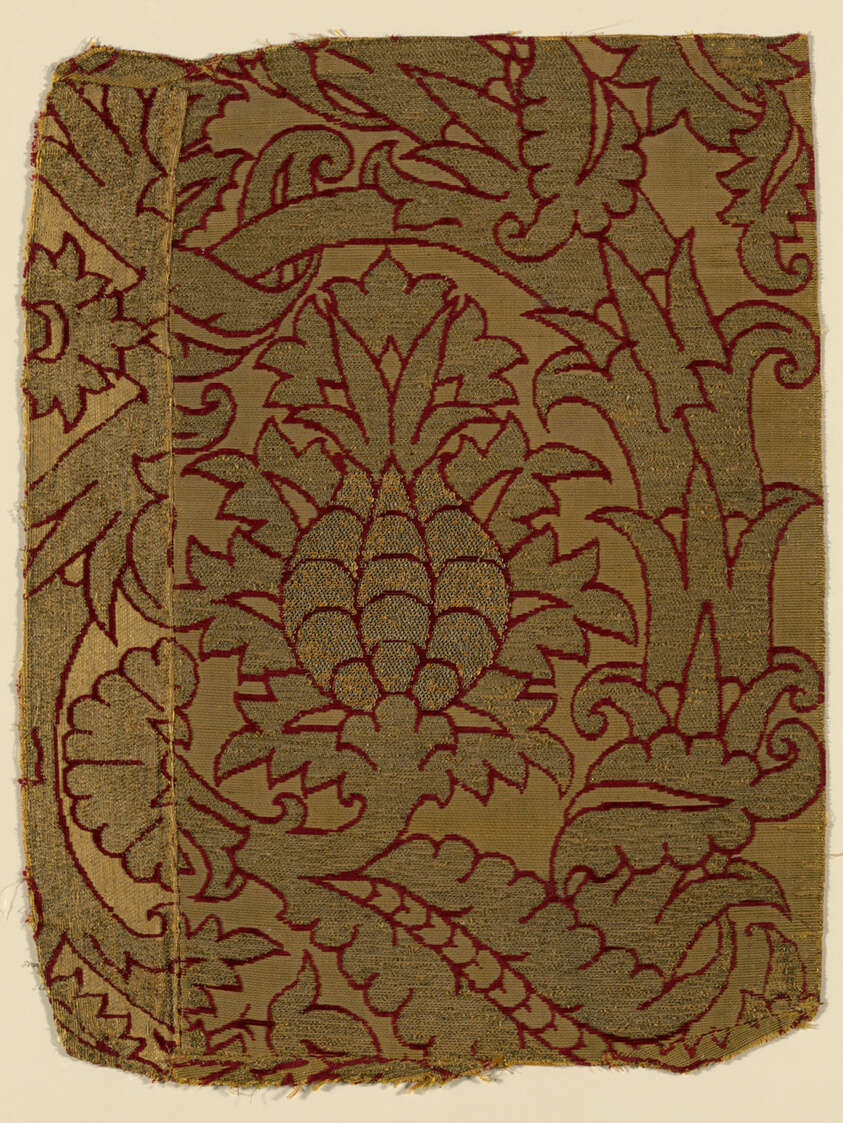
In the lexicon of luxury textiles, a fragment is not merely a remnant; it is a condensed archive of artisanal intelligence. At the Lauren Fashion Heritage Lab, we approach such artifacts as primary sources—material documents that speak to the evolution of craft, taste, and technical ingenuity. This particular fragment, a silk compound weave with voided velvet, brocading, and gilt-metal-strip-wrapped wefts, embodies the pinnacle of classic silk craftsmanship. Its materiality—a complex interplay of warp, weft, and supplementary elements—mirrors the precision and fluid elegance synonymous with London’s Savile Row, where tailoring is a dialogue between fabric and form. This paper deconstructs the fragment’s construction, aesthetic implications, and heritage significance, positioning it as a key artifact in understanding silk’s role in sartorial excellence.
Materiality and Construction: A Technical Deconstruction
The fragment’s foundation is a plain weave silk ground, a structure of exceptional clarity and strength. Plain weave, the simplest interlacing of warp and weft, provides a neutral canvas that allows the supplementary elements to command attention. The silk threads, likely sourced from mulberry silkworms, offer a lustrous, even surface—a hallmark of classic silk production. This base is not merely functional; it establishes a tactile baseline of smoothness against which the textured elements contrast.
Upon this ground, the weaver introduced supplementary silk facing wefts. These are additional weft threads that float across the surface, creating areas of dense, unbroken color. In this fragment, these facing wefts likely form the primary color fields—perhaps a deep crimson or midnight blue—that anchor the design. The term “facing” indicates they are visible on the fabric’s face, contributing to the overall pattern without disrupting the plain weave’s integrity. This technique allows for rich, saturated hues that are characteristic of high-end silks used in Savile Row eveningwear and ceremonial garments.
The most technically demanding element is the secondary binding warp system. These warps, distinct from the ground warps, are woven in to secure the supplementary gilt-metal-strip-wrapped silk patterning and brocading wefts. The gilt-metal strips—likely silver or gold leaf laminated onto a silk or linen core—are wrapped around a silk thread, creating a metallic filament that catches light with every movement. These wefts are not simply laid in; they are bound by the secondary warps at precise intervals, allowing them to form weft loops in areas. These loops, or bouclé-like structures, introduce a three-dimensional quality, reminiscent of the raised goldwork seen in ecclesiastical textiles and royal livery. The brocading technique further amplifies the design: brocading wefts are discontinuous, meaning they only appear where the pattern requires, allowing for intricate, localized motifs—such as floral sprigs or geometric medallions—without adding bulk to the entire fabric.
Finally, the fragment features supplementary pile warps forming cut voided velvet. Voided velvet is a technique where the pile—cut loops of silk—is present in specific areas, while other areas remain flat (the “void”). This is achieved by weaving the pile warps only where needed, then cutting them to create a soft, plush surface. The contrast between the cut velvet’s depth and the flat silk ground creates a chiaroscuro effect, emphasizing pattern and texture. In this fragment, the voided areas likely frame the metallic brocading, allowing the gilt to gleam against a matte or lustrous backdrop. The combination of cut pile, looped wefts, and flat silk results in a fabric of extraordinary tactility—a feast for the fingers as much as the eyes.
Aesthetic and Functional Implications: Fluid Elegance in Tailoring
From a Savile Row perspective, this fragment’s materiality directly informs its drape and wearability. The plain weave ground ensures structural integrity, preventing the fabric from sagging or distorting—critical for tailored jackets and waistcoats. The supplementary elements, while decorative, are engineered to maintain flexibility: the weft loops and cut pile are confined to specific areas, allowing the fabric to move with the body rather than against it. This is the essence of fluid elegance—a textile that responds to the wearer’s gestures without sacrificing its ornamental richness.
The use of gilt-metal-strip-wrapped silk introduces a subtle luminosity, not a garish shine. In Savile Row tradition, metallic threads are reserved for evening wear, diplomatic uniforms, or ceremonial pieces—garments meant to command attention under chandeliers or in formal processions. The fragment’s design likely incorporates a balanced distribution of metallic elements, perhaps as a border or a repeating motif, ensuring the fabric remains sophisticated rather than ostentatious. The voided velvet adds a layer of shadow and depth, creating a visual rhythm that guides the eye across the surface. This interplay of light and texture is a hallmark of classic silk craftsmanship, where every thread serves both aesthetic and functional purposes.
Heritage Significance: A Link to Artisanal Lineage
This fragment is not an isolated object; it is a link to a lineage of weavers who operated in the silk workshops of Lyon, Spitalfields, and Como—centers that supplied the finest fabrics to London’s tailoring houses. The technical complexity—combining plain weave, supplementary warps, weft loops, and voided velvet—suggests a master weaver working on a drawloom or, later, a Jacquard loom. Such fabrics were commissioned for the aristocracy and the haute bourgeoisie, often for court dress or special occasions. The fragment’s survival, even in a partial state, is a testament to its quality; lesser textiles would have disintegrated or been repurposed.
In the context of Lauren Fashion Heritage Lab, this artifact serves as a pedagogical tool. It demonstrates how historical techniques can inform contemporary design: the use of mixed textures, the integration of metallic threads, and the balance between structure and fluidity are principles that transcend eras. For a modern Savile Row tailor, studying this fragment might inspire a new approach to evening wear—perhaps a dinner jacket with a velvet collar that echoes the voided pile, or a waistcoat with metallic brocading that references the gilt wefts. The fragment is a reservoir of inspiration, reminding us that heritage is not static but a living dialogue between past and present.
Conclusion: The Fragment as a Living Archive
This silk fragment, with its plain weave ground, supplementary facing wefts, secondary binding warps, gilt-metal-strip-wrapped brocading, weft loops, and cut voided velvet, is a microcosm of classic silk craftsmanship. Its materiality speaks to the weaver’s technical virtuosity and the tailor’s pursuit of fluid elegance. At the Lauren Fashion Heritage Lab, we preserve such artifacts not as relics but as active participants in the ongoing story of luxury textiles. They remind us that every thread carries history, and every fragment holds the potential for renewal. In the hands of a discerning designer, this piece of silk can inspire garments that honor tradition while embracing innovation—a philosophy that lies at the heart of Savile Row’s enduring legacy.