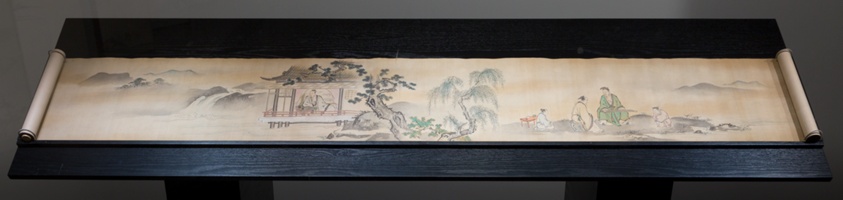
An Examination of Refinement: The Four Accomplishments as a Benchmark of Discretion
To engage with a work of this nature—ink and colours upon silk, depicting the venerable Four Accomplishments—is to conduct an audit of cultivated sensibility. It is not merely an artifact; it is a statement of principle, rendered in the most demanding of mediums. The subject matter, qin, qi, shu, hua—the lute, the game of strategy, calligraphy, and painting—represents not hobbies, but the essential quadrants of a disciplined mind. In the context of classic silk craftsmanship, this convergence creates a standard against which modern notions of refinement may be measured, or more often, found wanting.
The Ground: Silk as the Ultimate Canvas
One must first appreciate the foundation. Silk is not a passive substrate; it is an active participant in the dialogue of artistry. Its acquisition and preparation have historically been endeavours of significant investment, both in capital and in patience. To commission upon silk is to declare, from the outset, a commitment to permanence and a rejection of the ephemeral. The material possesses a latent luminosity, a depth of field that paper cannot emulate. It accepts ink and pigment not through absorption alone, but through a subtle negotiation, allowing colour to sit upon its surface with a jewel-like clarity while permitting washes to diffuse with a controlled, fluid elegance. This is the sartorial equivalent of a bespoke cloth from the lesser-known weavers of Huddersfield—possessing a handle and a fall that cheaper materials simper to imitate, yet forever fail to achieve. The silk ground is, therefore, the silent but essential first accomplishment; the prepared mind, the ordered environment upon which all else depends.
The Execution: Fluidity as a Discipline
The depiction of the Four Accomplishments demands a technical mastery that mirrors the skills it portrays. The application of ink and colour on silk is an unforgiving discipline. There is no room for hesitation, no possibility for material obfuscation. Each stroke—from the precise, architectural lines defining the scholar's robe as he contemplates the qi board, to the expressive, modulated brushwork capturing the swaying bamboo in his painting—must be executed with a confident fluency. This is not mere illustration; it is performance captured in mineral and vegetable pigment.
Consider the rendering of the qin, the seven-stringed zither. Its strings must be suggested with lines of impossible fineness and tautness, conveying not just form but the potential for resonance. The depiction of calligraphy, perhaps a line of poetry, requires the artist to be a master calligrapher himself, embedding a microcosm of the art within the larger composition. This layered reflexivity—the art of painting about the art of painting, of strategy, of music—is the very essence of a cultivated intelligence. The fluid elegance observed is not accidental or decorative; it is the visual manifestation of practised ease, the same quality seen in the drape of a perfectly cut garment where complex internal construction results in an appearance of sublime simplicity.
The Philosophy: A Quiet Assertion of Hierarchy
In the milieu of Savile Row and its global analogues, we understand that true distinction lies not in logos, but in a grammar of subtlety. The Four Accomplishments operate on a precisely analogous frequency. This painting is a sophisticated code, a quiet assertion of a hierarchy based on mental and artistic discipline rather than mere martial prowess or commercial accumulation. To possess such a work, or more importantly, to embody its principles, was to communicate one's position within a refined societal framework without uttering a single word.
The composition is never clamorous. The scholar figures are engaged in their pursuits with a focused tranquillity. The palette, however rich, is harmonious, subordinate to the authority of the ink. The message is one of interiority and self-containment. In an age of relentless external noise, the quiet confidence of this artifact is profoundly disruptive. It proposes that the ultimate luxury is not space, but attention—the focused attention required to master a musical piece, to navigate the infinite complexities of weiqi, to give life to characters with a brush, to capture the spirit of a landscape.
Conclusion: A Lasting Benchmark
This heritage research artifact, therefore, stands as a lasting benchmark. The materiality of silk establishes a plane of superior quality. The execution in ink and colour demonstrates a technical fluency that is the direct counterpart to the skills depicted. The subject matter, the Four Accomplishments, articulates a philosophy of cultivated life that values depth over breadth, mastery over novelty, and quiet assertion over public declaration.
To engage with it is to be reminded that elegance is never a single attribute, but a symphony of correct choices—from the foundation upwards. It is the integration of material, technique, and concept into a whole that is greater than the sum of its parts. In this, the silent language of ink on silk and the silent language of a perfectly executed bespoke suit are, ultimately, conversing on the same subject: the enduring power of understatement, the authority of tradition rightly understood, and the quiet, unassailable confidence that comes not from what one owns, but from what one has mastered.