The Lexicon of Absence: Terracotta Fragments and the Architecture of Old Money Silence in 2026
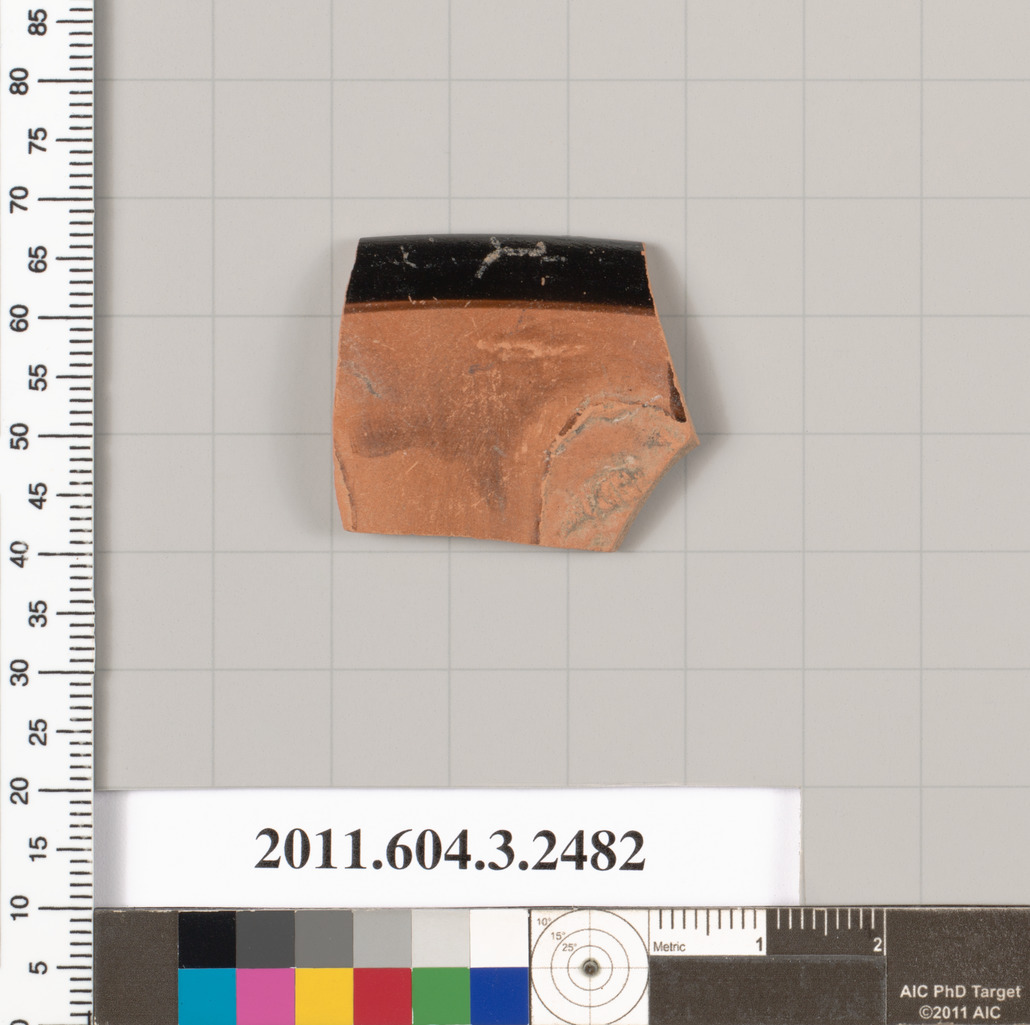
At the Lauren Fashion Heritage Lab, the curation of heritage is not an act of preservation but of translation. We do not merely archive the past; we decode its material whispers to inform the future. The museum artifact before us—a terracotta rim fragment of a Greek Attic kylix—appears, at first glance, to belong to a world utterly alien to the hushed corridors of Old Money aesthetics. Yet, when viewed through the lens of our internal genetic code, which prizes the “寂静” (stillness) and “时间” (time) embedded in objects like the Japanese “Udonge” plaque and the Joseon Dynasty clothing chest, this humble shard of fired clay reveals itself as a masterclass in the very principles that will define the 2026 Old Money silhouette. It is not a story of opulence, but of absence—a lexicon of silence, erosion, and the profound dignity of the incomplete.
I. The Kylix as a Vessel of “Ma” (間)
The kylix, a shallow drinking cup central to the Greek symposium, was a vessel for social bonding, philosophical debate, and the celebration of the ephemeral. Its rim fragment, now a broken arc of terracotta, retains only the essential geometry of its function. There are no figural scenes, no gilded handles—only the raw, burnt orange of the clay, the subtle curve of the lip, and the faint, almost imperceptible traces of a black-glaze band. This is the material equivalent of the Zen plaque’s “留白” (blank space). Just as the Udonge calligraphy on wood compels the eye to dwell in the void between strokes, this kylix fragment forces the viewer to contemplate the missing whole. The beauty lies not in what is shown, but in the tension of what is withheld.
For the 2026 Old Money silhouette, this principle translates directly into the architecture of the garment. The new luxury is not about maximalist display but about strategic erosion. We see this in the deliberate “unfinished” hems of a double-faced cashmere coat, where the raw edge is left to fray slightly, not as a sign of neglect, but as a mark of authenticity—a whisper of the garment’s own making. The silhouette itself becomes a fragment: a single-shoulder gown that suggests the missing second half of a classical chiton; a tailored jacket with a single, asymmetrical lapel that breaks the symmetry of the body. Like the kylix rim, these garments are “vessels” that invite the wearer to complete the form through movement, posture, and the invisible presence of time.
II. The Patina of Use: From Symposium to Wardrobe
The internal code’s reference to the Joseon 衣箱 (clothing chest) is critical here. That chest, with its lacquered surfaces and hidden compartments, was designed to “store” not just silk, but memory. Its beauty emerged from the accumulated patina of repeated opening and closing, the subtle wear of metal hinges, the faint scent of aged wood. Similarly, the terracotta kylix fragment carries the physical evidence of its own history: the rough break along the edge, the slight discoloration from centuries in the earth, the micro-abrasions from handling. This is not damage; it is narrative.
In the 2026 Old Money wardrobe, this translates into a radical embrace of material honesty. We reject the sterile perfection of mass-produced luxury. Instead, we champion fabrics that record time. A heavy wool flannel that develops a natural sheen at the elbows; a silk crepe that softens and drapes differently after a decade of wear; a linen shirt that acquires the “memory wrinkles” of the body that inhabits it. The silhouette itself is designed to accommodate this aging. A coat’s shoulder is cut with a slight excess of fabric, allowing the wool to settle and “slouch” into the wearer’s unique form over months. A skirt’s waistband is left unlined, so the silk lining can “bloom” with the subtle yellowing of time. This is the “暗香浮动” (subtle fragrance drifting) of the clothing chest—a beauty that is not declared, but discovered.
III. The Architecture of Restraint: The 2026 Silhouette as a “Vessel of Void”
The most profound lesson from the kylix fragment is its geometric restraint. The curve of the rim is not arbitrary; it is a precise mathematical arc designed to fit the human hand, to balance the weight of wine, to facilitate a specific gesture. This is the “器物之美” (beauty of the vessel)—form dictated by function, yet elevated to art. The 2026 Old Money silhouette will be defined by a similar architectural precision. We move away from the exaggerated volumes of the past decade—the puff sleeves, the billowing capes—toward a silhouette of containment.
Think of a columnar dress in heavy silk satin, its only ornament a single, precise seam that follows the spine. Think of a double-breasted blazer with a lapel that is exactly 3.5 inches wide—no more, no less—because that width creates the ideal negative space between the collar and the shoulder. Think of a trouser that falls in a straight line from hip to hem, with a break so subtle it is almost imperceptible, creating a “void” between the fabric and the shoe. These are not garments that shout; they are vessels that “hold” the wearer’s presence. Like the kylix fragment, they are incomplete without the human form to complete them.
IV. Conclusion: The Echo of the Symposium
The Greek symposium was a space of controlled excess—wine, poetry, and debate, all contained within the ritual of the kylix. The Old Money aesthetic, in its 2026 iteration, is a similar ritual of containment. It is not about austerity, but about concentration. The terracotta fragment teaches us that the most powerful statement is often the one that is withheld. The 2026 silhouette will be a “优昙花” (Udonge)—a rare bloom that appears only after a long silence. It will be a “衣箱” (clothing chest)—a repository of time, touch, and memory. It will be a kylix rim—a broken arc that, in its incompleteness, speaks of a whole that once was and a future that is yet to be filled. This is the new heritage: not the preservation of the past, but the architecture of absence that allows the present to breathe.