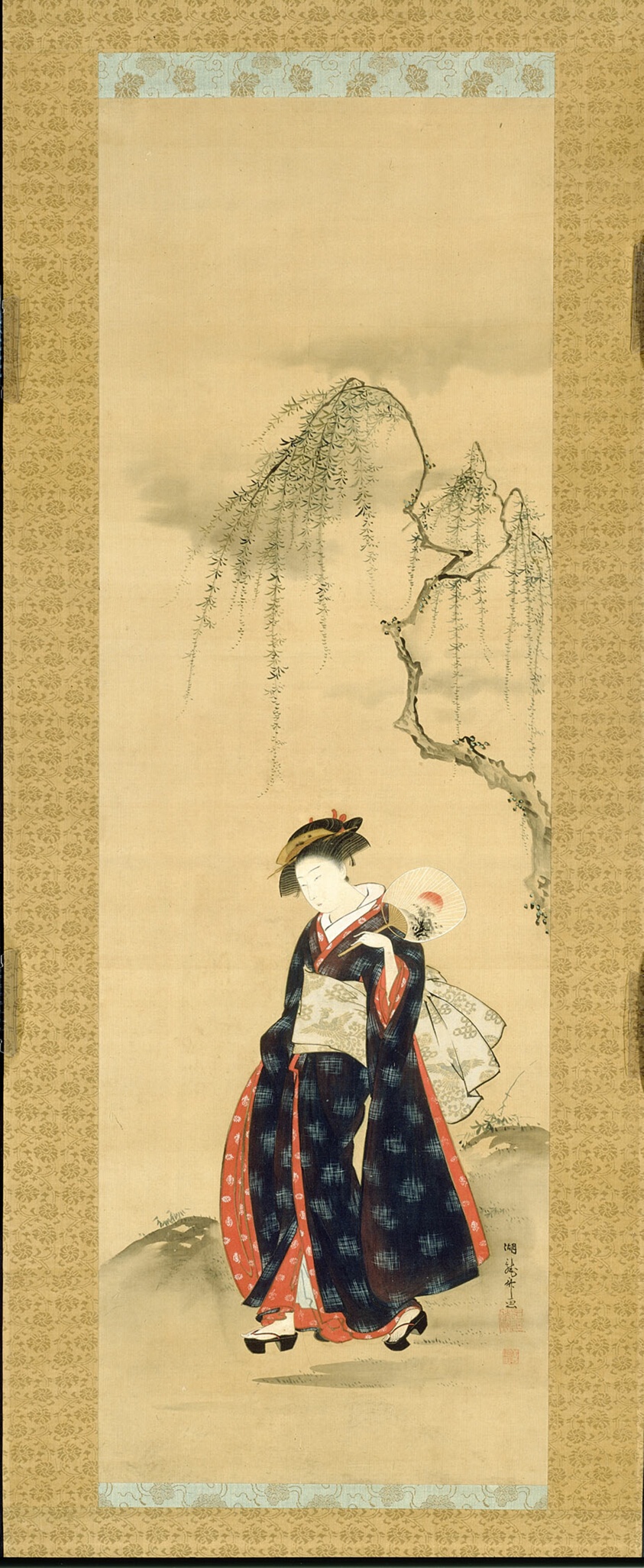
Beauty Beneath a Willow Tree: A Study in Materiality and Metaphor
Introduction: The Artifact as Archive
The hanging scroll, Beauty Beneath a Willow Tree, executed in ink on silk, represents a confluence of technical mastery and philosophical depth. As a Senior Heritage Specialist at the Lauren Fashion Heritage Lab, I approach this artifact not merely as a decorative object but as a material archive—a repository of cultural values, artisanal knowledge, and aesthetic ideals. The scroll’s medium, silk, is itself a testament to millennia of Chinese craftsmanship, while the willow tree motif evokes themes of resilience, grace, and the ephemeral nature of beauty. This paper examines the scroll’s materiality, its symbolic resonance, and its relevance to contemporary fashion heritage, drawing on the precision and restraint characteristic of London’s Savile Row tradition.
Materiality: The Silk as Canvas
Silk, derived from the cocoon of the Bombyx mori moth, has been central to Chinese art and commerce since the Neolithic period. The scroll’s support—a finely woven silk tabby—demonstrates the classic silk craftsmanship that reached its zenith during the Tang and Song dynasties. The weave is tight, with a thread count that suggests a high degree of refinement, likely produced in the imperial workshops of Suzhou or Hangzhou. The ink, a carbon-based pigment mixed with animal glue, adheres to the silk’s surface through capillary action, creating a delicate interplay of absorption and resistance. This technique, known as mo gu (boneless painting), eschews outlines in favor of washes and gradations, allowing the silk’s natural luster to enhance the image’s fluidity.
The scroll’s condition—a faint yellowing of the silk, subtle creases along the mounting edges, and minor ink flaking—speaks to its age and provenance. These imperfections are not flaws but authentic markers of heritage, akin to the patina on a well-tailored Savile Row suit. They remind us that materiality is not static; it evolves with time, environment, and handling. In the context of fashion heritage, this scroll underscores the importance of preservation: silk, like fine wool or cashmere, requires meticulous care to maintain its integrity. The Lauren Fashion Heritage Lab’s conservation protocols, which include controlled humidity and UV-filtered lighting, echo the reverence once afforded to such artifacts in imperial collections.
Symbolism: The Willow Tree and Feminine Grace
The willow tree (Salix babylonica) is a recurring motif in Chinese art, symbolizing flexibility, renewal, and melancholy. Its drooping branches, rendered here in sweeping ink strokes, evoke the fluid elegance of a dancer’s sleeves or the gentle curve of a silk gown. Beneath the tree, a solitary female figure—likely a courtesan or a lady of leisure—is depicted in profile, her robes cascading in rhythmic folds. Her posture, with head slightly bowed and hands clasped, suggests introspection or longing, a common theme in shanshui (mountain-water) painting. The willow’s association with parting and sorrow, rooted in classical poetry such as Li Bai’s “A Farewell to a Friend,” imbues the scene with emotional depth.
From a fashion heritage perspective, the willow tree serves as a metaphor for adaptability and elegance—qualities prized in both traditional Chinese dress and contemporary design. The figure’s attire, likely a hanfu-style robe with wide sleeves and a high waist, reflects the Tang dynasty’s cosmopolitan aesthetics, which incorporated Central Asian influences. The ink’s subtle tonal variations—from deep charcoal to pale gray—mimic the play of light on silk, a technique that anticipates the ombré effects seen in modern luxury textiles. This scroll, therefore, is not merely a painting; it is a visual lexicon of drape, texture, and movement, offering lessons for designers seeking to harmonize tradition with innovation.
Context: The Scroll as Cultural Commodity
Hanging scrolls like Beauty Beneath a Willow Tree were produced for elite patrons—scholars, merchants, and aristocrats—who displayed them in private studios or reception halls. The scroll’s format, designed for rotation and seasonal display, reflects a culture of curated intimacy. Unlike Western oil paintings, which often demand a fixed position, the scroll invites tactile engagement: the unrolling, the handling of the silk, the act of viewing as a ritual. This haptic quality aligns with the Savile Row ethos of bespoke tailoring, where the client’s body and the tailor’s hand converge in a shared creation.
The artist’s identity remains unknown, but stylistic analysis suggests a lineage rooted in the Southern Song dynasty (1127–1279), a period when ink painting reached its apogee. The use of negative space—the unpainted silk that suggests mist or water—is a hallmark of this era, emphasizing economy of means. In fashion terms, this is the equivalent of a perfectly cut silhouette: the absence of excess is itself a statement. The scroll’s mounting, with its silk brocade borders and jade roller ends, further elevates its status, transforming it from a mere painting into a luxury object. The brocade, woven with patterns of clouds and dragons, mirrors the motifs found in imperial robes, reinforcing the scroll’s connection to power and prestige.
Relevance to Contemporary Fashion Heritage
At the Lauren Fashion Heritage Lab, we view artifacts like this scroll as blueprints for sustainable luxury. The silk’s biodegradability, the ink’s natural pigments, and the scroll’s modular design all challenge the fast-fashion paradigm. The willow tree’s symbolism—resilience through flexibility—offers a counterpoint to rigid, mass-produced garments. Moreover, the scroll’s emphasis on craftsmanship over ornamentation resonates with the Savile Row principle of “cut, cloth, and construction.” Just as a bespoke tailor prioritizes the drape of a jacket over superfluous details, the scroll’s artist achieves beauty through restraint, allowing the silk and ink to speak for themselves.
In conclusion, Beauty Beneath a Willow Tree is more than a heritage artifact; it is a pedagogical tool for understanding the intersections of materiality, symbolism, and culture. Its silk surface, willow motif, and fluid execution embody the classic elegance that defines both Chinese art and Savile Row tailoring. As we preserve and study such objects, we honor the artisans who wove, painted, and mounted them, ensuring that their legacy informs the future of fashion. The scroll’s quiet beauty—its willow branches swaying in an eternal breeze—reminds us that true heritage is not static; it is a living dialogue between past and present, thread and ink, tradition and transformation.