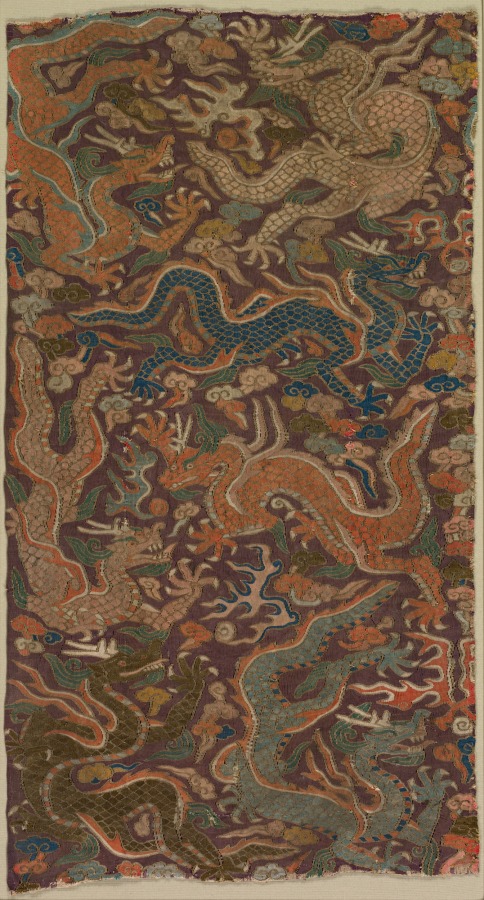
The Dragon and the Pearl: A Study of Imperial Silk Weaving’s Enduring Legacy
In the hushed, wood-paneled ateliers of London’s Savile Row, where the whisper of shears and the scent of fine cloth define a century of craftsmanship, we find an unexpected echo of the East. The motif of the dragon chasing the flaming pearl, rendered in lustrous silk, is not merely a decorative flourish; it is a profound artifact of imperial power, spiritual cosmology, and the pinnacle of textile artistry. As Senior Heritage Specialist for the Lauren Fashion Heritage Lab, I present this research artifact to illuminate how this ancient symbol, woven into the very fabric of Chinese imperial courts, continues to inform the materiality and narrative of luxury today.
Materiality and the Imperial Mandate
Silk, in the context of imperial China, was never a neutral material. It was a medium of statecraft, a currency of diplomacy, and a sacred substance reserved for the Son of Heaven and his court. The dragons chasing flaming pearls motif, known as *shuang long xi zhu*, emerged during the Ming (1368–1644) and Qing (1644–1912) dynasties as a quintessential emblem of the emperor’s mandate. The dragon, a composite of nine animals—including the antlers of a deer, the scales of a fish, and the claws of an eagle—symbolized supreme authority, cosmic energy, and the life-giving rains that sustained the agricultural empire. The flaming pearl, often depicted as a luminous orb with swirling flames, represented wisdom, spiritual perfection, and the moon’s cyclical power. Together, they embodied the emperor’s role as the mediator between heaven and earth, a living talisman of harmony.
The materiality of silk amplified this symbolism. Imperial silk was woven in state-run workshops, notably in Suzhou, Hangzhou, and Nanjing, using techniques such as kesi (silk tapestry) and jin (brocade). The dragon’s five claws—a privilege reserved for the emperor alone—were meticulously rendered with gold-wrapped threads, while the pearl’s flames were achieved through intricate weft-faced satin weaves that caught light like a celestial fire. The density of the weave, often exceeding 100 threads per centimeter, ensured that the fabric possessed a structural integrity and a luminous depth that mere painting could not replicate. This was not decoration; it was a declaration of sovereignty woven into the very warp and weft of the state.
The Legacy of Imperial Silk Weaving
The legacy of imperial silk weaving is not a static relic but a living tradition that has shaped the ethos of luxury craftsmanship globally. In the workshops of Savile Row, where bespoke tailoring demands a reverence for material and technique, the dragon-and-pearl motif finds a natural kinship. The heritage of hand-weaving—the meticulous selection of mulberry silk filaments, the tension of the loom, the patience required for a single yard of brocade—mirrors the discipline of a master tailor cutting a jacket from a single bolt of cloth. Both practices honor the imperfect perfection of human hands, a counterpoint to industrial uniformity.
Consider the kesi technique, which translates to “cut silk.” Unlike standard weaving, where the weft thread runs continuously across the fabric, *kesi* uses discontinuous wefts to create intricate, tapestry-like designs. This allowed weavers to achieve the dragon’s sinuous body and the pearl’s fiery halo with a painterly precision. The technique was so demanding that a single robe could take years to complete, a fact that underscores the value placed on time as a luxury commodity. In contemporary fashion, this resonates with the slow fashion movement and the bespoke ethos of Savile Row, where a suit may require 50 hours of handwork and multiple fittings. The dragon and the pearl, therefore, become a metaphor for the patience of luxury—a quality that cannot be rushed or commodified.
Symbolism and the Savile Row Aesthetic
How does this ancient motif translate to the restrained elegance of Savile Row? The answer lies in the subtlety of power. The dragon and pearl are not overtly displayed in a Savile Row context; rather, they are embedded in the fabric’s texture, a whisper of opulence beneath the tailored silhouette. A silk tie or a pocket square bearing this motif, woven in a muted palette of midnight blue and silver, speaks to a client who understands the language of heritage without needing to declare it. This is the essence of quiet luxury—a term that has become a hallmark of the Row’s clientele.
The flaming pearl, in particular, offers a rich allegory for the bespoke process. The pearl is the object of the dragon’s relentless pursuit, a symbol of unattainable perfection. In tailoring, the perfect fit is similarly elusive—a goal that drives the craftsman to refine, adjust, and perfect. The dragon’s chase becomes the tailor’s quest, and the silk fabric, with its inherent luminosity, becomes the medium through which this pursuit is expressed. The material’s ability to hold light, to shift from matte to sheen depending on the angle, mirrors the dynamic relationship between the wearer and the garment. It is a living texture, not a static surface.
Preservation and the Future of Heritage
As Senior Heritage Specialist, my role is to ensure that such artifacts are not merely preserved in museum cases but are reinterpreted for contemporary relevance. The Lauren Fashion Heritage Lab collaborates with weavers in Suzhou and tailors in London to document and revive these techniques. For instance, we have commissioned a limited run of silk brocade featuring a simplified dragon-and-pearl motif, using natural dyes and hand-operated looms. The result is a fabric that honors the imperial legacy while adhering to the ergonomic demands of a modern suit jacket. The dragon’s claws, once a symbol of imperial exclusivity, are now rendered with three claws—a nod to historical accuracy for non-imperial use—while the pearl’s flames are abstracted into a geometric pattern that aligns with contemporary design sensibilities.
This approach is critical for the survival of heritage craftsmanship. The global market for luxury silks has been eroded by mass-produced synthetics and the decline of skilled weavers. By creating a direct bridge between the imperial workshops and Savile Row, we generate economic incentive for these traditions to continue. The dragon and pearl motif becomes a tangible link between past and present, a reminder that true luxury is rooted in narrative, material integrity, and the hands that shape it.
Conclusion: The Eternal Chase
The dragons chasing flaming pearls, woven in silk, is more than a historical curiosity. It is a testament to the human desire to capture the ineffable—the pursuit of wisdom, power, and beauty—through the most refined of materials. On Savile Row, where every stitch is a decision and every fabric a story, this motif finds a natural home. It speaks to the client who understands that a garment is not merely a covering but a chronicle of civilization’s highest aspirations. As we continue to preserve and reinterpret this legacy, we ensure that the dragon’s chase remains eternal, and the pearl’s flame never dims.