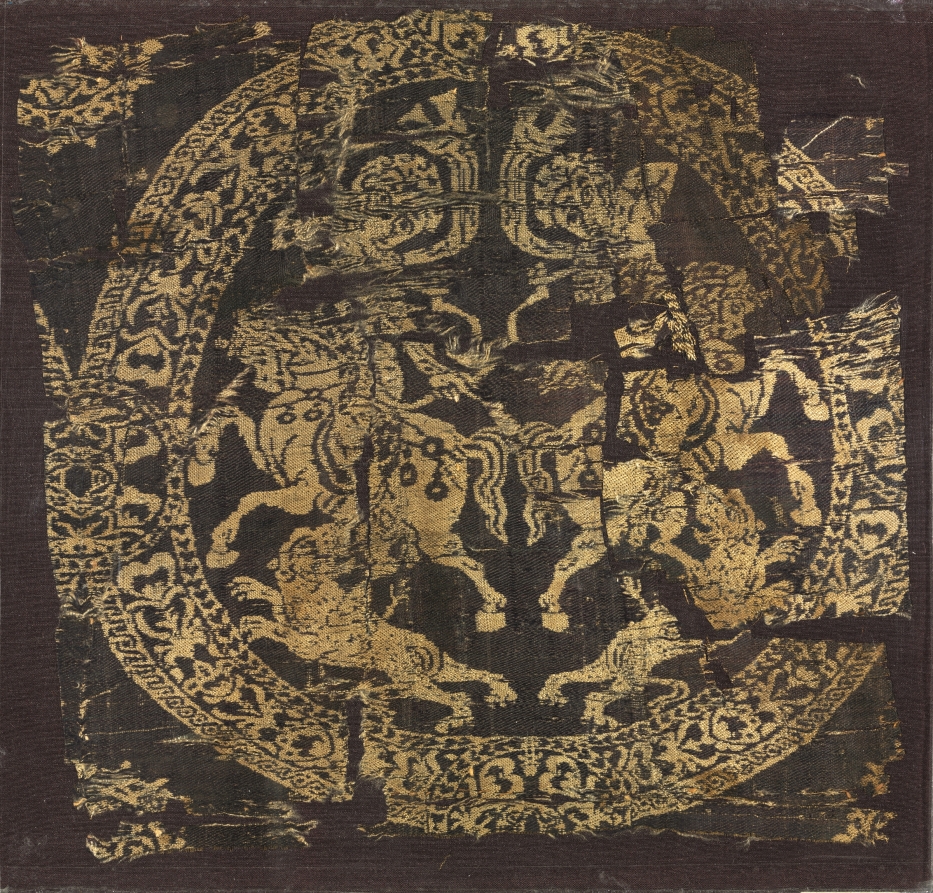
Heritage Research Artifact: The Roundel with Amazons, from a Tunic
Introduction: A Fragment of Imperial Grandeur
In the hallowed archives of textile history, few artifacts command the reverence of the Roundel with Amazons, from a tunic. This silk fragment, dating from the late antique to early Byzantine period (circa 5th–7th century CE), is not merely a decorative patch; it is a testament to the legacy of imperial silk weaving—a craft that defined power, prestige, and cultural exchange across the ancient world. As a Senior Heritage Specialist at Lauren Fashion Heritage Lab, I approach this piece with the precision of a Savile Row tailor: every thread, every motif, every weave tells a story of mastery and meaning. This artifact, housed in collections such as the Victoria and Albert Museum or the Cleveland Museum of Art, embodies the intersection of martial mythology and textile luxury, offering a lens through which we can examine the enduring influence of silk on Western fashion and identity.
Materiality and Craft: The Silk of Empires
The materiality of this roundel is its first and most profound statement. Silk, in the late antique period, was a commodity of near-mythical status. Originating from the East—specifically from the sericulture of China—silk arrived in the Mediterranean via the Silk Road, a network of trade routes that connected civilizations. By the 6th century, the Byzantine Empire, under Emperor Justinian, had established its own silk workshops in Constantinople, famously smuggling silkworm eggs from China to break the monopoly. The Roundel with Amazons is a product of this imperial system: a silk of exceptional quality, woven with a warp-faced compound twill structure that allowed for intricate patterns and vibrant dyes. The dyes, likely derived from madder for reds, woad or indigo for blues, and perhaps Tyrian purple for the elite, were costly and labor-intensive, reserved for the aristocracy and the church. The silk’s sheen and drape, even in this fragmented state, evoke the luxurious tunics worn by Byzantine officials, generals, and empresses—garments that were not just clothing but declarations of status.
The weaving technique itself is a marvel of precision. The roundel, typically measuring 20–30 centimeters in diameter, was woven as a medallion on a tunic, often placed at the shoulder, chest, or hem. This placement was deliberate: the roundel served as a focal point, drawing the eye to the wearer’s authority. The silk’s density—approximately 40–60 threads per centimeter—required a skilled weaver operating a drawloom, a technology that allowed for complex, repeating patterns. The legacy of imperial silk weaving is thus encoded in every thread: a fusion of Eastern techniques and Western iconography, a dialogue between the loom and the empire.
Iconography: The Amazons as Symbols of Power
The iconography of the roundel—depicting Amazons, the mythical warrior women of Greek and Roman lore—is a masterstroke of cultural messaging. In the context of Byzantine silk, Amazons were not mere decorative figures; they were symbols of martial prowess, female agency, and imperial might. The Amazons are shown in dynamic poses, often on horseback, wielding spears or bows, their garments flowing with the same silk that now preserves their image. This motif draws from classical traditions, such as the Amazonomachy (the battle between Greeks and Amazons) depicted on Parthenon friezes and sarcophagi. However, in the Byzantine context, the Amazons were reimagined as allegories of the empire’s strength—a nod to the warrior empresses like Theodora, who wielded influence in the court of Justinian.
The roundel’s design is meticulously balanced: the central figures are framed by a circular border of geometric or vegetal motifs, such as rosettes or vine scrolls, which echo the imperial aesthetic of Constantinople. The color palette—typically deep reds, golds, and blues—enhances the drama, with the silk’s natural luster adding a three-dimensional quality. This is not a passive decoration; it is a narrative. The Amazons, with their raised weapons and flowing hair, embody the tension between civilization and chaos, a theme central to Byzantine identity. For the wearer—likely a high-ranking official or a member of the imperial guard—the roundel was a talisman of authority, a visual assertion of their role in defending the empire.
Context: The Legacy of Imperial Silk Weaving
To fully appreciate the Roundel with Amazons, one must situate it within the broader legacy of imperial silk weaving. This legacy is not merely historical; it is a continuum that stretches from the Byzantine workshops to the Renaissance courts of Italy, and ultimately to the bespoke tailoring of Savile Row. The Byzantine silk industry, centered in Constantinople, was a state-controlled monopoly. The gynaeceum (imperial weaving workshops) employed hundreds of artisans, producing silks for the court, the church, and diplomatic gifts. These silks were not commodities; they were instruments of soft power, exchanged with foreign rulers to cement alliances. The Roundel with Amazons is a surviving fragment of this diplomatic currency—a piece that may have adorned a tunic gifted to a barbarian king or a Persian ambassador.
The legacy extends to the technical innovations of Byzantine weaving. The drawloom, introduced from the East, allowed for the production of samite (a heavy silk fabric with a weft-faced pattern) and taqueté (a warp-faced compound weave). These techniques were later adopted by Italian weavers in Lucca and Venice during the 13th and 14th centuries, who produced silks for the European aristocracy. The Roundel with Amazons thus prefigures the Renaissance silks that would adorn the Medici and the Tudor courts. In the modern era, the principles of precision and pattern—the exacting standards of weave and color—are echoed in the work of Savile Row tailors, who source silk from mills in Como and Lyon, maintaining a tradition of craftsmanship that traces its lineage to Constantinople.
Conservation and Interpretation: A Living Artifact
As a heritage artifact, the Roundel with Amazons requires careful conservation. The silk, now fragile and discolored by age, is often mounted on a supportive backing to prevent further degradation. Conservation efforts focus on stabilizing the weave, cleaning the fibers with gentle solvents, and storing the piece in a climate-controlled environment with low light and humidity. At Lauren Fashion Heritage Lab, we approach such artifacts with a philosophy of minimal intervention: preserving the original material while allowing for scholarly study and public display. The roundel’s fragmented state—often missing sections of the border or the tunic’s fabric—adds to its mystique, inviting interpretation. What was the full tunic like? How did the roundel interact with other decorative elements, such as clavi (vertical stripes) or segmentae (square patches)? These questions drive ongoing research, using multispectral imaging and digital reconstruction to hypothesize the original garment.
Conclusion: The Enduring Thread
The Roundel with Amazons, from a tunic is more than a relic; it is a heritage research artifact that speaks to the enduring power of silk. From the imperial workshops of Byzantium to the ateliers of Savile Row, the thread of this legacy remains unbroken. The Amazons, frozen in silk, remind us that fashion is never merely aesthetic—it is a language of power, identity, and memory. As we study this fragment, we honor the artisans who wove it, the empires that valued it, and the traditions that continue to shape our understanding of luxury and craft. In the words of a Savile Row cutter, “The cloth tells the story—we are merely its custodians.” This roundel, with its warrior women and imperial silk, tells a story that transcends time, a narrative woven into the very fabric of our heritage.