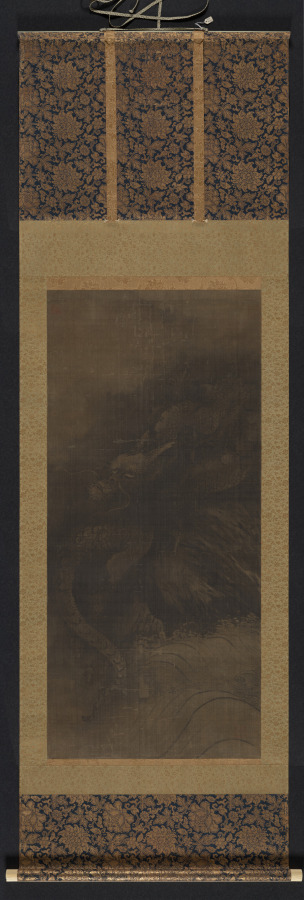
An Examination of the Draconic Motif within the Imperial Silk Weaving Legacy
To engage with the subject of the dragon rendered in silk is to engage with a narrative of absolute authority, a visual language of power so potent that its very production was, for centuries, a state-controlled enterprise. This is not mere ornamentation; it is heraldry of the most profound order, woven not upon wool or linen, but upon the very substrate of imperial legitimacy. The materiality of silk is, in this context, non-negotiable. Its inherent qualities—the luminous sheen, the formidable tensile strength, the capacity to hold colour with a jewel-like intensity—made it the sole medium worthy of bearing such a symbol. One does not commission a dragon; one commands it. And the command was executed within the confines of the Imperial Weaving Workshops, institutions whose output was as much a matter of state security as the army or the treasury.
The Grammar of Power: Codification of the Imperial Dragon
The imperial dragon, as it evolved into its Ming and Qing dynasty zenith, operated within a strict sartorial grammar. This was a lexicon of claws, scales, and celestial associations, each element meticulously prescribed and understood by the court and the populace alike. The five-clawed dragon, the long, was reserved exclusively for the Son of Heaven. Its four-clawed counterpart, the mang, denoted princes and nobles of the highest rank. This distinction was not a matter of aesthetic preference but of law, enforced with severe penalties for transgressions. The dragon’s form, whether in flight amidst clouds or pursuing the flaming pearl of wisdom, communicated specific attributes of imperial virtue: potency, benevolence, and a celestial mandate.
The weaving techniques employed were commensurate with the symbol’s status. The kesi tapestry weave, often described as "carved silk," allowed for unparalleled pictorial complexity and colour gradation, creating dragons of astonishing dimensionality and texture. In satin weaves, the dragon emerged from a ground of profound darkness or luminous yellow, its form defined by the play of light on the differing silk planes. Embroidery, using floss silk and gold-wrapped thread, added a further layer of opulence and tactile grandeur. The result was a motif that did not simply rest upon the fabric but was architected into its very matrix.
The Workshop as Apparatus: Precision, Secrecy, and Scale
The legacy we examine is inseparable from the formidable apparatus that produced it. The Imperial Weaving Establishments in Nanjing, Suzhou, and Hangzhou were less ateliers and more ministries of visual propaganda. They operated on a scale and with a precision that would be the envy of any modern luxury house. Artisans were specialists: a draughtsman for initial cartoons, a colourist, a loom technician, each a master of a single facet of the process. Patterns were archived and replicated with exacting fidelity, ensuring consistency of the imperial image across robes, altar cloths, and architectural hangings.
This was a closed ecosystem. The finest silks, the most potent dyes—like the imperial yellow derived from gardenia or the revered crimson from cochineal—were monopolised. Technical knowledge was guarded. The workshops were, in essence, the research and development division of sovereignty. The dragon robe, or longpao, was thus not a garment in any conventional sense. It was a portable throne, a kinetic assertion of order. When the emperor moved, the dragons upon his robes moved with him, a constellation of power made manifest.
Enduring Resonance: From Imperial Edict to Modern Lexicon
The collapse of the imperial system did not, as one might presume, relegate the dragon to mere historical curiosity. Instead, it transitioned—a testament to the profound depth of its cultural coding. The symbol, stripped of its exclusively monarchical connotations but retaining its aura of strength, auspiciousness, and cultural identity, entered a new phase. Its translation into modern fashion and design is a delicate operation, one that requires the discernment of a connoisseur.
A contemporary interpretation worthy of the legacy does not engage in pastiche. It understands the grammar. It recognises that the power of the motif lies in its restraint and its context. A single, finely rendered dragon embroidered on the cuff of a tailored jacket carries more weight than a garment overwhelmed by the pattern. The choice of silk remains paramount—a heavy shantung for its texture and authority, a fluid habotai for a more dynamic, modern expression. The craftsmanship must be implicit, a quiet assertion of quality that echoes the silent labour of the imperial workshops.
In conclusion, the dragon in imperial silk is a paramount case study in the intersection of material, symbol, and power. It demonstrates that true luxury is never merely decorative; it is communicative. The silk provided the requisite luminosity and prestige; the imperial workshops provided the disciplined, secretive craftsmanship; the dragon provided the immutable, awe-inspiring narrative. To engage with this heritage today is to acknowledge that certain symbols carry a weight of history that cannot be lightly worn. It is to treat them with the respect of a scholar and the precision of a tailor, ensuring that each modern invocation is, like the finest kesi weave, both a continuation of the legacy and a statement of impeccable contemporary judgement.