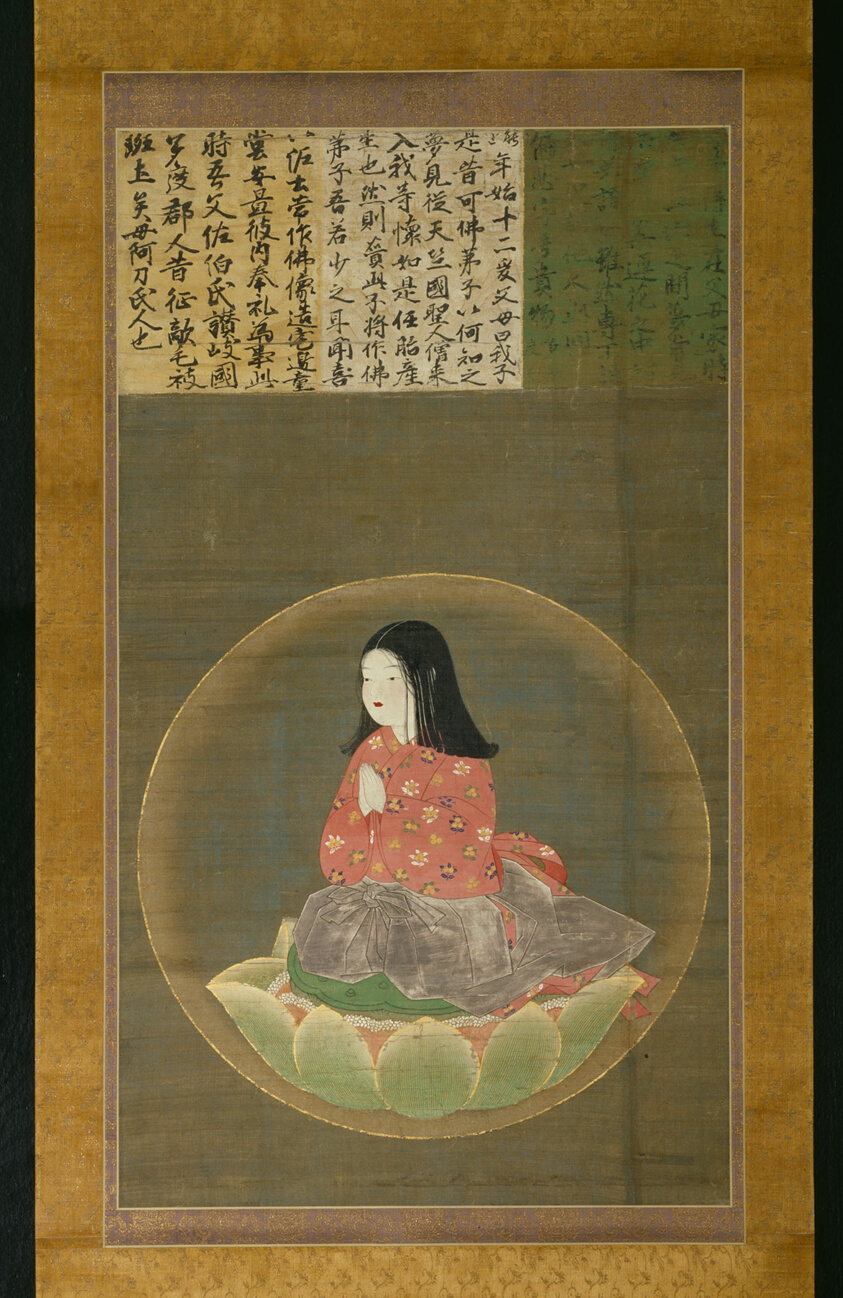
The Thread of Enlightenment: Interpreting Kobo Daishi as a Boy (Chigo Daishi) through Silk and Savile Row Precision
Introduction: The Materiality of the Sacred
In the hallowed corridors of heritage preservation, where the tactile and the transcendent converge, few artifacts command the quiet reverence of a hanging scroll depicting Kobo Daishi—known posthumously as Kukai—as a boy, or Chigo Daishi. This particular piece, executed in ink and color on silk, is not merely a religious icon; it is a testament to the classic silk craftsmanship that defined Japanese aesthetic excellence during the Heian and Kamakura periods. As a Senior Heritage Specialist at the Lauren Fashion Heritage Lab, I approach this artifact with the same discerning eye that a Savile Row tailor applies to a bolt of worsted wool: every thread, every hue, every brushstroke must be understood as a deliberate act of mastery. The silk substrate, with its fluid elegance, becomes the canvas for a narrative that bridges the earthly and the divine—a narrative of a boy who would become one of Japan’s most venerated Buddhist saints.
The Silk Substrate: A Foundation of Craftsmanship
The choice of silk for this hanging scroll is no arbitrary decision. In the context of Japanese heritage, silk was the premier material for sacred and secular art alike, prized for its luminosity, durability, and capacity to absorb pigment with an almost ethereal softness. The scroll’s silk weave, likely a plain or tabby structure, offers a surface that is both resilient and responsive—qualities that align with the Savile Row ethos of fabric selection, where a cloth must drape impeccably while enduring the rigors of wear. Here, the silk’s natural sheen enhances the ink’s blackness and the pigments’ vibrancy, creating a visual depth that mirrors the spiritual depth of the subject. The fluid elegance of the silk is not merely decorative; it is functional, allowing the scroll to be rolled and unrolled for ritual use without compromising the integrity of the image. This practical sophistication echoes the bespoke tailoring tradition, where form and function are inseparable.
Iconography of Chigo Daishi: The Boy as Symbol
Kobo Daishi as a boy, or Chigo Daishi, is a rare and poignant depiction within Japanese Buddhist art. Typically, Kukai is portrayed as an adult monk, founder of the Shingon school, or as a pilgrim. The chigo, or child, form emphasizes his early life—specifically, the legend of his youthful enlightenment. According to tradition, the young Kukai, born into the aristocratic Saeki family, displayed extraordinary intelligence and a precocious spiritual inclination. He is said to have climbed Mount Tairyu as a child, where he encountered a manifestation of the Buddha and received a vision that would shape his destiny. In this scroll, the boy is rendered with delicate features, a serene expression, and flowing robes that cascade like liquid silk. The ink and color on silk technique allows for subtle gradations: the whites of his garments, the soft blush of his cheeks, the deep black of his hair—all executed with a precision that recalls the meticulous hand-stitching of a Savile Row lapel. Each brushstroke is a decision, a commitment to form that cannot be undone.
Cultural and Religious Context: The Fabric of Belief
To fully appreciate this artifact, one must understand the cultural and religious context that gave it meaning. The Heian period (794–1185) was a golden age for Buddhist art in Japan, marked by a synthesis of indigenous Shinto sensibilities and imported Mahayana doctrines. Silk scrolls like this one were often commissioned by aristocratic patrons or temples as objects of devotion, meditation, and education. The depiction of Kukai as a boy served a dual purpose: it humanized the saint, making his journey accessible to lay believers, while also reinforcing the Buddhist ideal of innate enlightenment—the idea that spiritual potential exists in all beings, even children. The fluid elegance of the silk, with its gentle undulations and soft folds, mirrors the flow of Buddhist teachings, which adapt to the vessel of the believer. In the same way that a Savile Row suit is tailored to the individual, this scroll is tailored to the spiritual needs of its audience, offering a visual sermon on the virtues of humility, wisdom, and perseverance.
Artistic Technique: Ink, Color, and the Hand of the Master
The technical execution of this scroll is a study in classic silk craftsmanship. The artist, likely a trained monk or court painter, employed a method known as tsukuri-e (built-up painting), where layers of pigment are applied over a preliminary ink outline. The ink, made from soot and animal glue, provides the structural framework—the bones of the composition—while the colors, derived from mineral and organic sources, add flesh and spirit. The silk’s absorbency demands a confident hand; mistakes cannot be easily erased, much like a tailor’s cut in a length of fine worsted. The boy’s robes, for instance, are rendered in a palette of vermilion, indigo, and gold, with highlights that catch the light as the scroll is viewed from different angles. This dynamic quality is a hallmark of silk painting, where the material itself becomes part of the visual experience. The fluid elegance is not static; it shifts with the viewer’s gaze, inviting contemplation—a quality that resonates with the Savile Row principle of a garment that moves with the wearer, never against.
Preservation and Legacy: The Artifact as Living Heritage
As a heritage artifact, this hanging scroll faces the challenges of time: fading pigments, silk degradation, and environmental fluctuations. Yet, its preservation is paramount, not only for its artistic value but for its cultural memory. The Lauren Fashion Heritage Lab approaches such artifacts with a multidisciplinary lens, combining textile science, art history, and conservation ethics. The silk must be stored in controlled humidity and light levels, much like a bespoke suit is stored in a breathable garment bag. The ink and color layers require stabilization to prevent flaking, a process akin to reinforcing a tailored seam. This scroll is not a relic of a bygone era; it is a living document of classic silk craftsmanship and spiritual aspiration. It speaks to the enduring human desire to capture the ineffable—the moment when a boy becomes a saint, when silk becomes sacred, when craft becomes art.
Conclusion: The Tailored Thread of Heritage
In the end, the Chigo Daishi hanging scroll is a masterclass in the marriage of material and meaning. The silk, with its fluid elegance, is not a passive backdrop but an active participant in the narrative. It carries the ink and color with a grace that mirrors the boy’s own journey from earthly form to enlightened being. For the scholar, the collector, or the connoisseur of fine craftsmanship, this artifact offers a lesson in precision, patience, and the pursuit of perfection—values that resonate as strongly on Savile Row as they do in a Kyoto temple. As we continue to study and preserve such works, we honor not only the hand that created them but the thread that connects us all: the thread of heritage, woven with care and intention, for generations yet to come.