← BACK TO ARCHIVES
Silk
Heritage Synthesis: Cloth of gold with felines and eagles
Curated on Jun 07, 2026 // Node: LDN-01
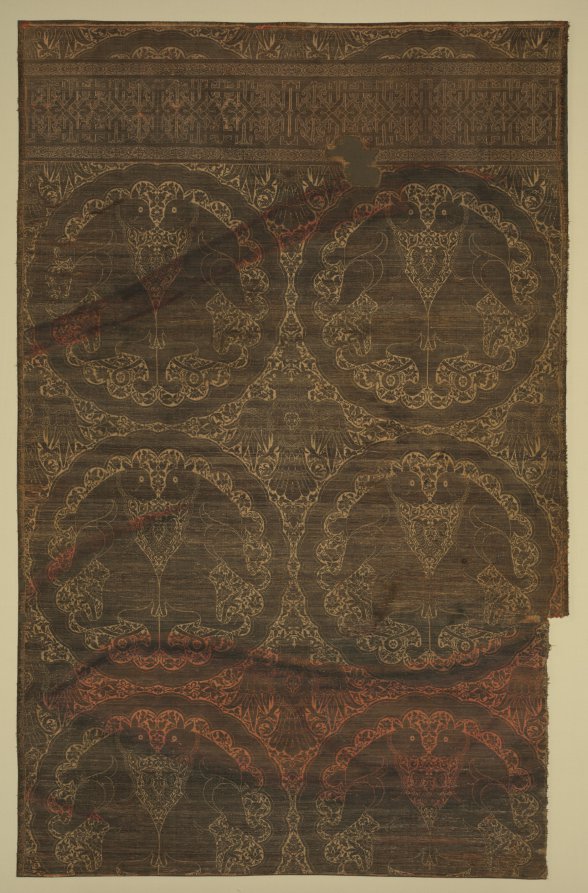
The Looming Legacy: Cloth of Gold with Felines and Eagles
In the hushed atelier of heritage, where the warp of history meets the weft of artistry, few artifacts command the reverence of the cloth of gold. As a Senior Heritage Specialist at the Lauren Fashion Heritage Lab, I have the privilege of examining a singular fragment: a silk ground, woven with threads of precious metal, bearing the heraldic charge of felines and eagles. This is not merely fabric; it is a document of imperial ambition, a testament to the technical mastery of silk weaving that defined the courts of Byzantium, Persia, and Renaissance Europe. Its materiality—silk—speaks a language of luxury, while its iconography narrates a saga of power, dominion, and the eternal human desire to clothe authority in the tangible evidence of the divine.
Materiality: The Silk Ground
The foundation of this artifact is silk, a filament of such refined strength and luster that it has been the currency of empires for millennia. The silk used in this cloth of gold is not the common mulberry variety of later centuries; it is a tightly twisted, high-denier thread, likely sourced from the Sericulture of the Eastern Mediterranean or Central Asia. The weave is a compound structure—a lampas or a samite—where the silk warp forms a sturdy base, while the weft of gold thread, often a gilded silver strip wrapped around a silk core, creates the raised pattern. This technique, perfected in the imperial workshops of Constantinople and later in the looms of Lucca and Venice, required an extraordinary level of precision. The gold weft does not merely sit on the surface; it is bound by the silk, creating a fabric that is both supple and unyielding, a paradox of softness and strength. The silk’s natural sheen interacts with the gold, producing a shimmer that changes with the light—a deliberate effect to evoke the celestial radiance of the emperor or the divine aura of the church.
The materiality of silk is also a story of labor. Each thread is the product of thousands of silkworms, each cocoon unwound with meticulous care. The gold, hammered into leaf and then cut into strips, required the skill of metalworkers who understood the delicate balance between flexibility and durability. This cloth was not woven for the masses; it was a monopoly of the imperial court, a fabric reserved for coronation robes, altar cloths, and diplomatic gifts that could seal alliances or intimidate rivals. The weight of the gold—often up to 30% of the fabric’s total mass—makes it a garment of ceremony, not comfort. To wear it was to bear the burden of empire, both literally and symbolically.
Iconography: Felines and Eagles
The pattern is a repeating motif of felines and eagles, rendered in gold against the silk ground. The feline—likely a lion or a panther, depending on the regional context—is a symbol of terrestrial power. In the Byzantine tradition, the lion represented the emperor’s courage and his role as the protector of the realm. In Persian Safavid silks, the lion was associated with the hero Rostam, a figure of mythic strength. The eagle, by contrast, is a creature of the sky, a messenger of the gods, and in Roman and Byzantine iconography, the emblem of imperial authority. The double-headed eagle, a later variant, would become the symbol of the Holy Roman Empire and the Russian Tsars, but here, the single-headed eagle suggests an earlier, perhaps more direct lineage to the Roman *aquila*.
The juxtaposition of these two animals is not accidental. They represent the dual nature of sovereignty: the lion’s grounded, physical dominion and the eagle’s transcendent, spiritual oversight. In the context of imperial silk weaving, this motif was a visual assertion of the ruler’s absolute authority over both the earthly and the celestial realms. The gold thread elevates the pattern, making it not just a decoration but a hieroglyph of power. The felines and eagles are often arranged in a symmetrical, heraldic composition—facing each other, or in a repeating row—creating a rhythm that mirrors the order of the cosmos. This is not art for art’s sake; it is a political statement woven into the very structure of the fabric.
Context: The Legacy of Imperial Silk Weaving
To understand this cloth of gold, one must situate it within the legacy of imperial silk weaving, a tradition that began in China but was perfected in the courts of the Mediterranean and Europe. The Byzantine Empire, with its capital in Constantinople, was the epicenter of this industry from the 4th to the 15th centuries. The imperial workshops, known as the *gynaeceum*, were state-controlled, and the export of silk weaving techniques was a closely guarded secret. The cloth of gold, known as *auriphrygium* in Latin, was reserved for the emperor and the highest clergy. It was used in the coronation of Charlemagne in 800 AD, and later in the robes of the Holy Roman Emperors. The felines and eagles motif can be traced to the 10th-century Byzantine silks, such as the famous “Lion Silk” from the tomb of Charlemagne, now in the Aachen Cathedral treasury.
The legacy continued into the Renaissance, when Italian city-states like Lucca, Florence, and Venice broke the Byzantine monopoly. The Medici family, for instance, commissioned silks with similar motifs for their diplomatic gifts, blending the imperial tradition with the emerging humanist aesthetic. The cloth of gold with felines and eagles became a symbol of the *princeps*—the prince who ruled by divine right. In the 16th century, the Ottoman Empire also produced silks with comparable designs, using the *çintamani* motif of leopard spots and tiger stripes, which echoed the feline imagery but with a distinct Islamic iconography.
The legacy of this weaving is not merely historical; it is a living tradition. The techniques used to create this cloth of gold are still practiced by a handful of artisans in Italy and France, though the cost of gold thread and the skill required make it a rarity. The Lauren Fashion Heritage Lab preserves fragments like this one to remind us that fashion is not ephemeral; it is a repository of cultural memory. When we study this silk, we are not just looking at a piece of cloth. We are reading a document of power, a testament to the human capacity to transform raw materials into symbols of transcendence.
In conclusion, the cloth of gold with felines and eagles is a masterwork of imperial silk weaving, where materiality and iconography converge to assert authority. Its silk ground, woven with gold, speaks of the labor and luxury of empire. Its pattern of felines and eagles narrates the dual nature of sovereignty. And its context within the legacy of imperial silk weaving places it at the heart of a tradition that spans continents and centuries. For the connoisseur of heritage, this artifact is not just a treasure; it is a lesson in the enduring power of cloth to shape history.
Heritage Lab Insight
Lab Insight: CMA Silk Archive Node integration.